


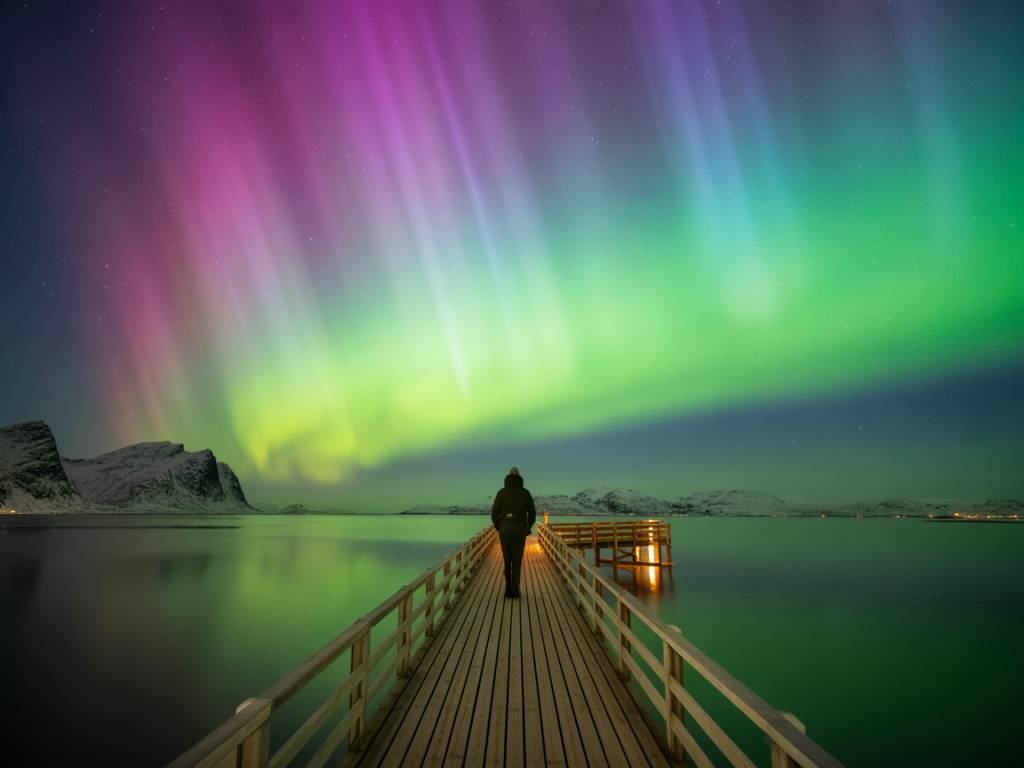
When people plan an aurora trip, Denmark usually isn’t the first country that comes to mind. And that’s fair: you’re at a relatively low latitude here, so the Northern Lights sit low on the horizon and only show up when the Sun is really active. But with the right geomagnetic conditions (think KP 5–7), clear skies and a dark coastline, Denmark can deliver surprisingly photogenic auroras.
In this guide, I’ll walk you through ten places in Denmark where you actually have a realistic chance to see the Northern Lights, with concrete instructions on where to stand, where to park, and what to expect. The goal: less time refreshing apps, more time looking up at the sky.
How Northern Lights work in Denmark
Before we zoom in on specific locations, it helps to set expectations. Denmark sits around 55–58°N latitude. That’s south of the typical auroral oval, which usually favors Northern Norway, Sweden and Finland. For Denmark, you generally need stronger geomagnetic storms than you would in Tromsø or Abisko.
Useful rules of thumb:
- KP 3–4: Auroras sometimes visible in far northern Jutland, low on the northern horizon, usually faint.
- KP 5–6: Good chance along the northern and western coasts, especially in dark areas away from towns.
- KP 7+: Denmark-wide potential, including southern dark-sky sites like Møn and large parts of Sjælland and Fyn.
Because the aurora usually sits to the north, you want:
- A clear, low northern horizon (beach or open field).
- Minimal light pollution behind you (the main town should be to your back or distant).
- Wind-aware planning: clear skies in Denmark often come with wind; pick a location where you can use dunes, forest edges or buildings as shelter.
With that context in mind, let’s look at the most practical places to try.
Skagen & Grenen – where two seas meet and the sky opens
Skagen, at the very top of Jutland, is one of Denmark’s classic aurora spots. You’re as far north as you can get in the country, with water on both sides and wide, open horizons.
For a field-style session, head towards Grenen, where the North Sea and the Baltic meet. You don’t need to walk to the very tip at night; that sandbar can be windswept and slippery. Instead, park at the official Grenen parking area and use the wide beach stretches closer to the lot.
On stronger KP nights, you can also stay in town and walk out onto the beach near the old Skagen neighborhoods – useful if clouds are moving fast and you want quick shelter.
- Best direction to watch: North and north-west over the sea.
- Access & parking: Large car park at Grenen (paid in season, quieter in winter). From there, 5–15 minutes on foot to find a dark spot.
- Light pollution: Moderate glow from Skagen itself; walk a little east of the main paths to get into darker sand dunes.
- Plan B: If wind gets too rough, use the town beach closer to Skagen’s houses; not as dark, but more sheltered.
Hirtshals & Tornby Beach – ferries, lighthouses and auroras
Hirtshals is a working ferry town facing the North Sea. It’s not remote wilderness, but for aurora hunting it balances accessibility, infrastructure and decent darkness once you get a few kilometers away from the harbor lights.
One of the most practical spots is Tornby Strand, just south of Hirtshals. You get a long, wide beach, gentle dunes and a good view to the north and north-west.
- Best direction to watch: Mostly north-west and north over the sea.
- Access & parking: Several small parking areas along Tornby Beach road; from each it’s a short walk over dunes to the sand.
- Light pollution: Visible glow from Hirtshals to the north-east; walk a bit further south along the beach to reduce it.
- Plan B: If the forecast is marginal, you can stay near Hirtshals Lighthouse – there’s some light, but the elevated view gives you a clear northern horizon.
Thy National Park & Cold Hawaii – wide horizons in West Jutland
The west coast of Jutland combines dark skies, wild weather and very long beaches. Nationalpark Thy, Denmark’s first national park, is particularly interesting for aurora chasers because it offers multiple coastal viewpoints within a relatively short drive.
A practical base is the fishing town of Vorupør or the surf hub Klitmøller (“Cold Hawaii”). From there you can pick your beach based on wind direction and cloud gaps.
- Best direction to watch: North and north-west. On intense storms, aurora can even stretch overhead and to the west.
- Access & parking:
- Vorupør: easy access from the main parking by the pier.
- Klitmøller: beach parking lots just behind the dunes.
- Light pollution: Low once you step away from town lights; dunes provide good shielding.
- Plan B: If sea spray and wind are too strong, drive a bit inland to one of the park’s lakes (e.g., Nors Sø) and shoot north across open water instead.
Bulbjerg Cliff & Jammerbugten – dark skies over a lone cliff
Bulbjerg is a rare, steep limestone cliff on an otherwise flat coastline. It’s remote enough to stay relatively dark and high enough to give you a slightly elevated view of the northern horizon.
The small parking lot near Bulbjerg gets you very close to the edge; from there you can walk short paths along the cliff and pick a sheltered spot out of the wind.
- Best direction to watch: North over the sea; the cliff itself faces north-west.
- Access & parking: Direct car access via narrow roads; the parking area is small but usually quiet at night in winter.
- Light pollution: Minimal. Some distant glow from coastal towns towards the east and west, but generally dark.
- Plan B: If coastal fog rolls in, move slightly inland towards Fosdalen or Svinkløv areas and find clearings with a northern view.
Løkken & Rubjerg Knude – moving sand, moving lights
The stretch of coast between Løkken and the famous Rubjerg Knude Lighthouse is constantly reshaped by wind and waves. That same exposure makes it a good aurora area when the sky is clear.
For a low-effort option, use the town beach at Løkken and walk 10–15 minutes away from the pier to escape most of the glow. For more drama (and more wind), head towards Rubjerg Knude and position yourself where you can see the lighthouse silhouette under an active sky.
- Best direction to watch: North and north-west along the coastline.
- Access & parking:
- Løkken: several large car parks near the town center and dunes.
- Rubjerg Knude: dedicated parking area off the main road; 10–20 minutes hiking through sand to the lighthouse.
- Light pollution: Noticeable around Løkken; much less near Rubjerg Knude, where it’s mostly just the lighthouse and distant glows.
- Plan B: Use Løkken as a quick-shelter base if the wind at Rubjerg Knude is too intense.
Rømø Island – wide tidal flats and open northern views
Rømø, connected to the mainland by a causeway, sits in the Wadden Sea and offers some of the widest beaches in Denmark. On the west side, the horizon feels endless, and even on a busy day there is always room to spread out. At night in winter, you’ll mostly be sharing it with the wind.
For aurora watching you actually want to look north, back towards the Jutland coast, but the flatness of the island means you still get a clear view of the sky.
- Best direction to watch: North and north-east, away from the low glow of Sylt and German towns.
- Access & parking: Big parking areas at Lakolk Strand and Sønderstrand; from both, you can walk along the beach to find darker corners.
- Light pollution: Very low on the west side; some distant horizon glows but no large cities nearby.
- Plan B: If low clouds hug the coast, sometimes the sky inland in Jutland is clearer – keep an eye on satellite cloud maps and be prepared to drive back over the causeway.
Fanø Island – a quieter Wadden Sea option
Fanø, just off Esbjerg, is another Wadden Sea island but a little more compact and easy to navigate than Rømø. The ferry ride is short, and once on the island you can pick north-facing beaches or dunes depending on the wind.
On strong geomagnetic nights, Fanø’s dark skies can show green arcs and pillars clearly above the northern horizon. You’ll still see some glow from Esbjerg, but if you walk a bit away from the main villages, it’s manageable.
- Best direction to watch: North and north-west, over the water between Fanø and Jutland.
- Access & parking: Ferry from Esbjerg to Nordby; from there, drive to Fanø Bad or Rindby Strand for easy beach access and parking.
- Light pollution: Esbjerg’s glow to the north-east is visible but low on the horizon; consider it a feature in wide-angle photos.
- Plan B: If clouds hang over the northern part of Fanø, drive south towards Sønderho and look for breaks in the sky over the sea.
Møn & the Dark Sky Park – when the aurora goes south
Most people know Møn for its Dark Sky Park status and the white chalk cliffs of Møns Klint. It’s one of the best places in Denmark for stargazing in general. For Northern Lights, you need stronger conditions (KP 6–7+), but when they hit, Møn can be spectacular because of its very low light pollution.
For auroras you don’t need to stand right on the cliff edge (it’s not recommended at night anyway). Instead, use the designated viewpoints and parking areas near the Klint and find open fields with a view to the north.
- Best direction to watch: North, away from the Baltic horizon.
- Access & parking: Several parking areas along the Møns Klint access road; also open spaces around Klintholm and the Dark Sky Park zones.
- Light pollution: Very low. This is one of Denmark’s darkest regions; any aurora activity stands out strongly.
- Plan B: If clouds sit over the cliffs, drive a bit inland towards Stege or Nyord and find clear northern views from farm roads and small harbors.
Bornholm – Baltic island with dual horizons
Bornholm sits out in the Baltic Sea, far from Denmark’s main light domes. That isolation makes it attractive for aurora chasers during strong solar storms. You get several distinct viewing styles: sandy beaches, rocky headlands, and small harbors.
Two good vantage zones for Northern Lights are Dueodde Beach in the south and the Hammeren area in the north-west, near Hammershus castle. For aurora, favor places where your northern horizon isn’t blocked by forest or hills.
- Best direction to watch: Generally north and north-west. From Hammeren you can also watch over the sea towards Sweden.
- Access & parking:
- Dueodde: marked parking with boardwalk access to a wide beach.
- Hammeren/Hammershus: parking lots by the castle and at various coast access points.
- Light pollution: Low to moderate; Rønne gives a glow but is easy to avoid by staying on the opposite side of the island.
- Plan B: If one coast is clouded, drive to the other side of the island – weather can differ significantly over short distances here.
Samsø – central, quiet and surprisingly dark
Samsø sits in the middle of Denmark, surrounded by water on all sides and with very small settlements. Light pollution is relatively low, especially along the northern and western shores.
Because Samsø is more central and a bit further south than Jutland’s tip, you’ll want a higher KP to get a clear show. But once the indices climb, the combination of calm countryside, sea views and easy access makes it a relaxed spot to wait things out.
- Best direction to watch: North from the northern tip near Issehoved, or north-west from western beaches.
- Access & parking: Ferries from Hou or Kalundborg; once on the island, use small coastal parking areas or quiet farm roads.
- Light pollution: Very low; just small village glows.
- Plan B: If clouds linger in one part of the island, you can cross to the other side in 15–20 minutes by car.
Planning a Northern Lights trip to Denmark
Denmark will never be as statistically reliable as northern Scandinavia for aurora chasing, but it has a big advantage: it’s easy to move quickly. Distances are short, roads are good, and within a few hours you can pivot from the Baltic side to the North Sea or Wadden Sea.
To turn the spots above into a workable plan, keep a few operational guidelines in mind:
- Let the KP index guide how far south you dare:
- KP 4–5: prioritize northern Jutland locations (Skagen, Hirtshals, Thy, Jammerbugten).
- KP 6: Jutland coasts plus islands like Rømø, Fanø, Samsø become interesting.
- KP 7+: start thinking Møn, Bornholm and even darker corners of Sjælland and Fyn.
- Track clouds, not just aurora: Use satellite cloud images and local forecasts every 1–2 hours. In Denmark, cloud gaps can be narrow; it’s worth driving 30–60 minutes if you see a clear slot upwind of you.
- Have a city or village fallback: Choose a base town (Skagen, Hirtshals, Klitmøller, Stege, Rønne, etc.) with:
- At least one north-facing beach or harbor you can reach in 10–15 minutes.
- Shelter: cafés, petrol stations, your accommodation – for warm-up breaks between sky checks.
- Gear for wet, windy coasts:
- Waterproof, windproof outer layer, hat, gloves.
- Tripod and wide-angle lens if you plan to photograph; in Denmark, the aurora is often low and diffuse, so your camera may see more than your eyes.
- Headlamp with a red light mode – handy on dunes and cliffs without ruining your night vision.
- Safety margins:
- Avoid cliff edges and unmarked paths at night, especially near Møns Klint, Rubjerg Knude and Bulbjerg.
- On tidal flats (Rømø, Fanø), respect tide times and any local signage; stick to known beach access routes in the dark.
Finally, manage your expectations: in Denmark, many aurora nights are subtle. You might first notice a greyish arc low in the north that only turns vividly green or shows pillars on camera. Give your eyes 15–20 minutes to adapt, stay patient, and keep checking the whole sky, not just a single patch.
When the right solar storm aligns with one of these dark Danish coasts, the combination of sea, dunes, lighthouses and quiet winter air can rival far more famous aurora destinations. And if the lights don’t show? You still come home with a solid map of Denmark’s wild edges – ready for the next active night.