


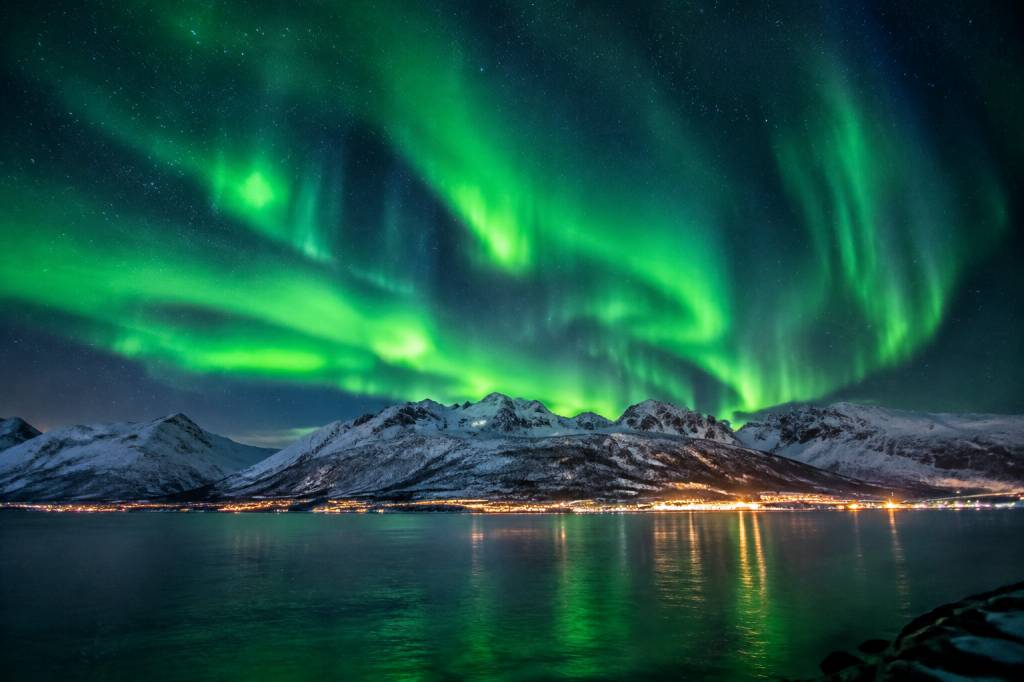
A 27-day aurora forecast for Tromsø can help you choose when to travel, but it cannot tell you exactly which night the Northern Lights will appear. At that range, forecasts are best treated as a planning guide, not a promise. Solar activity can change quickly, and clouds may hide even a strong display.
The practical approach is to use the long-range outlook to set your dates, then make decisions day by day using cloud forecasts, local conditions and updated aurora data. That way, you can plan a useful trip without spending every evening refreshing a chart—or assuming that one low KP number means your chances are over.
What a 27-day aurora forecast can tell you
The Sun rotates roughly once every 27 days. When an active region faces Earth, it may return to a similar position during a later rotation. This is one reason long-range aurora outlooks look for patterns over several weeks.
But the Sun is not a clockwork schedule. Active regions can weaken, grow or disappear, and new solar events may occur at any time. A forecast three or four weeks ahead cannot reliably say, “The aurora will be visible over Tromsø on Thursday at 10 p.m.” It can only offer a broad indication of possible activity.
Use a 27-day forecast to compare possible travel dates and identify periods that might be more promising than others. Do not use it to decide that a particular night is guaranteed—or that a quiet-looking date is hopeless.
Why Tromsø is a strong base for aurora watching
Tromsø sits within the auroral oval, the region where auroras commonly occur around the magnetic poles. That gives visitors a good chance of seeing activity without needing an extreme geomagnetic storm. A high KP index can bring auroras farther south, but it is not a simple “higher number equals better trip” score for Tromsø.
Local conditions often matter more. A modest display beneath clear skies can be a better experience than a powerful aurora hidden behind thick cloud. Tromsø also offers a useful mix of city accommodation, transport, guided tours and access to darker areas outside the centre.
The trade-off is weather. Coastal northern Norway can be cloudy, windy and changeable. A clear sky in town does not guarantee clear skies on the islands or inland, and the reverse can also happen. Your best plan includes more than one place to watch.
Use the forecast in three planning stages
Three to four weeks before your trip
Check the 27-day outlook to get a general sense of solar activity around your travel dates. If your schedule is flexible, you can use it as one factor when choosing between weeks. Keep other practical considerations in view too: flight prices, accommodation availability, daylight activities and how many nights you can stay.
Most importantly, allow several nights in Tromsø if seeing the aurora is a priority. A short, one-night visit leaves little room for cloud, poor timing or plain bad luck. Three to five nights give you more opportunities to adapt. No number of nights guarantees a sighting, but extra time gives the weather more chances to cooperate.
Three to seven days before
Start looking closely at local cloud forecasts and the broader weather pattern. Forecasts become more useful as the date approaches, though conditions can still change. Check cloud cover for both Tromsø and possible alternative locations. Also look at wind, precipitation and temperature: a clear but dangerously windy night on an exposed coast may not be a sensible outing.
Choose a primary viewing plan and a backup. Your backup might be a different direction from town, a guided tour that can follow clear skies, or a city-edge spot if driving conditions deteriorate.
On the day
Check the latest cloud forecast, aurora activity information, road conditions and local alerts before you set out. Recheck them in the evening. A map showing clear skies over a location is useful only if the roads are open, visibility is safe and you have somewhere legal to stop.
Make the final decision based on the whole picture: cloud gaps, expected activity, darkness, access and your own comfort. Forecasts are tools, not instructions to drive into a snowstorm.
Read KP correctly for Tromsø
KP measures geomagnetic disturbance on a scale from 0 to 9. It is useful for describing broad activity, but it does not show exactly where an aurora will be visible or whether your sky will be clear. In Tromsø, auroras can appear at relatively low KP values because the city is already far north.
Think of KP as one clue among several. A higher value may increase the chance of brighter or more active displays, but clouds can block them completely. Conversely, a calm-looking index does not rule out a visible aurora. Watch for real-time changes, and give your eyes time to adjust before deciding the sky is empty.
There is another common source of confusion: a forecast map may show aurora activity somewhere in the region, while your exact location sits beneath cloud. The map is not a cloud report. Check cloud cover separately, ideally at a local scale.
Choose a viewing location with a backup
You do not always need to travel far from Tromsø. If skies are clear, locations around the city can work, though streetlights reduce contrast. Telegrafbukta and the area around Prestvannet are accessible city options for a quick check. They are not dark wilderness sites, so expectations should be realistic, especially when the aurora is faint.
If you have a car or join a tour, darker areas farther from the city may offer a wider view and less artificial light. Routes towards Ersfjordbotn, Kvaløya or Sommarøy are popular options, but popularity does not make every roadside pullout safe or suitable. Confirm access, parking and road conditions before leaving. Do not stop in the road or use a private driveway as a viewing point.
A guided aurora tour can be useful when cloud cover varies across the region. Experienced local operators may adjust their route to look for clearer skies, and they handle the driving on unfamiliar winter roads. Ask what is included, how long the tour lasts, and whether the operator has a clear cancellation or safety policy.
- Plan A: Pick a legal, accessible location that is forecast to have clear skies.
- Plan B: Identify a second area in a different direction, if roads and weather allow.
- Plan C: Stay near town, check accessible viewpoints, or postpone the outing if conditions are unsafe.
Do not assume that “chasing clear skies” means driving as far as possible. In winter, a shorter and safer route is often the better choice.
Build an evening routine that saves time
During the dark season, you do not need to watch the sky continuously from sunset to sunrise. Set a practical evening window, check the latest information before heading out, and stay flexible. Auroras can appear and fade, so avoid treating one quiet half-hour as a final verdict.
Before you leave your accommodation, charge your phone, download maps for offline use and tell someone where you are going. Take warm layers, gloves, a hat, sturdy footwear and a headlamp with a red-light setting if available. Bring water and a snack if you expect to be outside for a while. Keep a power bank warm; cold can drain phone batteries quickly.
Give your eyes about 15 to 20 minutes to adjust to darkness. At first, a weak aurora may look like a pale, grey-green cloud. A camera can record colour more strongly than your eyes, but a long exposure does not prove the display was vivid to the naked eye. Look for movement, changing shape and structure rather than judging the sky only from a phone screen.
Make the most of a cloudy night
If cloud covers Tromsø, check whether clearer conditions are forecast elsewhere—but make the call using current information, not a guess based on a distant patch of blue on a map. Coastal cloud can move quickly, and a long drive may lead to the same grey sky at the other end.
If there is no safe route to a clear area, keep the evening local. Enjoy a meal, rest for another night or prepare for the next forecast window. This is not wasted time. A well-rested traveller is better placed to take advantage of a clear break the following evening.
Also separate “no aurora” from “no trip.” Tromsø has winter activities and city sights that do not depend on solar activity. Planning daytime options takes pressure off the evening forecast and makes the whole trip more rewarding.
Common mistakes when using long-range forecasts
- Booking around one predicted peak: A 27-day outlook cannot reliably identify an exact viewing night. Build in several nights where possible.
- Chasing a high KP number: In Tromsø, cloud cover and local visibility may matter more than a dramatic index reading.
- Confusing aurora and cloud maps: They describe different conditions. Check both.
- Driving without checking access: Winter roads, wind and visibility can change quickly. Review current road information and obey closures.
- Expecting every aurora to look like a photograph: Displays vary. Some are subtle, and cameras may show colours more clearly than the unaided eye.
- Giving up too soon: Activity may change during the night. If conditions are safe, a little patience can help—but set a sensible limit for cold and fatigue.
A simple planning checklist
Before booking, check a 27-day outlook for broad trends, but choose travel dates around your wider plans and aim for several nights in Tromsø. A few days before arrival, compare local cloud forecasts and prepare alternative viewing areas. Each evening, check updated aurora information, cloud cover, road conditions and local safety guidance.
On the night, dress for standing still in cold weather, bring navigation and a backup battery, and choose a location with safe access. If the sky is cloudy or the roads are poor, change the plan. The Northern Lights are a natural event, not a scheduled performance.
The best use of a 27-day aurora forecast is simple: let it help you plan your window, then let current weather and safe local conditions guide each evening. Tromsø gives you a strong starting point, but flexibility is what turns a forecast into a workable trip plan.