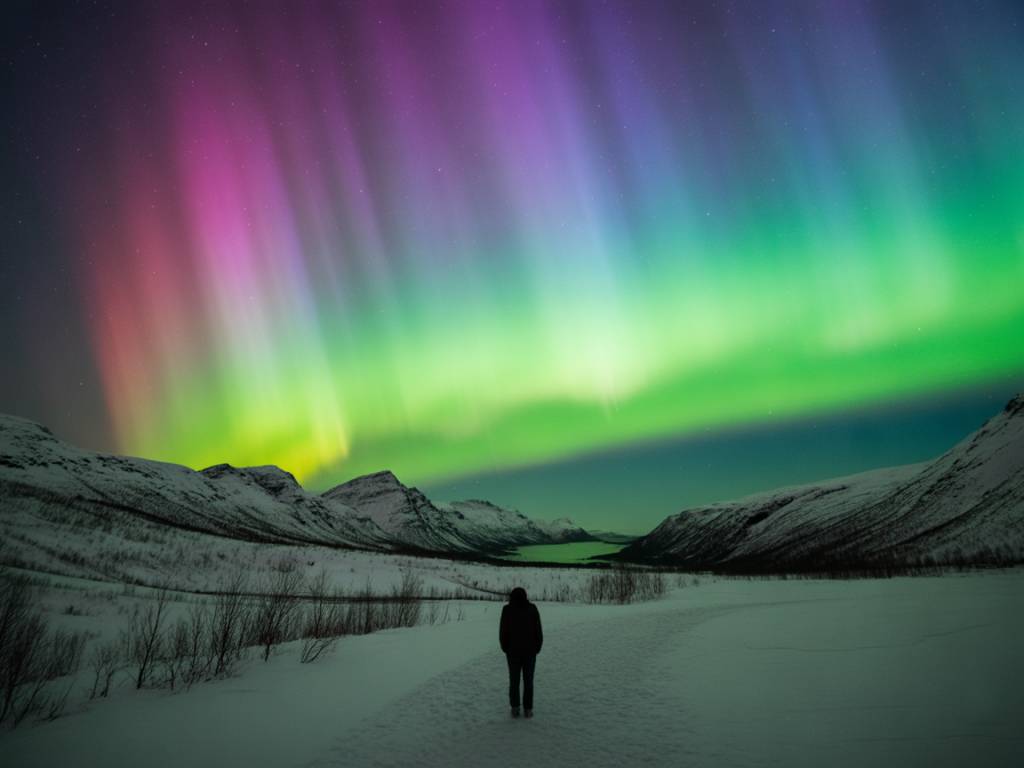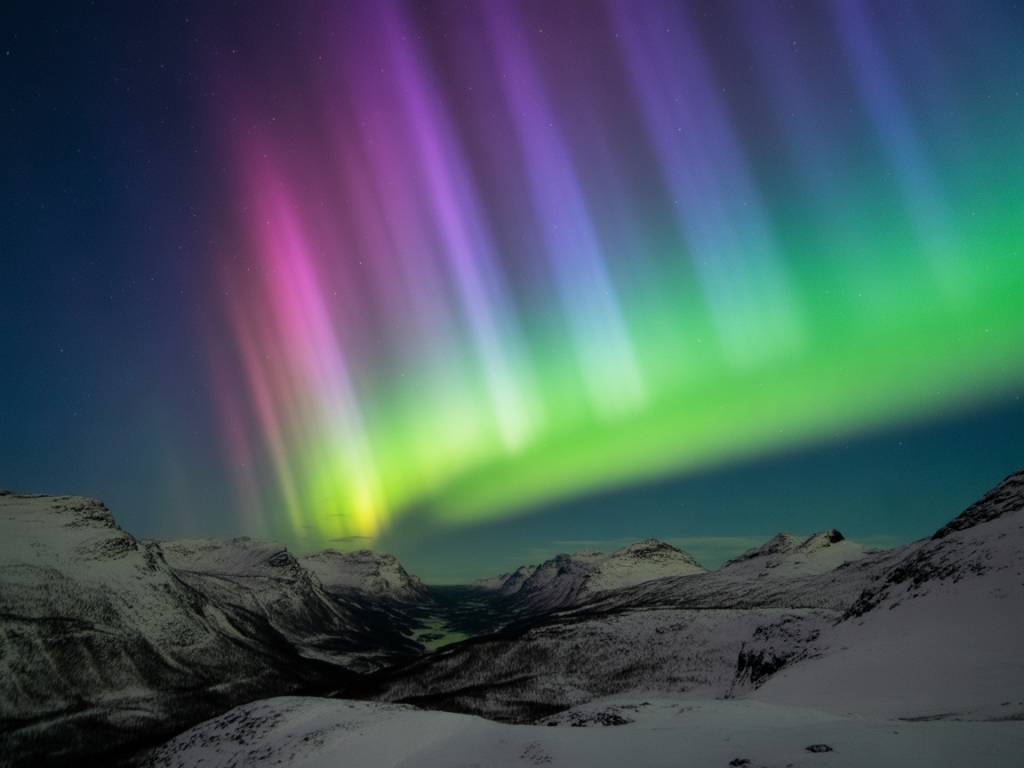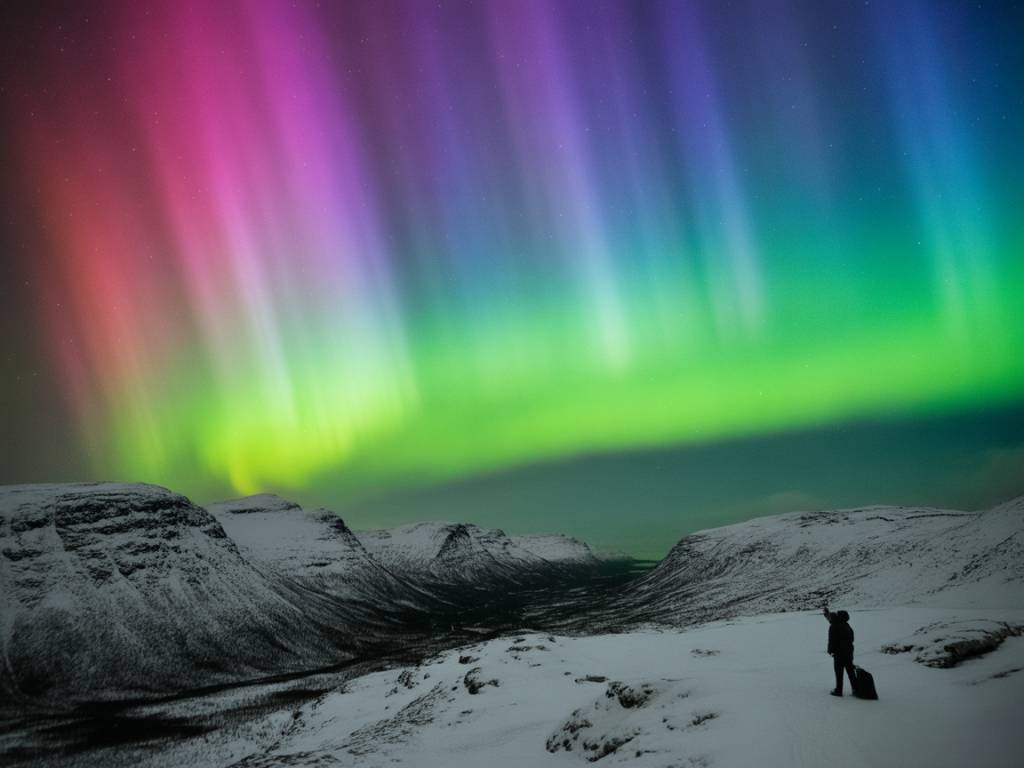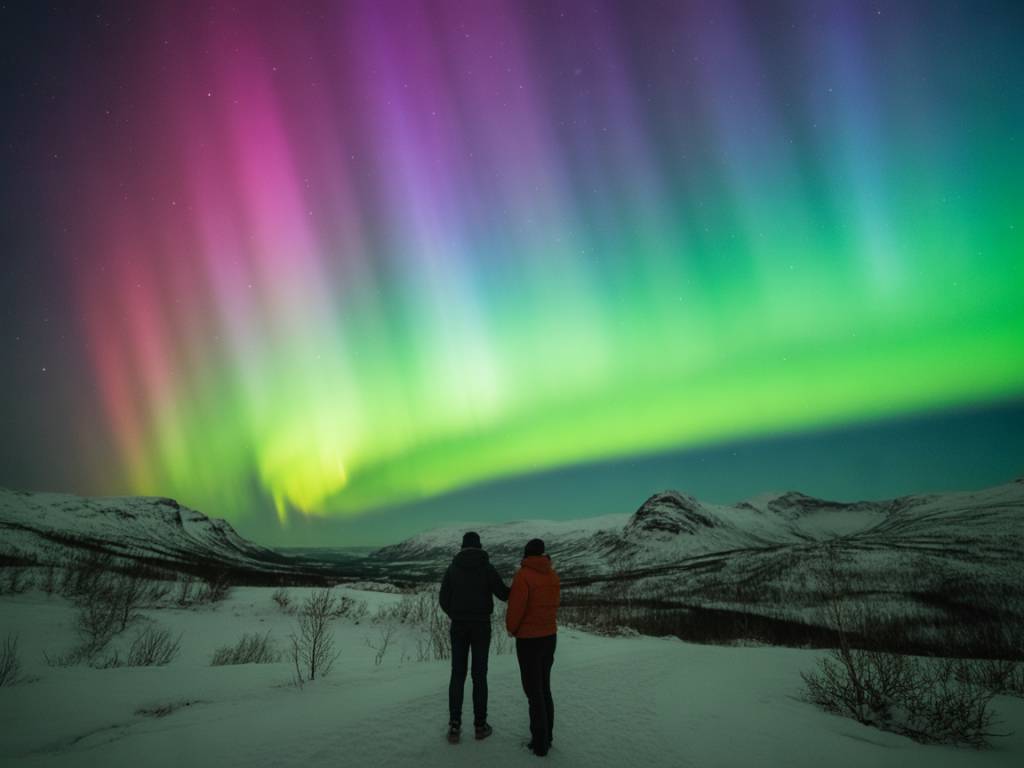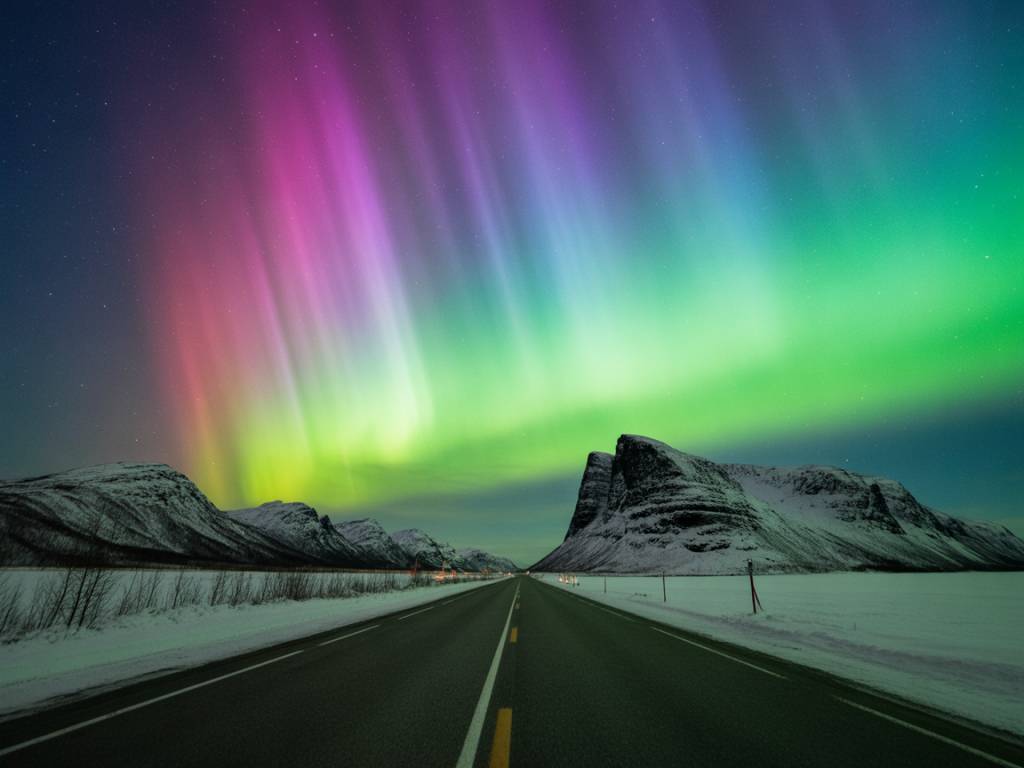


If you’ve already spent one or two cloudy nights outside, staring at an empty sky while the forecast promised “high KP”, you know this: reading a northern lights forecast is not as simple as checking one number. The good news is that with a bit of method, you can turn tonight’s forecast into a clear plan: where to go, when to move, and when it’s safe to stay in the hotel bar.
Why a “bad” forecast can still give you a great show
Let’s start with a mindset shift. Forecasts for the aurora are not like sunrise times. They’re more like a rain radar: useful, but never perfect. A “low chance” night can suddenly explode into a 20-minute storm. A “high KP” night can be totally clouded out.
If you only look at the headline (“KP 2” or “Quiet conditions”), you’ll miss the windows where the sky actually comes alive. The goal is not to predict every detail. The goal is to recognize when conditions are “good enough” to justify going out – and how to be ready if the sky suddenly wakes up.
Here’s how to read tonight’s forecast like someone who’s been burned before and doesn’t want to waste their short Arctic trip on the wrong hill at the wrong hour.
Stop chasing the KP index alone
The KP index is usually the first thing you see. It measures the overall strength of the geomagnetic disturbance on a scale from 0 to 9. Higher KP means the auroral oval expands further south.
Useful? Yes. Sufficient? No.
What KP you need depends mainly on where you are:
- High-latitude areas (Northern Norway, Finnish Lapland, Iceland, northern Sweden, northern Alaska, Yukon): even KP 1–2 can be enough if the sky is dark and clear.
- Mid-latitude or “borderline” areas (Scotland, southern Sweden, southern Canada, northern USA, central Europe): you usually need KP 4–6 or more to see anything, and often just low on the northern horizon.
So 3 rules for tonight:
- If you’re in the Arctic Circle and the forecast shows KP 1–3, don’t give up. You’re already under, or very close to, the oval.
- If you’re far south and KP is stuck at 1–2 for the whole night, manage expectations. You’ll probably need a real storm or a surprise spike to see anything.
- Ignore long-range KP predictions beyond 2–3 days. For tonight, watch the short-term KP estimates and real-time data instead of a 27-day outlook.
The KP index tells you if the aurora is broadly “on the menu”. But what determines whether the chef actually serves you something is the combination of solar wind details and your local weather.
What tonight’s forecast page is really telling you
Most aurora forecast pages show similar technical pieces. Here’s how to turn them into actual decisions.
Bz (north-south component of the IMF)
- You’ll often see something like Bz = -4 nT or a graph that drops below zero.
- When Bz is negative (southward), it opens the door for charged particles to enter Earth’s magnetosphere and create brighter auroras.
- When Bz is positive, the system is more “locked”, and even a high KP forecast can disappoint.
For tonight, note this rule of thumb:
- If Bz spends a lot of time below -3 or -5 nT and solar wind speed is decent, stay alert even if KP isn’t huge yet.
Solar wind speed
- Measured in km/s (kilometres per second).
- “Quiet” nights are often around 300–350 km/s.
- When speed climbs above 450–500 km/s, the aurora tends to become more dynamic, with faster moving curtains and more frequent bursts.
Combined reading for tonight:
- Solar wind 500–600 km/s + Bz negative + KP >= 3 in the Arctic = high chance of active displays if the sky is clear.
- Solar wind 350 km/s + Bz hovering around zero = weaker, but still worth a try in very dark, northern locations.
Auroral oval maps
- These maps show the probability that the aurora is overhead at different latitudes.
- If the oval is clearly covering your location or just slightly north of you, you don’t need extreme KP – you just need clear skies.
- If the oval stops far north of you, you’ll need a strong storm or a real-time spike in activity.
When you check tonight’s forecast, don’t just read the number. Ask: Is the oval roughly above me? Is Bz negative? Is the solar wind speed healthy? If yes, focus your energy on the next big factor: clouds.
Cloud cover: your real enemy
Most people miss the aurora not because the Sun was quiet, but because they were under the wrong clouds at the wrong time.
On forecast maps, you’ll often see:
- Total cloud cover, sometimes split into low / mid / high layers.
- Time steps (e.g. 19:00, 22:00, 01:00, 04:00) showing the expected cloud movement.
For tonight, read the cloud maps like this:
- Look for holes, not perfection. You don’t need a completely blue map. You need a corridor of clearer sky in the general direction of the north.
- Low clouds (stratus, fog) are the worst. They form a solid ceiling that blocks everything. If low cloud cover is 90–100% all night, especially in a coastal area, consider driving inland or uphill if possible.
- High clouds (thin cirrus) can be tolerable. You might still see the aurora through them, especially bright arcs.
- Watch the movement, not just the snapshot. If the map shows a gap opening between 23:00 and 01:00, that’s your prime window, even if the rest of the evening looks bad.
Example: you’re in Tromsø. The coastal area shows thick low clouds all night, but 30–40 km inland the map is much lighter after 22:00. In that case, a 40–60 minute drive inland (Lyngen direction, for instance) can make the difference between “totally clouded out” and “perfect green arc dancing over a frozen lake”.
Timing your night so you don’t burn out at 2 a.m.
The aurora doesn’t follow your sleep schedule, but it does have some patterns.
Typical active window
- Local time about 21:00–01:00 is often the best compromise between darkness and geomagnetic activity.
- Substorms (those 10–30 minute bursts of intense activity) can happen anytime, but many nights have a peak around magnetic midnight (not always the same as civil midnight, but often close enough for planning).
For tonight, build a simple plan instead of randomly checking outside every five minutes:
- Check the forecast in the late afternoon and identify:
- 1–2 likely cloud gaps,
- the period when KP / Bz / solar wind look most promising.
- Pick a main window, for example 22:30–00:30, where you commit to being outside, in a dark spot with a clear northern view.
- If real-time data show a sudden spike earlier (e.g. KP jumps, Bz turns sharply negative), be flexible and head out sooner.
The key: don’t try to be on full alert for 7 hours. Focus on 2–3 high-probability hours, with a bit of buffer before and after.
Choosing your viewing spot in and around a city
A great reading of the forecast is useless if you’re standing under a streetlamp between two hotels.
When you look at tonight’s forecast, combine it with a local map:
- Leave the city glow. Aim for at least 15–30 minutes away from major light pollution if possible.
- Check a map for:
- parking areas,
- small roads with safe lay-bys,
- open fields, frozen lakes or beaches with a clear northern horizon.
- If cloud maps show clearer sky slightly east or west of town, choose a spot in that direction. Use the forecast to decide not just when to go, but which road to take.
- Consider wind: if low clouds are forming over the sea and the wind is blowing inland, you may want to head upwind or further inland where skies can be clearer.
Practical rule for tonight: once your forecast window approaches, you should already be parked, lights off, and your eyes adapted to the dark. Don’t wait for the KP to spike before you start driving.
How to react when the forecast suddenly changes
A lot of travelers lose their nerve right when things get interesting. The KP drops, or a cloud bank appears, and they give up 20 minutes before a substorm opens a perfect hole right overhead.
To avoid this, prepare a simple decision tree for tonight:
- Plan A: Your main spot and time window based on the forecast.
- Plan B: A secondary spot in a different direction (e.g. inland vs. coast, higher vs. lower elevation) if cloud maps start to shift.
- Plan C: If everything turns worse (full overcast, Bz positive for hours), accept it, save your energy, and be ready for the next night instead of freezing for nothing.
Use real-time apps or websites that show live Bz, solar wind, and short-term KP. For tonight, watch for patterns like:
- Bz has been positive for hours but suddenly drops to -6 or lower and stays there for 15–30 minutes.
- KP forecast for the next 1–3 hours ticks up, not because of long-range models, but because live data improved.
In those cases, even if you were about to call it a night, it can be worth one more check outside if the sky is at least partially open.
Common forecast traps that make people miss the show
Based on many field nights, these are the classic mistakes:
- Trusting “tonight: low activity” as a full stop. If you are already in a high-latitude area and the sky is clear, low activity can still mean a gentle but very visible arc.
- Waiting for KP 5–6 in Tromsø, Abisko, Rovaniemi or Reykjavik. KP 2–3 is often more than enough there.
- Ignoring cloud motion. People see clouds at 20:00 and write off the whole night, even when the forecast clearly shows a clearing after 22:30.
- Standing under local clouds while the region is mostly clear. Fog in a valley, or a single cloud band over your town, doesn’t mean the entire region is lost. A short drive can change everything.
- Chasing the brightest forecast, not the most realistic window. “KP 7 at 04:00” sounds epic, but if you’re exhausted, freezing and half asleep in the car, you might do better with a solid KP 3 between 22:00 and midnight.
- Not looking north. In moderate activity, the aurora might just be a low arc on the northern horizon, not overhead. Many people only realize it was there when they look at someone else’s photos the next day.
Example: turning tonight’s numbers into a practical plan
Let’s walk through a fictional but realistic example and translate it into actions.
Imagine you’re in Levi (Finnish Lapland) and tonight’s data around 17:00 looks like this:
- KP forecast: 2–3 all evening, maybe 3–4 between 22:00–01:00.
- Solar wind speed: 480 km/s and stable.
- Bz: hovering between -2 and -6 nT, slightly negative on average.
- Cloud cover: 70–90% over Levi until 22:00, then a corridor of 20–40% cloud between 22:30 and 01:30 extending slightly north and east.
What a “pro” reading would say:
- Location is already under the auroral oval – KP 3 is enough.
- Solar wind speed is good, Bz is slightly negative. That’s promising for at least moderate activity.
- The cloud map suggests that after 22:30, your chances improve a lot, especially if you move a bit north/east.
Concrete plan:
- Eat early, charge batteries, prepare warm layers and tripod by 21:00.
- At 21:45, check updated cloud maps and Bz.
- If the forecast corridor still exists, drive 20–30 minutes north-east to an open lake or hill with parking and a clear northern view, arriving by about 22:30.
- Commit to staying outside, eyes adapted, from 22:30 to at least 00:30, with short breaks in the car to warm up.
- Use a camera or phone with night mode to check the sky: sometimes a faint grey arc your eyes barely notice is already an aurora that will brighten during a substorm.
This plan doesn’t promise a “guaranteed show”, but it gives you a structured, low-stress way to squeeze the most out of tonight’s conditions.
Quick checklist before you head out
To make tonight smoother, run through this short list:
- Forecast factors:
- KP for the next 3–6 hours.
- Bz trend (ideally negative or at least fluctuating below zero).
- Solar wind speed (the higher, the better, usually above 400–450 km/s).
- Auroral oval position relative to your latitude.
- Weather factors:
- Total and low cloud cover at 1–2 hour steps.
- Any forecasted clear corridor or temporary gap.
- Wind direction (to help guess where low clouds might form or break).
- Logistics:
- Chosen main spot (Plan A) with coordinates or a pinned map marker.
- Backup spot (Plan B) in a different direction if clouds shift.
- Full tank or enough battery charge, warm clothing, hot drink, headlamp with red light mode.
- Timing:
- Main viewing window (for example 22:30–00:30).
- Buffer before and after, if conditions look promising.
Once you’ve done this a couple of times, reading the nightly forecast stops being stressful. You won’t obsess over every wiggly line on a graph. You’ll know what matters for your location tonight, how to adapt if things shift, and when it’s smarter to get some sleep and be ready for the next window.
And when that surprise aurora storm finally erupts while other people are still “waiting for KP 6”, you’ll already be outside, eyes up, camera ready, exactly where you planned to be.