
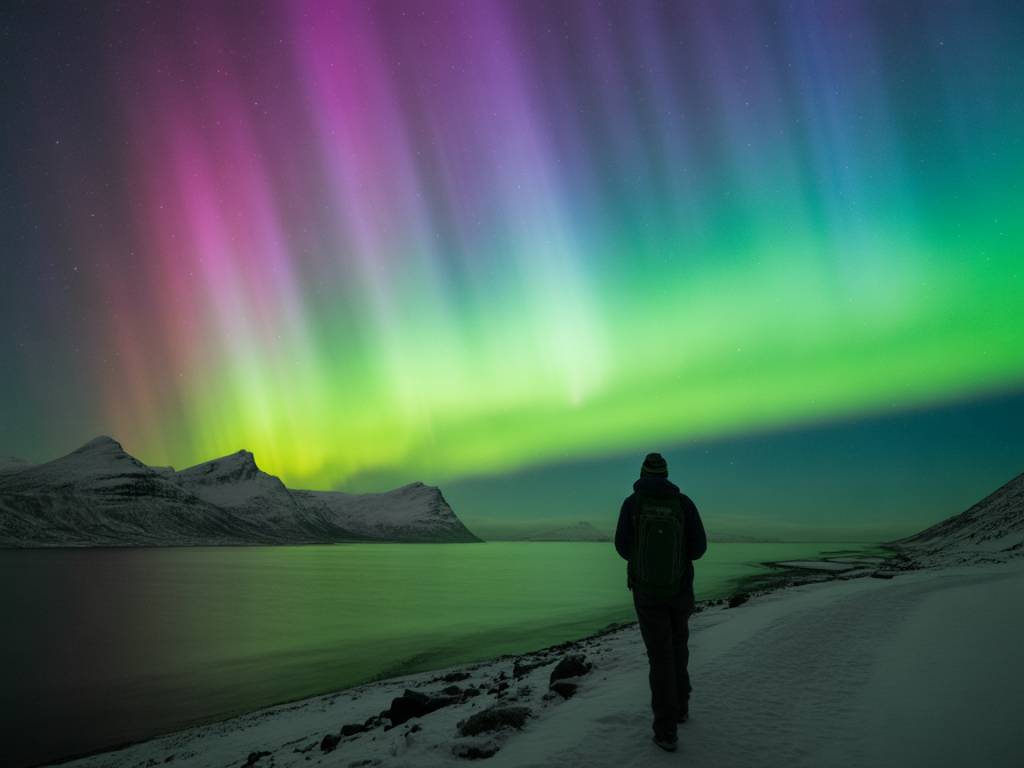
Why a northern lights checklist matters, even for “quick” city chases
Most aurora chases near a city start the same way: you see a promising forecast, you throw a jacket in the car, you drive 20–30 minutes out of town… and you realise you forgot your tripod, your spare battery or even the one thing you really need in the cold: proper gloves.
If you live in a northern latitude city (Tromsø, Fairbanks, Rovaniemi, Reykjavik, Yellowknife, even “borderline” places like Edinburgh or Tallinn), the temptation is always the same: “It’s close, I don’t need to plan much.” That shortcut is exactly what makes people miss good displays or spend their night stressed instead of looking up.
A simple checklist, adapted to your local conditions, removes a lot of that stress. Instead of scrolling through 10 different apps and emptying half your wardrobe “just in case”, you follow a short, repeatable routine before you leave. In other words: you turn a chaotic last-minute decision into a controlled field outing, even if you’re only heading 15 km away from downtown.
Below, I’ll walk you through how to build your own northern lights checklist specifically for quick chases near your city: what to check, what to pack, and how to set up your backup plans so you don’t feel like you’re gambling your sleep every time the KP index moves.
Step one of the checklist: check if it’s actually worth going out
Before you touch your backpack, you want a 5-minute data check. Near a city, you don’t have the margin of an all-night expedition: if conditions are poor, you’ll mostly see clouds and light pollution.
On your checklist, keep this as a short “GO / NO-GO” block:
- Aurora strength near your latitude
- Cloud cover and local weather
- Darkness level (Moon + city lights)
Aurora strength: translate KP into something you can use
KP is a global index. What you need is: “At my latitude, with this KP, do I have a realistic chance?” Add your usual threshold to your checklist:
- High-latitude cities (e.g. Tromsø, Fairbanks, Yellowknife, Rovaniemi): KP 1–2 can already give visible aurora overhead, KP 3–4+ is good.
- Mid-latitude edge cities (e.g. Reykjavik, northern Scotland, southern Scandinavia, parts of Canada): KP 3 is decent, KP 4–5+ is where you want to move fast.
- Low-ish latitude hopefuls (northern Germany, Scotland’s central belt, US northern states): KP 5–6+ is your realistic trigger; lower than that is mostly for very patient chasers.
Turn that into a line on your checklist, for example:
“Aurora potential: KP forecast ≥ X for my city? YES / NO”
Cloud cover: local, not global
Most people cancel too early or too late because they only check a generic weather app. You want cloud maps, ideally hour by hour:
- Check total cloud cover for the next 3–6 hours.
- Check if you can drive under a gap with max 30–40 minutes from the city centre.
- Note the wind direction: will clouds move in or clear out during the night?
Add to your checklist:
“Clouds within 30–40 min of city: at least one clear window of 1–2 hours? YES / NO”
Dark enough to matter
Close to a city, your main enemies are light pollution and the Moon.
- If the Moon is bright and high and you are in a light-polluted ring road zone, you’ll only see the strongest displays.
- If the Moon is bright but you can drive behind a hill or a building that blocks city lights, it becomes less of a problem and can even improve foreground light for photos.
Your checklist item:
“Darkness: no twilight, Moon manageable from my planned spot? YES / NO”
If any of those three blocks is a clear “NO”, that’s your cue to either delay by an hour, choose a different direction, or save your sleep for the next night.
Pick your spots in advance: the “near-city” location checklist
For a short aurora chase, you don’t want to be discovering locations on the fly. You want 2–3 pre-checked spots, entered in your GPS, that you know are:
- Legally accessible at night
- Safe to park
- Open to the northern sky
- Far enough from direct city glare
Build a mini “location bank”
On a cloudy day, or off-season, take a couple of hours to scout around your city. Look for:
- Dead-end roads with space to turn around and park off the traffic lane
- Small lakes or open fields with low horizons to the north
- Quiet coastal stretches or piers (watch for tides and wind)
- Viewpoints above the city (sometimes the glow is visible even with city lights below you)
For each spot, write a short, practical line in your checklist or notes app, for example:
- “Lake North Pier – 22 min from home, gravel parking for 5 cars, open north view, some city glow low on horizon, last 2 km icy in winter.”
- “Old Quarry Hill – 18 min, steep last 500 m, 4×4 better in deep snow, wind-exposed, 270° horizon.”
Your location block on the checklist
Before leaving, you don’t want to think “Where do I go?” You want to tick:
- “Primary location selected: _______ (GPS pinned)”
- “Backup location in opposite direction of clouds: _______”
This alone can save you 30 minutes of indecision in a car park under growing cloud cover.
The basic gear checklist: what you always bring, even for short trips
Your exact gear will depend on whether you plan to photograph or just watch. But there is a core “near-city” kit that I recommend you prepare once and leave by the door or in your car (when temperatures allow).
Clothing and comfort
- Base layer (wool or synthetic, no cotton next to skin)
- Insulating layer (fleece or light down jacket)
- Wind- and waterproof shell
- Warm hat + neck gaiter or scarf
- Thin liner gloves + thick over-gloves or mittens
- Warm socks (and one spare pair in a zip bag)
- Insulated boots with decent grip (especially near a city where roads can be icy but not snow-covered)
For a “quick” chase, many people skip half of this, then end up spending most of their time inside the car warming up. Your checklist is there to stop you from going out in sneakers “just this once”.
Basic field kit
- Headlamp with red light mode (to keep night vision)
- Small power bank + phone charging cable
- Printed or offline map of your spots (in case your favourite app fails)
- Thermos with hot drink
- Simple snacks (things you can eat with gloves on)
- Hand warmers (chemical or rechargeable)
- Microfibre cloth for lenses and glasses
On your master checklist, separate “always in the bag” items (which you check once a week) from “add before leaving” items like the thermos.
If you plan to shoot photos: camera and phone checklist
Nothing creates more frustration than strong aurora plus a dead battery or a forgotten tripod. Make a small, fixed list for your photo gear, and stick it on your camera bag.
Camera body & lenses
- Camera body (mirrorless/DSLR) – battery inserted
- Wide-angle lens (e.g. 14–24 mm on full frame, or 10–18 mm APS-C)
- Lens hood (helps with light pollution and stray light)
Power and storage
- At least 2 fully charged batteries (3 if under -15°C)
- Memory card inserted + one spare card
- Battery pack (optional, for USB-charging cameras)
Stability and control
- Tripod (sturdy enough for wind; near cities, roadside wind can be nasty)
- Remote shutter release or intervalometer (optional but helpful)
- Lens cleaning cloth (again – you will use it more than you think)
“Pre-set before you leave” items
On a quick chase, you don’t want to spend 20 minutes configuring your camera in the dark. Before leaving, check:
- Camera set to RAW (or RAW+JPEG if you prefer)
- Manual mode available on the dial
- High ISO noise reduction off (to avoid long processing time between shots)
- White balance fixed (e.g. 3500–4000 K) so colours are consistent
Add a simple line on your checklist like:
“Camera pre-checked: RAW, manual mode ready, extra batteries, tripod packed.”
If you only have a smartphone
Many near-city chases are “phone only”, and that’s fine as long as your expectations are realistic. Add to your checklist:
- Phone fully charged (aim for 90–100%)
- Long-exposure or “night mode” app tested beforehand
- Simple phone tripod or clamp, or at least a solid surface where you can stabilise the phone
- Plenty of free storage (aurora time is not when you want to sort old videos)
Safety and logistics: boring to think about, crucial on the road
Chasing near a city often gives a false sense of security. In practice, the places with dark skies are the ones where:
- Roads receive less winter maintenance
- Traffic is rare (good for photos, bad if you slide into a ditch)
- Phone signal can be spotty
Your checklist should cover a few low-effort but important safety points.
Vehicle readiness
- Fuel: at least half a tank (idling with heater on all night uses more than you think)
- Ice scraper + small snow brush
- Basic emergency kit (reflective triangle, high-visibility vest, small shovel if you are in snow country)
- Winter tyres with enough tread (if you’re in a region where ice is common)
People and communication
- Tell someone your target area and rough schedule (“North of town, back by 01:00”)
- Have at least one backup navigation app or an offline map
- If you’re alone, keep the car as your base, and don’t wander far in unfamiliar terrain
Add this line to your checklist:
“Shared my plan with: _______. Time back: _______.”
It takes 10 seconds to write and forces you to think of a realistic return time.
Time management: when to leave, how long to wait
Close to a city, your time window is usually narrower: work the next day, public transport schedules, family logistics. Your checklist should make you decide beforehand how long you are willing to wait under the sky.
Anchor your outing to the data
- Note the expected peak time from your aurora apps (e.g. “Strongest activity 22:00–00:00”).
- Check cloud evolution during that window.
- Set a “latest departure” time where it still makes sense to go (e.g. “If I’m not on the road by 22:30, I stay home”).
On the checklist, you can write:
- “Departure time decided: _______”
- “Minimum on-site time: _______ (e.g. I commit to stay 60–90 min before giving up)”
Deciding your “give up” time in advance reduces the endless “10 more minutes” loop in a freezing parking lot.
Managing expectations: visual vs. camera reality
Many near-city chasers are first-timers. They’ve seen bright green curtains on social media and expect the same from a KP 2 under mild light pollution. Your checklist can also remind you of what is realistic for the night.
Before you go, ask yourself:
- “Is tonight likely to give faint, greyish bands or fast, bright curtains?”
- “Am I going mainly to watch or to shoot photos?”
- “Would I be satisfied with a weak display and a short outing, or am I hoping for a ‘bucket list’ moment?”
You can add a simple note like:
“Expected level tonight (visual): low / medium / high. I’m OK with that.”
It sounds trivial, but writing it helps avoid frustration when the sky doesn’t match the Instagram version that brought you there.
Plan B: your in-city backup if the chase fails
Sometimes the forecast collapses: clouds thicken, the solar wind slows down, or the KP falls at the wrong time. Having a small “plan B” on your checklist can turn a failed chase into a still enjoyable night.
Simple backup ideas near a city
- High viewpoint overlooking the city lights for night photography practice
- Short night walk along a lit trail or waterfront with sky views “just in case”
- Café or late-night spot on the way home where you can warm up and quickly recheck the data
Add to your checklist:
“If aurora doesn’t show by ________, I will: ________ (backup activity).”
This stops you from driving aimlessly or going home in a bad mood because the sky didn’t cooperate.
Putting it all together: an example near-city checklist
Below is an example you can copy, translate into your own words, and keep in your phone notes. Adjust the numbers and items to your latitude and city.
- 1. GO / NO-GO
- Aurora forecast KP ≥ X for my latitude: YES / NO
- Clouds: at least 1–2 hours clear within 30–40 min drive: YES / NO
- Dark enough (no twilight, Moon manageable from chosen spot): YES / NO
- 2. LOCATION
- Primary spot selected: __________ (GPS pinned)
- Backup spot in different direction: __________
- Parking and access checked (legal, safe, not blocking traffic): YES / NO
- 3. TIME
- Expected activity window: ________–________
- Departure time: ________
- Minimum on-site time before I give up: ________
- Latest return time: ________
- 4. CLOTHING & COMFORT
- Base + mid layer + shell
- Warm hat, neck gaiter, liner gloves, over-gloves
- Warm socks + spare, winter boots
- Headlamp (red mode), thermos, snacks, hand warmers
- 5. CAMERA / PHONE
- Camera + wide lens / or smartphone only
- Extra batteries (2+) and memory card
- Tripod (camera or phone)
- Camera pre-set: RAW, manual, WB fixed, NR off
- Phone: fully charged, night app tested, storage cleared
- 6. SAFETY & LOGISTICS
- Fuel ≥ half tank, winter equipment in car
- Plan shared with: ________. Back by: ________.
- Offline map or backup navigation ready
- 7. EXPECTATIONS & PLAN B
- Expected visual level: low / medium / high (I accept that)
- If no aurora by ________: backup idea (city viewpoint / night walk / café)
Once you’ve run through this routine a few times, it becomes fast. Most boxes will be automatic; you’ll know your favourite locations and what clothes you need at -5°C versus -20°C. The difference is that, with a checklist, you reduce avoidable mistakes and free your brain for what you actually came for: watching the sky instead of arguing with your own gear, the weather, or the clock.
The next time your aurora app lights up and you feel the familiar “Should I go?” hesitation, open your checklist first. If most boxes turn green, you’re not just chasing a rumour in the sky anymore – you’re running a small, efficient field mission right outside your city.