


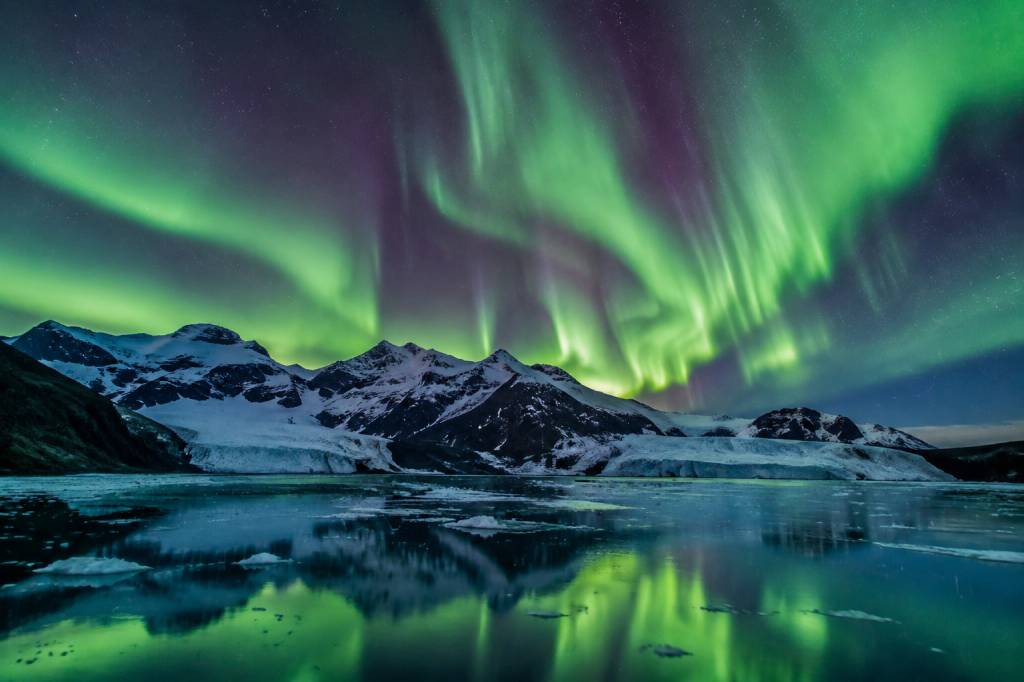
Aialik Glacier is one of the most impressive destinations in Kenai Fjords National Park, but it is not a conventional northern lights viewing site. The glacier lies deep inside Aialik Bay, reached by boat or sea kayak from Seward. Most visitors arrive during daylight, watch ice calve into the water, and return before the sky becomes dark enough for aurora hunting.
That distinction matters. If your main goal is to see the northern lights, Seward and the roads around Resurrection Bay are more practical bases than the glacier itself. If you are already planning a trip to Aialik Glacier, however, you can combine two very different Alaskan experiences: a day among tidewater ice and a separate night under the auroral sky.
Where Is Aialik Glacier?
Aialik Glacier is located in Kenai Fjords National Park on the Kenai Peninsula, approximately 20 miles southwest of Seward as the crow flies. It is one of the park’s major tidewater glaciers, flowing from the Harding Icefield toward Aialik Bay.
There is no road to the glacier, no public parking area at the terminus, and no simple roadside viewpoint. Access normally involves one of the following:
- A boat tour departing from Seward.
- A guided sea-kayaking excursion from Aialik Bay or nearby coastal waters.
- A private vessel, operated by someone experienced in the area and familiar with National Park Service regulations.
The journey from Seward is part of the attraction. Depending on the boat, sea conditions and itinerary, reaching the glacier can take several hours. Wildlife sightings are common along the route, including sea otters, Steller sea lions, harbor seals, whales and bald eagles. In other words, the trip is not a quick aurora transfer. It is a full wilderness excursion.
Can You See the Northern Lights at Aialik Glacier?
Technically, yes. Aialik Glacier is far enough north for auroral displays to occur, and the surrounding wilderness has very little artificial light. On a clear, active night, the view could be exceptional.
Practically, the answer is more complicated. Most commercial glacier tours operate during the brighter months, particularly from May through September. During this period, nights are short and twilight can last for much of the night. In June and July, darkness is insufficient for reliable aurora viewing.
Even in late August or September, standard daytime cruises usually return to Seward before the best viewing hours. A boat may leave the glacier area in the afternoon, while the aurora appears at 11 p.m. or 2 a.m. The glacier itself is therefore not a dependable northern lights excursion.
The most realistic plan is to visit Aialik Glacier during the day and search for auroras from Seward or a nearby dark location after midnight. This gives you a far better balance of access, safety and flexibility.
The Best Time to Combine Aialik Glacier and Aurora Viewing
For this combination, late August through early April offers the most useful window. Each part of the season has advantages and limitations.
- Late August: Darkness begins returning, but aurora viewing may still be limited by short nights and changing weather. Glacier tours are generally still operating.
- September: A strong compromise for travelers who want both a boat trip and a reasonable chance of seeing auroras. The nights are longer, although coastal cloud remains a serious factor.
- October: Longer darkness and potentially active aurora conditions, but fewer tour departures and more unsettled marine weather.
- November to February: Excellent darkness, but winter transportation, snow, wind and reduced tour availability make the glacier difficult or impossible to visit by regular excursion.
- March and early April: Good darkness during the evening and increasing daylight for travel. Some marine operators may begin preparing for the new season, but schedules vary.
There is no single perfect month. If the glacier is the priority, choose a period when boat tours are operating. If the aurora is the priority, choose the darkest season and treat the glacier as a separate daytime experience.
Why Seward Is the Practical Aurora Base
Seward sits at approximately 60 degrees north, within the southern part of the auroral zone. Strong geomagnetic storms can produce visible auroras here, but weak activity may remain farther north. This is where the KP index needs to be interpreted correctly.
A KP 2 or KP 3 forecast does not guarantee a display in Seward. During stronger events, activity may expand south and become visible above Resurrection Bay. A KP 4 or KP 5 event improves the odds, but cloud cover can still hide everything. A high KP number under an overcast sky is just an impressive-looking graph that you cannot see.
For a useful forecast, check three elements together:
- Cloud cover: Ideally below 30 percent in the direction of the expected aurora. Low cloud near the mountains can still block the horizon even when a general forecast looks favorable.
- Solar wind and geomagnetic activity: Look for sustained activity rather than one isolated spike. The Bz component turning south can help energy enter Earth’s magnetic field.
- Local darkness: Wait until astronomical darkness, normally from late evening through the early morning depending on the month.
In Seward, aurora activity often requires patience. You may see nothing at 9 p.m., then notice a faint green arc at 1 a.m. Keep checking the sky, but do not spend the entire night staring at a phone application. Forecasts are guidance, not reservations.
Where to Watch Near Seward
Seward has mountains, water and frequent coastal cloud. The best location changes with the weather. A useful approach is to begin with an accessible viewpoint and move only if the cloud pattern justifies it.
Waterfront areas: The harbor and waterfront are easy to reach and offer reflections when the sky is clear. Artificial light from boats, buildings and street lamps reduces contrast, but a strong aurora can still be visible overhead.
Lowell Point Road: This road follows the shoreline south of Seward and can provide darker views away from the central town. Pull completely off the road where permitted. Do not stop in narrow sections or block access for residents and emergency vehicles.
Exit Glacier Road: The road toward Kenai Fjords National Park can offer darker surroundings, particularly near open areas before the glacier access zone. Winter access is limited, and the road may not be maintained all the way to the end. Check current conditions before driving.
Higher viewpoints: A higher location can help you look over low coastal cloud, but mountain roads and trails become dangerous in darkness, snow and ice. Do not turn an aurora chase into an unplanned mountaineering exercise. A safe pullout with a clear northern view is more useful than a dramatic but inaccessible ridge.
A Realistic Two-Night Plan
Trying to place a glacier cruise and an aurora hunt on the same day can create unnecessary stress. The boat excursion may be canceled, delayed or extended because of sea conditions and wildlife activity. Leave a margin.
A practical itinerary could look like this:
- Day one: Arrive in Seward, check marine forecasts and confirm the next day’s Aialik Glacier departure.
- Night one: If the sky is clear and activity is promising, make a short aurora attempt close to town. Avoid a long drive after a day of travel.
- Day two: Take the boat or kayak excursion to Aialik Glacier. Bring waterproof layers even if the forecast looks calm in Seward.
- Night two: Use the latest cloud and aurora updates to choose between the waterfront, Lowell Point Road or a darker area along an accessible route.
- Day three: Keep flexible time for weather delays, road changes or a second aurora attempt.
This arrangement also protects you from a common travel mistake: treating a once-in-a-lifetime natural event like a train departure. The glacier will not adjust its tidewater schedule to match the aurora forecast, and the aurora will not appear simply because you have booked a boat.
What to Pack for Aialik Glacier
Conditions on the water are colder than in town, even during summer. Wind across the bay can make a mild forecast feel raw. Pack for spray, low temperatures and long periods outside.
- Waterproof jacket and trousers.
- Warm mid-layer, such as fleece or light insulation.
- Wool or synthetic base layers.
- Water-resistant gloves and a warm hat.
- Sturdy shoes with good grip.
- Dry bag or waterproof phone pouch.
- Sun protection and sunglasses for bright water and ice.
- Headlamp for evening travel, with spare batteries.
For aurora viewing, add a tripod, spare camera batteries and a power bank. Batteries drain quickly in cold weather. Keep a spare battery inside an inner pocket and avoid opening the camera bag unnecessarily in rain or snow.
Photography Tips at the Glacier and at Night
Aialik Glacier is easiest to photograph during daylight. Use a wide-angle lens for the ice face and surrounding cliffs, but include a boat, kayak or person in the frame to show scale. Icebergs can look surprisingly small in photographs unless there is a clear reference point.
For northern lights, use manual settings as a starting point:
- Manual focus set to infinity, checked against a distant light.
- Aperture as wide as the lens allows.
- Shutter speed between 2 and 10 seconds, adjusted according to movement.
- ISO commonly between 1600 and 6400.
- Delayed shutter or remote trigger to reduce vibration.
Fast aurora movement requires shorter exposures. If the curtains are shifting rapidly, a 20-second exposure will turn detail into a green blur. A faint display may need a longer exposure, but keep checking the result rather than trusting the camera screen alone.
Safety and Access Considerations
Aialik Bay is remote. Mobile phone coverage can be limited or absent, and marine weather can change quickly. Use a licensed operator with appropriate safety equipment and follow the guide’s instructions near the glacier face. Never approach floating ice casually. Small pieces can roll, break apart or create waves without warning.
Do not attempt to reach the glacier independently unless you have the vessel, navigation experience, cold-water equipment and local knowledge required for the route. Sea kayaking near a tidewater glacier is not the same as paddling on a calm lake.
For nighttime aurora drives, check road conditions before leaving Seward. Wildlife may be present, shoulders can be narrow, and ice can form even when the main road appears clear. Tell someone where you are going, carry a charged phone, and keep enough fuel for an unplanned delay.
How to Set Your Expectations
The northern lights are never guaranteed at Aialik Glacier, Seward or anywhere else in Alaska. A clear sky is only the first requirement. You also need darkness, sufficient geomagnetic activity and a view toward the active part of the sky.
Think of the trip as two separate rewards. Aialik Glacier offers towering blue ice, marine wildlife and a dramatic journey through Kenai Fjords National Park. Seward offers a realistic base for watching the sky at night. If the aurora appears, it becomes an extraordinary bonus rather than the only reason the day succeeded.
That is the most reliable way to plan this destination: book the glacier for the landscape, monitor the forecast for the aurora, and leave enough time to respond when Alaska changes the plan. In the North, flexibility is not a backup strategy. It is part of the itinerary.