


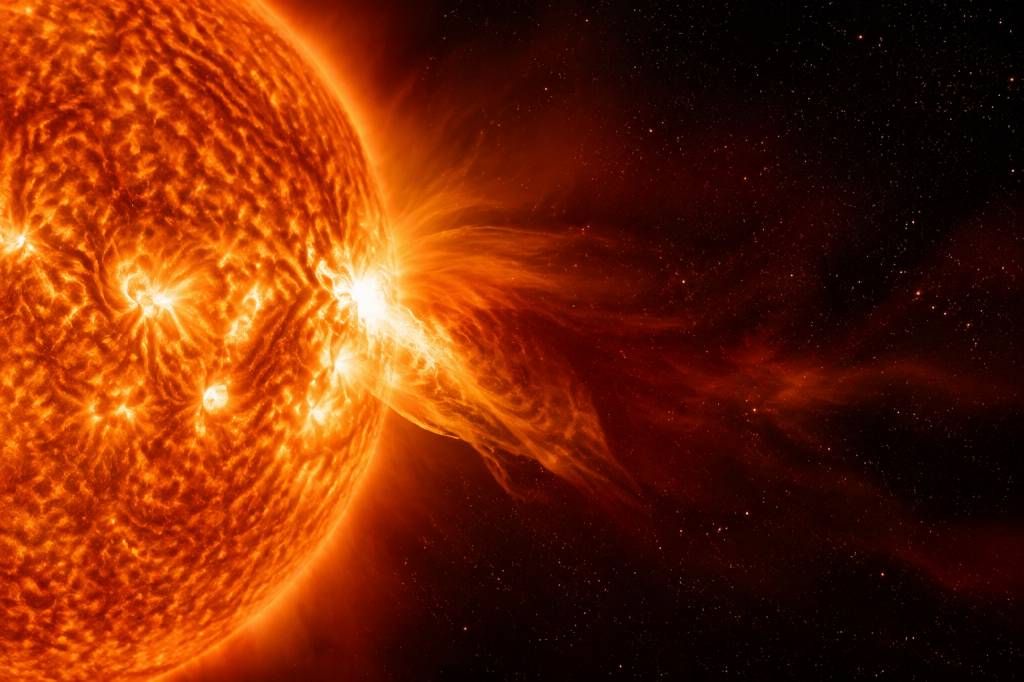
Solar flares make dramatic headlines, but they do not automatically mean a bright aurora is on the way. They are sudden bursts of energy from the Sun. The northern lights, by contrast, depend on charged particles reaching Earth and interacting with its magnetic field and upper atmosphere. The two events can be connected, but the connection is not as simple as “flare today, aurora tonight.”
If you are planning an evening under northern skies, the useful questions are practical ones: Was there a coronal mass ejection? Is it heading toward Earth? When might it arrive? And will the sky above your viewing spot be clear? Here is how to separate solar activity from an actual aurora opportunity.
What is happening on the Sun?
A solar flare is a sudden release of energy from a region of the Sun’s atmosphere. It produces radiation across the electromagnetic spectrum, including X-rays and ultraviolet light. Flares are classified by strength, from A and B through C, M, and X. Each class is ten times stronger than the one before it; an X-class flare is therefore much more powerful than a C-class flare.
That sounds like the main number to watch. For aurora planning, it is not. The flare’s radiation reaches Earth at the speed of light, in roughly eight minutes. It can affect radio communications on the sunlit side of Earth, but it does not usually deliver the slower-moving cloud of particles that directly drives a large geomagnetic storm.
That cloud is often a coronal mass ejection, or CME: a huge expulsion of solar material and magnetic field into space. A flare and a CME can occur together, but not every flare produces a CME, and not every CME is directed toward Earth. If a CME is Earth-bound, it commonly takes a day or several days to arrive, though the timing varies.
Think of the flare as a flash and the CME as a travelling weather system. The flash tells you that something energetic happened. The incoming cloud is often the more important part of the aurora forecast.
Are we experiencing solar flares right now?
Solar flares are a normal feature of an active Sun. Whether one is happening at this exact moment changes quickly, so a static article cannot reliably confirm current conditions. Check a live solar activity feed from a recognised space-weather agency, such as NOAA’s Space Weather Prediction Center, and look at the timestamp. A report from yesterday may already be out of date for tonight’s plans.
When you check, note the flare class and whether a CME has been observed. Then look for information about the CME’s direction, estimated arrival time, and expected geomagnetic effects. A strong flare on its own is not a reason to drive into the countryside, book a last-minute flight, or promise your travel companions a light show.
For a useful forecast, combine three pieces of information: solar-wind and geomagnetic conditions, local cloud cover, and darkness at your location. A powerful solar event cannot shine through a solid layer of cloud. A modest event under a clear, dark sky may give you a better viewing chance than a headline-making flare beneath overcast weather.
How solar activity turns into northern lights
The aurora appears when charged particles and energy from space interact with gases in Earth’s upper atmosphere. Earth’s magnetic field guides much of this activity toward the polar regions. Collisions with oxygen and nitrogen produce the colours we see: green is common, while red, pink, violet, and blue can appear under different conditions and at different altitudes.
The solar wind flows continuously from the Sun. When it carries the right conditions, it can transfer energy into Earth’s magnetic environment. A CME may intensify that process, especially if its magnetic field is oriented in a way that couples effectively with Earth’s field. Speed, density, direction, and magnetic orientation all matter. This is why a CME’s arrival can be difficult to judge precisely until it reaches spacecraft monitoring the space between Earth and the Sun.
When geomagnetic activity increases, the aurora oval can expand toward lower latitudes. In northern Norway, Iceland, Finland, Sweden, Alaska, and northern Canada, that may mean brighter displays or activity overhead. Farther south, the same storm could bring a chance of seeing aurora on the northern horizon. It does not guarantee that every location will see a colourful sky.
What KP can—and cannot—tell you
The KP index is a measure of global geomagnetic disturbance, usually reported on a scale from 0 to 9. Higher values often mean that the aurora oval may extend farther from the poles. That makes KP useful as a broad guide to where aurora might be visible, but it is not a brightness score for your exact location.
A high KP reading does not tell you whether your local sky is clear, whether the activity will peak at the time you are outside, or whether the aurora will be visible to the naked eye. KP is also based on measurements over a period of time, so it can lag behind fast changes in the space-weather environment.
For a trip in the aurora zone, do not wait for a high number before checking the sky. Activity can be visible at lower KP values at high latitudes. In practice, location, darkness, cloud cover, and patience can matter more than chasing a single index value.
Turn a solar headline into a viewing plan
When you see news of a flare or possible CME, use it as a prompt to check conditions—not as a promise. Start with the local cloud forecast, then check darkness and the latest aurora or geomagnetic forecast. If conditions look promising, choose a safe, accessible site with a clear view north or, if you are far north, a broad view of the sky.
-
Check the clock. Find out when it gets properly dark and keep an eye on short-term forecasts through the evening. Space-weather timing can shift, and cloud forecasts can change too.
-
Find a gap in the clouds. A clear patch nearby may be more valuable than a famous viewpoint under cloud. Compare several locations within a sensible driving distance.
-
Choose a safe pull-in or viewing area. Use established parking and public access points. Do not stop on a road shoulder, block a gate, or walk across an unfamiliar frozen surface in the dark.
-
Keep a backup plan. If your first site clouds over, know where you can legally and safely go next. In a city, a park or waterfront with a darker, open northern view can be worth checking.
-
Give your eyes time. Spend at least 20 minutes away from bright screens and streetlights. A faint aurora may first look like a pale grey or greenish band before it strengthens.
On a recent-style field check, for example, the most useful decision is often not “Should I chase the strongest KP?” but “Which nearby valley is clear, and can I reach its public viewpoint before the cloud arrives?” The best choice may be a simple roadside lay-by in a safe, permitted location rather than a celebrated mountain top that is windy, icy, or completely hidden by cloud.
What a flare means for tonight
If a flare has just occurred, its radiation has already reached Earth by the time the report appears. That does not mean an aurora is already underway. Look for a separate CME report and an estimated arrival window. If there is no Earth-directed CME, the flare may have little direct effect on the aurora you can see.
If a CME is expected to arrive, forecasts can become more useful as it approaches. Spacecraft near Earth can measure the solar wind and magnetic field before the material interacts with Earth’s magnetic environment. Even then, the exact onset and strength of auroral activity are not guaranteed. Treat an arrival time as a planning window, not a scheduled performance.
For tonight, the practical checklist is simple: Is it dark? Is there a clear patch of sky? Is there current evidence of geomagnetic activity? Can you get to a safe viewing point and wait? If the answers are mostly yes, go out. If clouds are widespread, a dramatic solar headline will not fix the view.
Pack for the wait, not just the photograph
Aurora watching involves standing still outdoors, sometimes for hours. Cold feels sharper when you are waiting rather than walking, and a phone loses battery faster in low temperatures. Pack for the conditions at your viewing site, which may be colder and windier than the town forecast suggests.
-
Wear insulating layers, a windproof outer layer, warm socks, gloves, and a hat.
-
Bring a fully charged phone, a power bank kept warm, and a headlamp with a red-light setting if available.
-
Carry water and a warm drink, and tell someone where you are going if you are heading beyond town.
-
Check road conditions before setting out, and avoid driving tired or staring at forecast screens while moving.
For photographs, a tripod and manual exposure controls help, but do not spend the whole night looking at your screen. A camera may record colour that your eyes cannot easily see, especially during faint activity. That is normal. The live sky is still the point of the trip.
Set expectations before you leave
A solar flare is exciting evidence that the Sun is active. It is not an aurora guarantee, and a high KP forecast is not a promise of bright curtains above your hotel. The chain from flare to visible lights includes several steps, and local weather can stop the show at the final one.
Use solar reports to understand what may be developing, then make decisions from the latest local forecast. Pick a clear, safe site, leave room for the timing to change, and plan a comfortable wait. If the sky stays quiet, you have not misread the Sun; you have encountered the uncertainty that comes with observing a natural event. If the lights do appear, you will be in position to see them rather than still trying to decode a headline.