


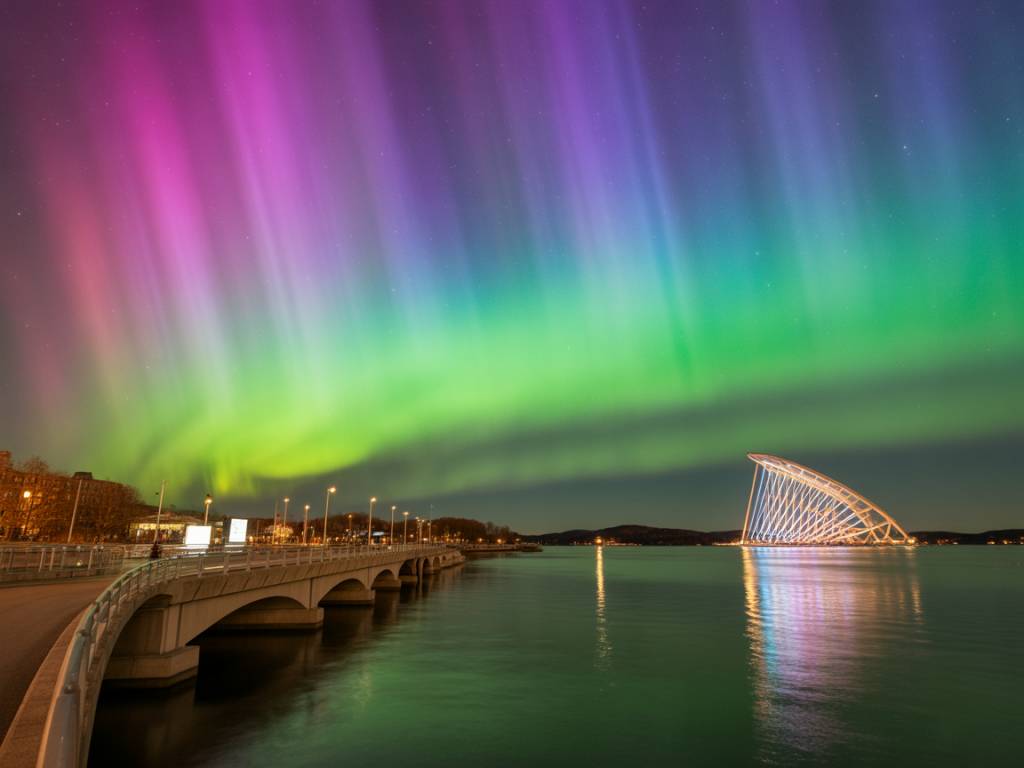
Some nights the aurora ignores all the rules: instead of hiding in remote valleys, it pours straight over cities, reflecting in rivers, hugging harbours and popping up over office towers. These “urban aurora” nights are rare but unforgettable – and if you know exactly where to go in town, you can get results that rival many classic wilderness shots.
Below, I’ll walk you through how to pick the best city parks and waterfronts for northern lights viewing and photography, with concrete examples from real locations and a checklist you can reuse at home, whatever your latitude.
What counts as a “strong urban aurora” night?
First point: you don’t need a KP 9 monster storm to see auroras above a city, but you do need the right combo of three factors:
- High geomagnetic activity: For cities north of 65°N (Tromsø, Fairbanks, Yellowknife), a KP 3–4 can already light up the sky above the skyline. For mid-latitude cities (Oslo, Helsinki, Stockholm, Edinburgh, Calgary), you’re usually looking at KP 5–6+. Below ~55°N or S, you’re chasing the real outliers: KP 7–8+ storms.
- Low to moderate cloud cover: Under 40–50% cloud cover, urban aurora hunting is still worth it if you have gaps towards the north. Thick overcast? Save the energy.
- Dark enough surroundings: Even in bright cities, there are “pockets” where direct light is lower and reflections work for you instead of against you.
Whenever the forecast suggests that the auroral oval will dip over or just south of your city and cloud cover is broken rather than solid, treat it as a potential urban aurora night and have a short list of spots ready.
What makes a good city aurora spot?
In town, you’re not trying to escape all light – that’s impossible. You’re trying to manage it. When I scout a city, I look for five things:
- Clear view to the northern sky (or to the area where the oval will be, depending on your latitude).
- Reduced direct light hitting your eyes and camera (no floodlights, football pitches, or car headlights facing you).
- Open space (parks, riverfronts, lakes, harbours, elevated lookouts).
- Foreground interest for photos (water, bridges, modest skyline, boats, trees).
- Safe, easily accessible location with simple parking or public transport, and somewhere to retreat if conditions deteriorate.
Ask yourself, before you head out: Can I stand here for an hour without being blinded, freezing in a wind tunnel, or worrying about traffic? If the answer is yes, you’re on the right track.
Why parks work so well in cities
Urban parks are usually your best first option. Here’s why:
- Less direct lighting: City parks often have softer, downward-facing lamps or dark corners away from main paths.
- Open sky: Lawns, sports fields and open meadows give good sky coverage without tall buildings.
- Foreground options: Trees, statues, fountains and gentle hills make instant compositions.
- Easy access: Central parks are usually well-connected by tram, metro or bus, and often walkable from hotels.
Once you know this, you can “translate” it to almost any city. But let’s look at real examples and what actually works on the ground.
Proven city parks that work in real aurora storms
Below are specific parks where I or other spotters have successfully caught auroras during strong events. The key is not to memorize every name, but to understand why these spots work so you can find your equivalent at home.
Tromsø, Norway – Prestvannet and Telegrafbukta
- Prestvannet Lake (on the island): A dark(er) bowl surrounded by houses but with no harsh floodlights over the water. You get reflections on the lake and a wide view towards the north and east. Parking is limited on small residential streets, so arrive early and respect local residents.
- Telegrafbukta park on the south-west coast: Popular with locals. If the aurora arcs across the whole sky, you can frame it over the fjord with city lights behind you, using the shoreline and rocks as foreground.
Reykjavík, Iceland – Öskjuhlíð and Grótta area
- Öskjuhlíð hill (around the Perlan building): Patchy trees, some darker paths and small clearings with good views across the city and towards the north. Walk a few minutes away from the brightest lights of Perlan itself.
- Grótta lighthouse vicinity (technically a bit outside the densest core, but still urban): During big storms, auroras dance straight over the city skyline to the east and over the sea to the north. Stay off closed areas in stormy weather and respect the posted access hours.
Rovaniemi, Finland – Ounasvaara hilltop zones
- Ounasvaara recreation area is a five-to-ten minute drive from many central hotels. Small clearings along the ski tracks and near the hilltop viewpoints work surprisingly well during bright auroras. You get a mix of forest silhouettes and faint city glow under the arc.
Fairbanks, Alaska – Pioneer Park & riverside edges
- Pioneer Park and the Chena River waterfront: On strong nights, green and purple curtains can appear right above the city. Look for darker corners along the river and small open park spaces where streetlights are behind you, not in your line of sight.
Yellowknife, Canada – Frame Lake trail
- Frame Lake trail offers multiple viewing spots with the water acting as a shield against some city lights. When the aurora is strong, it will outshine the downtown glow and reflect nicely on the lake.
Oslo, Norway – Bygdøy and Ekebergparken in rare big storms
- Bygdøy peninsula: Semi-urban, reachable by bus from the centre. Small beaches and open lawns with views northwards across the Oslofjord. On KP 6+ nights (rare but not impossible), arcs have been visible here.
- Ekebergparken: Elevated sculpture park on the hillside south-east of the centre. It gives you a panoramic view of the city, fjord and northern sky. Move away from the brightest installations to find darker edges.
Stockholm, Sweden – Djurgården and Skeppsholmen
- Djurgården: Big island park with pockets of darkness and harbours. On major storms, you can catch auroras over the city with water in the foreground.
- Skeppsholmen island: Bridges, boats and waterfront railings make good shooting platforms with a clean view north over the water.
Edinburgh, Scotland – Calton Hill and Holyrood Park
- Calton Hill: Not dark by wilderness standards, but the elevated view to the north over the Firth of Forth makes it surprisingly effective during strong KP 6+ events. Use the monuments and skyline silhouettes as foreground elements.
- Holyrood Park / Arthur’s Seat lower slopes: A few minutes’ walk from the Royal Mile, you can reach darker patches of grass with more sky and less direct lamp glare.
Calgary, Canada – Nose Hill and Bow River paths
- Nose Hill Park: Huge natural park inside the city. On strong nights, the northern skyline glows green above the suburbs. You get a much darker horizon than in most inner-city spots.
- Bow River pathways: Several stretches away from car traffic, with the river separating you from some of the urban brightness.
You can repeat this pattern for almost any northern city: identify an elevated park, a large central green space, and a quieter urban “nature” park, then test them on the next strong forecast.
Waterfronts: turning city light into your ally
When you stand by a river, lake, or harbour, you automatically get two advantages:
- No buildings in one direction: Water gives you an open horizon towards the aurora, ideal when it sits low.
- Reflections: The aurora reflecting in water often photographs brighter and more dramatically than the sky itself in urban conditions.
But waterfronts can be tricky: bright quays, restaurant strips, and car traffic can wreck your night if you pick the wrong side. Here’s how I evaluate a waterfront spot:
- Stand with city lights behind you as much as possible, facing towards the darkest part of the sky.
- Check for floodlights on piers and bridges. One badly placed white LED can flare across every frame.
- Look for small piers, marinas or sandy beaches set slightly away from the busiest promenade.
- Consider wind exposure: Waterfronts can be much colder and windier than interior parks; plan your clothing accordingly.
Examples that work well in practice:
- Tromsø: Telegrafbukta and the calm stretches of shoreline near Folkeparken give a dark-ish fjord foreground, with auroras rising behind mountains.
- Reykjavík: The coastal path west of the Sun Voyager sculpture, and corners near Grótta (within safe access zones), allow compositions with sea, rocks, and city glow on one side and aurora on the other.
- Helsinki: During rare strong events, quieter bays like those around Lauttasaari and Seurasaari give you more darkness than the central South Harbour.
How to scout your own city spots before the storm hits
Don’t wait for a KP 7 alert to start guessing where to go. You can prep this on any cloudy Tuesday evening:
- Use satellite view on Google Maps / OpenStreetMap to identify:
- Large parks without stadiums
- Lakes, ponds, wide rivers and harbours
- Hilltops with viewpoints
- Visit at night for a 10–15 minute walk:
- Check how bright the lamps really are.
- Note any floodlit buildings, billboards, or car-heavy roads.
- Find at least two or three “dark pockets” with clear view north.
- Pin exact spots on your map app with comments like “good N view, low lamps” or “too bright, avoid”.
- Test your tripod positions: Make sure there’s somewhere stable to set up, away from busy footpaths and traffic.
Do this homework once, and every strong aurora warning becomes a simple decision: “clouds are moving in from the west, wind will be rough by the harbour, I’ll start at the inner city park and keep the waterfront as backup.”
City-specific strategy by latitude
Your latitude changes how you use parks and waterfronts, and what you expect to see.
High arctic and subarctic cities (65–70°N+) – Tromsø, Rovaniemi, Fairbanks, Yellowknife
- Frequency: Auroras are common; you don’t need extreme KP.
- Strategy: Use city parks and waterfronts on marginal weather nights when you don’t want to drive far. On very bright nights (KP 5+), even moderate light pollution doesn’t matter much.
- Expectation: Auroras overhead, multi-layered structures, frequent movement.
Northern European & Canadian cities (60–65°N) – Oslo, Stockholm, Helsinki, Reykjavík, Calgary
- Frequency: Good displays mostly tied to stronger activity (KP 4–6+).
- Strategy: Have two tiers of spots:
- Urban parks and waterfronts for quick, no-car nights.
- Nearby dark-sky areas (15–45 minutes’ drive) as Plan A for moderate forecasts.
- Expectation: Arcs often low in the northern sky; big overhead coronas only during stronger storms.
Mid-latitude cities (50–60°N, 50–60°S in the south) – Edinburgh, northern Germany, much of Canada & northern US, southern Scandinavia
- Frequency: Rare but intense events.
- Strategy: Treat these nights like short-notice eclipses:
- Have 1–2 very dark city parks or waterfronts scouted in advance.
- Watch real-time data (auroral cameras, magnetometer spikes) to decide if it’s worth heading out.
- Expectation: Auroras will sit low on the northern horizon for much of the time; compositions with water or wide horizons are particularly valuable.
Urban aurora photography: specific settings and tricks
You don’t need top-end gear to capture strong city auroras, but you do need to adjust for mixed light. Here’s a base setup that works reliably:
- Camera & lens: Any recent DSLR or mirrorless with manual mode + a wide lens (14–24mm on full frame, 10–18mm on APS‑C) at f/2.8–f/4.
- Tripod: Essential to keep ISO reasonable and avoid blur.
- Manual focus: Focus on a distant light or bright star, then lock focus.
- Starting settings for bright city sky:
- ISO 800–1600
- Shutter 2–6 seconds
- Aperture f/2.8–f/3.5
- White balance: Try 3500–4000K to tame orange city glow; adjust later in post.
- Histogram watch: Check that you’re not blowing out the highlights in streetlamps and buildings; shorten exposure if necessary.
- Composition tips:
- Use water reflections to double the aurora impact.
- Frame with trees or buildings on the sides to hide some light sources.
- Include a bit of city for context – the contrast between aurora and urban landscape is the story.
For phones, switch to night/long exposure mode if available, brace the phone on a railing or mini-tripod, and tap to focus slightly below the brightest auroral area. Lower expectations a bit, but on very strong nights, even phones can produce publishable shots.
Safety, comfort and etiquette in city aurora spots
Urban aurora hunting solves some problems (no icy backroads) but introduces others. A few ground rules from the field:
- Dress for standing still: In parks and on waterfronts you’re not walking much. Add one more layer than you’d use for a normal city walk, plus hat and gloves you can operate buttons with.
- Headlamps on red mode: White light ruins other people’s shots and your night vision. In cities, your eyes are already fighting lamp glow; keep extra light minimal.
- Tripod positioning: Don’t block narrow paths or stairways. In popular parks, set up slightly off the main route.
- Respect residential areas: Many good parks border housing. Keep noise down and avoid shining lights into windows.
- Keep a backup spot: If one park turns out brighter than you expected (new floodlights, construction), have a second option pre-scouted within 10–15 minutes.
Putting it all together on a real urban aurora night
Let’s run through a realistic scenario.
It’s 18:00, you’re in a northern city hotel lobby, and you see alerts: KP 6 expected, cloud cover 40% with gaps from the north. Here’s how you could structure the evening:
- 18:15 – Check your pins: Choose a park with good northern exposure and a waterfront as Plan B. Look at wind forecast; if wind chill is brutal by the harbour, start inland.
- 19:30 – Early recon: Walk to your first spot before full darkness. Confirm lamp positions, test a couple of compositions, and adjust your mental map.
- 20:30–23:00 – Main watch: Stay flexible. If clouds thicken above the park but satellite images or local webcams show clearer skies near the waterfront, move. Urban hunting is about short, efficient relocations.
- Throughout – Adjust expectations: On some strong nights the aurora will hover low behind haze and light pollution. In that case, switch to tighter compositions using trees, monuments or smaller patches of sky. On very clear, strong nights, go wide and use the city as foreground.
Over time, you’ll build your own mental map of “tier 1” and “tier 2” city spots, and those all-nighter drives far into the countryside will become optional, not mandatory, whenever the aurora decides to visit the city instead.
Strong urban aurora events are rare but predictable enough that a bit of preparation pays off for years. If you invest a couple of quiet evenings scouting your parks and waterfronts now, the next time the forecast spikes you’ll know exactly where to go, where to park, and where to point your lens – instead of burning an hour driving out of town and hoping for the best.