


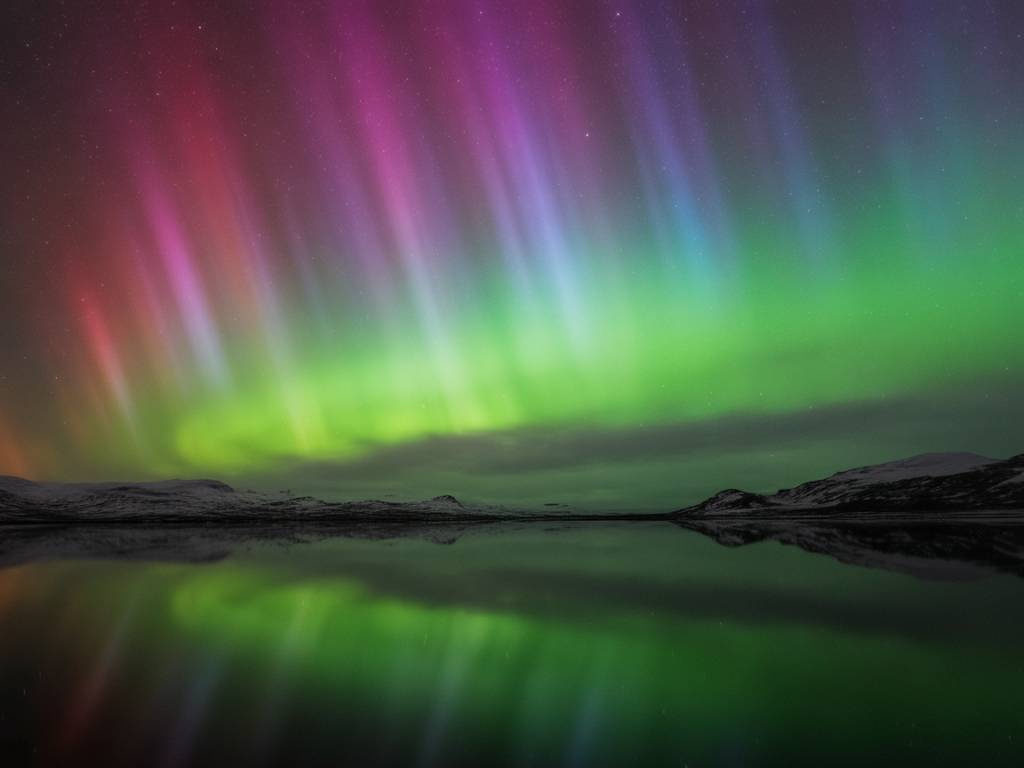
If you live in or near a city, you’ve probably asked yourself: “Is it even worth trying to see the aurora from here? Is my sky already ‘too bright’?”
On Northernlights-Forecast I spend a lot of time talking about KP index, cloud cover and solar wind, but there’s a fourth factor that can quietly ruin a good aurora night: light pollution. The trick is not to panic about it, but to learn how much light is too much for your specific home town and when it’s still worth going out.
In this guide we’ll stay very down-to-earth: how bright is your sky, what kind of aurora can cut through that brightness, and how far you really need to drive (if at all) to give yourself a fair chance.
Why light pollution is a problem – but not always a show‑stopper
Light pollution doesn’t “kill” the aurora. It just raises the brightness of the background sky. Think of it like watching a weak projector in a sunlit room versus a dark cinema.
For aurora watching, that means:
-
Weak aurora + bright sky → washed out, maybe invisible to the naked eye, but still catchable on camera.
-
Medium aurora + moderate light pollution → visible as a pale arc or glow, colours mostly on camera.
-
Strong aurora + even heavy light pollution → still visible, sometimes very obvious, especially towards the darkest horizon.
The key is to stop thinking in absolute terms (“I live in a city, so it’s impossible”) and start thinking in thresholds:
-
How bright is my sky technically?
-
What type of aurora am I realistically going to get at my latitude?
-
Given those two, what are my minimum actions to make a forecast night count?
Once you know those thresholds, you can decide in a few minutes: stay on the balcony, walk 10 minutes to a darker corner, or drive 30–40 minutes out of town.
How bright is your sky? Three quick ways to find out
You don’t need professional instruments to evaluate your local light pollution. Three simple approaches are enough for aurora planning.
Use a light pollution map
Open any global light pollution map such as:
-
lightpollutionmap.info (very detailed radiance data)
-
DarkSiteFinder or similar applications
Zoom to your town and check the colour and values:
-
White / bright yellow core: city centre, heavy light pollution, usually Bortle 7–9.
-
Orange / red belt: suburbs, small towns, Bortle 5–6.
-
Green / blue zones: rural outskirts, Bortle 3–4.
-
Dark blue / grey patches: very dark countryside, Bortle 1–2.
You don’t need exact numbers; what matters is to mentally mark:
-
“Home base” – where you usually are at night (centre, suburb, village).
-
“First escape ring” – the next darker zone reachable in 20–40 minutes.
-
“Deep dark spots” – the truly dark locations if you’re ready to drive longer.
Use the Bortle scale as a language
The Bortle scale is a 1–9 scale used by astronomers to describe sky brightness:
-
Bortle 1–2: pristine dark sky, Milky Way bright and structured.
-
Bortle 3–4: rural, Milky Way visible but less dramatic.
-
Bortle 5–6: suburban, Milky Way faint or invisible; only the brightest stars are obvious.
-
Bortle 7–9: city to inner-city, sky washed out, very few stars.
Most mid-sized European cities sit around Bortle 7–8 in the centre and 5–6 in the outer districts. Many northern towns in Norway, Sweden, Finland sit closer to 4–5 because of smaller populations and more open surroundings.
Knowing your Bortle “home value” helps answer the central question: how much aurora do I need to beat this background glow?
Quick naked‑eye test: what can you see now?
On a clear, moonless night, step outside and look up for a few minutes. Ask yourself:
-
Can I see the Milky Way as a fuzzy band? → You’re probably Bortle 4 or better.
-
Can I see the constellation Orion easily in winter (3 bright stars in a row, plus the “shoulders” and “feet”)? → Roughly Bortle 5–6.
-
Do I only see a handful of bright stars and the background is grey‑orange? → Bortle 7–9, city sky.
This isn’t precision science, but it’s enough to set realistic expectations for aurora visibility at home.
What kind of aurora can beat city lights?
Light pollution is only half the story. The other half is latitude and aurora strength (KP index). A Bortle 7 sky in Tromsø is not the same situation as a Bortle 7 sky in Paris.
Let’s break it down by broad latitude bands.
If you live in the auroral zone (roughly 64–70°N)
Examples: Tromsø, Kiruna, Rovaniemi, Yellowknife, Fairbanks outskirts.
-
Typical aurora: frequent, often moderate (KP 2–4), often directly overhead.
-
City centre (Bortle 7–8): On many clear nights with KP ≥ 2–3, you can still see aurora as a bright arc or moving bands, especially towards the north and away from the main light domes. It may look pale to the eye but will be bright green on camera.
-
Suburbs / edges (Bortle 5–6): KP ≥ 1.5–2 already gives usable aurora. From here, almost any active night is worth going out.
-
Rural ring (Bortle 3–4): This is where faint structures, coronas and subtle colours start to pop. Ideal for serious photography.
Bottom line: in the auroral zone, light pollution is annoying but rarely a total blocker. If forecasts say “active night” and your sky is clear, even in town, it’s usually worth heading out, at least to a park or a hill.
If you live in high mid‑latitudes (roughly 55–63°N)
Examples: Scotland, Southern Norway/Sweden/Finland, Baltic states, Northern Germany/Poland, parts of Canada.
-
Typical aurora: occasional, often low in the north, really good only when KP ≥ 4–5.
-
City centre (Bortle 7–8): You usually need a strong storm (KP 6+) to see an obvious auroral arc or pillars from the middle of town. Below that, aurora can be there but lost in the skyglow.
-
Suburbs (Bortle 5–6): KP 5–6 can produce visible arcs on the northern horizon. They may look like a pale, slightly greenish or grey band, especially after a few minutes of dark adaptation.
-
Rural ring (Bortle 3–4): KP 4–5 already gives a decent chance, with structures sometimes visible. KP 6–7 becomes spectacular.
Here, light pollution interacts strongly with aurora strength. On a marginal KP 4 night, staying in the city can mean “no show”, while a 30–40 minute drive out may transform it into a clear low arc or even dancing curtains.
If you live in lower latitudes (below ~55°N)
Examples: Most of central Europe, US lower 48 (except far north), UK Midlands and south.
-
Typical aurora: rare, usually during strong geomagnetic storms (KP 7+).
-
City centre (Bortle 7–9): You’ll likely only see a diffuse reddish or whitish glow low in the north on major events. Often, the camera sees it much better than your eyes.
-
Suburbs (Bortle 5–6): Strong storms can show a clear band or vertical rays on the northern horizon.
-
Rural ring (Bortle 3–4): This is effectively mandatory if you want more than a vague glow. During big events, the aurora can reach high enough to be obvious here.
At these latitudes, light pollution can easily ruin a rare aurora opportunity. If serious forecasts mention KP 7–8 and you’re under a Bortle 7–8 sky, everything depends on your willingness to escape that light dome.
So how much light pollution is “too much”? Practical thresholds
Let’s translate all of this into simple rules of thumb you can apply quickly on a forecast night.
Rule 1 – If you can see the Milky Way, you’re in good shape.
If the Milky Way is visible, your sky is dark enough for most non-trivial auroral events where your latitude is favourable. At high latitudes, even KP 1.5–2 can be worth watching. At mid-latitudes, KP 4–5 stands a fair chance.
Rule 2 – If you can’t see the Milky Way but see lots of stars, you need a moderate to strong aurora.
This is typical suburb sky (Bortle 5–6). Here:
-
In/near the auroral zone: KP ≥ 2–3 is often fine.
-
High mid-latitudes: KP ≥ 4–5 to see something clearly.
-
Lower latitudes: KP ≥ 6–7 and even then, look low in the north and use a camera as “night vision”.
Rule 3 – If you see only a handful of stars, you need luck and a big storm.
That’s inner-city (Bortle 7–9). From here:
-
In Tromsø-type cities, you still regularly see aurora because the oval passes overhead so often, but even there a short trip to a darker area will massively improve the show.
-
In mid or low latitudes, you’re depending on truly strong events (KP 7+). For anything below that, assume your eyes will struggle and treat it like a “camera hunt” unless you can move to darker ground.
Reading your own town like an aurora map
Once you know your Bortle and latitude, the next step is mapping “micro‑dark zones” in and around your town. This is where the fieldwork starts.
Look on a normal map (Google Maps, OpenStreetMap) and combine it with what you saw on the light pollution map. Mark:
-
Parks and open fields on the north side of town, away from big malls or stadiums.
-
Hilltops or viewpoints where you can see a wide northern horizon and stand in the shadow of buildings or trees.
-
Lake shores, river banks, beaches on the dark side of town. Water surfaces don’t emit light and often block lights from the opposite shore.
-
Industrial areas at night‑off times – some factories go dark after a certain hour, leaving big open skies.
On a test night with no aurora, visit one or two of these spots, let your eyes adapt for 10–15 minutes and compare:
-
How many more stars can you see compared to your home window?
-
Is the northern horizon less washed out?
-
Are there direct lamps in your field of view, or can you place yourself so that a tree, building or slope shields them?
You’re trying to create your own mental toolkit: “If clouds are thin and KP hits 5, I go straight to this parking near the lake, stand in this corner, north is that direction.” The idea is to reduce decisions when time and conditions are changing fast.
Micro‑strategies: squeezing the best out of a bright town
Sometimes you can’t leave the city. Maybe you don’t have a car, or roads are icy, or you have to be back home quickly. Even then, you can make a surprising difference with a few small tricks.
-
Kill nearby lights if possible: Some public lights are on motion sensors or switches; some balconies and gardens have lights you can simply turn off for an hour.
-
Use building shadows: Stand on the dark side of a building or wall so that street lamps are behind you and out of your direct line of sight.
-
Go higher: Rooftops (where legal and safe), parking garages, or small hills can get you above some of the low‑level glare that dominates city streets.
-
Aim away from the worst light dome: If your city centre is south of you, consider yourself lucky. Your northern sky might be much darker than the southern glow.
-
Use your car as a shield: In a parking lot, position the car so incoming headlights and street lamps are blocked while your view north remains open.
None of these will transform a Bortle 8 sky into a Bortle 3 sky, but combined, they can move you one or two steps down the brightness ladder. That can be enough to turn a “nothing” into a faint, real auroral arc.
When you really should drive out of town
There are nights where staying in town is fine, and nights where you’re just wasting a rare opportunity. My own decision tree usually looks like this:
-
KP forecast is low or uncertain (KP 2–3), but I’m in or near the auroral zone → If clouds cooperate, I’ll often try a local park or hill first. If activity picks up, I may then drive 20–30 minutes out for darker skies.
-
KP forecast moderate (KP 4–5) and I’m at high mid‑latitudes → I almost always go straight for my “first escape ring” (Bortle 3–4) if roads and schedule allow. It significantly increases my chances compared to staying in town.
-
KP forecast strong (KP 6–7+) and I live far from the auroral oval → This is “drop what you’re doing and get out of the light dome” territory. I’ll aim for the darkest reachable location with a clear northern horizon, sometimes planning this in advance as soon as the space weather looks promising.
The goal is to avoid regret. You don’t want to wake up to social media full of green skies from villages 20 minutes away while you saw only orange haze from your balcony.
When the sky is too bright for your eyes – but not for your camera
There is one last detail that often surprises people: your camera can “see” aurora that your eyes can’t. Long exposures at high ISO will pick up faint green or red structures on a sky that looks uniformly grey to you.
If you’re stuck under heavy light pollution:
-
Use a tripod, 5–10 second exposures, ISO 1600–3200, wide open aperture (f/1.4–f/2.8).
-
Point your camera low towards the darkest northern sector you can find.
-
Check your images regularly; a faint green band or reddish glow may appear before you consciously see anything.
This doesn’t replace the feeling of watching curtains dance overhead, but on marginal nights, it can be the difference between “nothing happened” and “we actually caught the storm, even from town”.
In the end, the real question isn’t “Is my city too bright for aurora?” It’s “What can I realistically expect from this sky, and what’s the simplest move I can make tonight to see more than I would from my couch?”
Map your light pollution, know your latitude, identify your escape rings, and keep your decisions simple. The aurora takes care of the rest.