


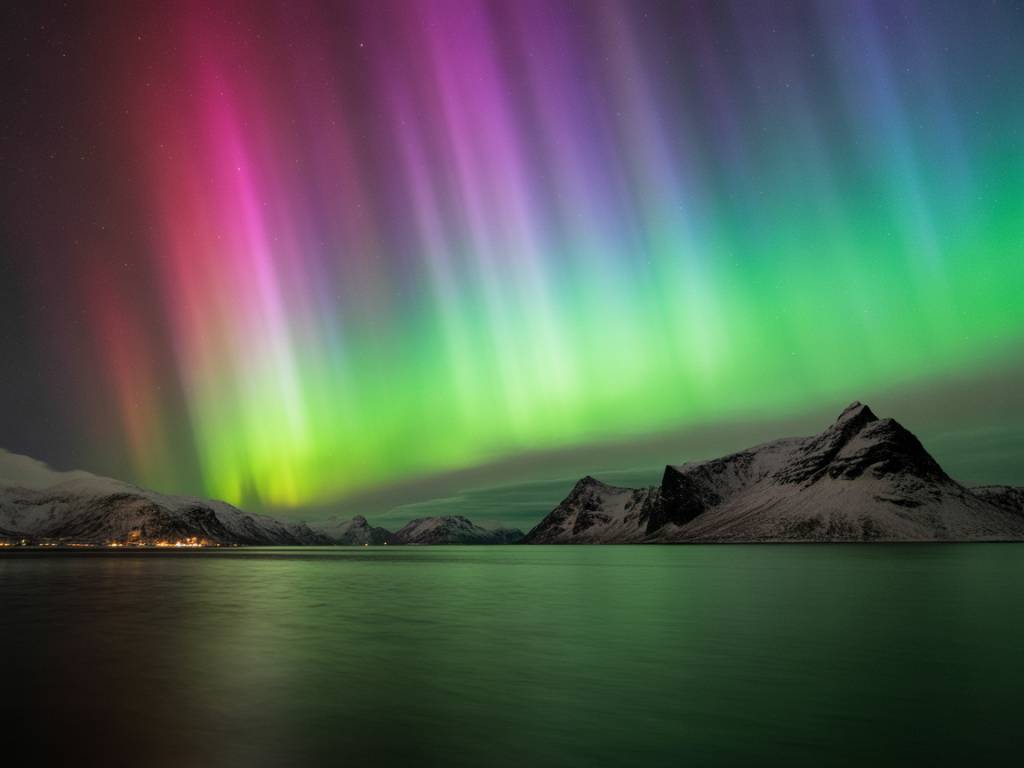
Most of the year, if you want a decent chance to see auroras, you have to travel north: Tromsø, Rovaniemi, Fairbanks, Yellowknife, Reykjavik. But every once in a while, the northern lights ignore the usual rules and spill far to the south — glowing above Berlin, Paris, New York, even Rome or northern Spain.
Those rare nights are driven by geomagnetic storms. Understanding how they work helps you know when it’s worth dropping everything, grabbing a jacket, and heading out to the darkest place you can reach from your city.
What is a geomagnetic storm in plain language?
A geomagnetic storm is a disturbance of Earth’s magnetic field caused by “space weather” — mainly blasts of solar wind and charged particles coming from the Sun.
Three key ingredients usually line up:
- A solar eruption: A solar flare or coronal mass ejection (CME) blasts plasma and magnetic fields into space.
- Good aim: That CME happens to be directed toward Earth.
- Right magnetic orientation: The magnetic field inside the CME points mostly southward relative to Earth’s field, which makes it easier for energy to transfer into our magnetosphere.
When this solar material hits Earth’s magnetic field, it compresses and distorts it. Charged particles are funneled along magnetic field lines toward the polar regions. There, they collide with atoms and molecules in the upper atmosphere, exciting them and producing light — the aurora.
On quiet nights, this auroral “ring” (the auroral oval) sits roughly over the Arctic and subarctic. During a strong geomagnetic storm, that oval expands and shifts toward the equator. That is exactly when major cities far from the Arctic suddenly get a chance.
KP index: the quick way to know how far south the lights can go
Most aurora forecasts (including ours) highlight a number between 0 and 9: the Kp index. It’s a global measure of geomagnetic activity. You don’t need to be a scientist to use it; you just need a rough idea of what Kp means for your location.
Very simplified, for the Northern Hemisphere:
- Kp 0–2: Only high Arctic, deep inside the auroral oval (e.g. northern Norway, northern Finland, northern Canada, central Alaska).
- Kp 3–4: Typical “good aurora night” for Tromsø, Fairbanks, Yellowknife, Reykjavik, Rovaniemi.
- Kp 5 (minor storm): Oval expands. Auroras often visible across all of Scandinavia, Scotland, parts of the Baltics, southern Canada.
- Kp 6–7 (moderate to strong storm): Lights become visible much farther south: Ireland, UK midlands, northern Germany and Poland, most of central Canada, northern US states.
- Kp 8–9 (severe/extreme storm): This is when we get headlines. Auroras can appear over Paris, London, New York, Chicago, Denver, Prague, sometimes even northern Spain or Italy.
Those latitude bands are approximate and strongly affected by local conditions (clouds, light pollution, altitude, and your north-facing horizon). But as a rule of thumb: the higher the Kp, the farther south the night’s “auroral action” will move.
How geomagnetic storms push the auroral oval over big cities
Imagine the auroral oval as a glowing ring around the magnetic pole. On quiet days, that ring is tight and sits mostly over sparsely populated polar areas. When a geomagnetic storm hits, two things happen:
- The ring grows: Stronger energy input from the Sun pumps more particles into the magnetosphere. The oval widens, covering more latitudes.
- The ring shifts: Distortions in Earth’s magnetic field push the oval equatorward (toward lower latitudes) on the night side of the planet.
If the storm is strong enough and happens during your local night, this expanded, shifted oval can park itself over regions that rarely see auroras — including heavily populated belts like:
- US–Canada border and down into the central US
- Most of central and northern Europe
- Parts of northern China and Japan
- Southern Australia and New Zealand (for southern lights, the aurora australis)
From those regions, the aurora may appear as:
- A low, colored arc on the northern horizon (for more southern observers)
- Pillars and bands rising higher in the sky as you get closer to the center of the expanded oval
- Sometimes overhead if the storm is extreme and your city sits under the shifted ring
This is why a Kp 8 storm can light up the sky over Berlin while a normal Kp 3 night leaves even Oslo with only a weak glow on the horizon.
Real-world examples: when big cities met big auroras
These events are rare, but they do happen. A few modern examples that many of today’s travelers remember or have seen photos of:
- May 10–11, 2024:
- One of the strongest geomagnetic storms of the 21st century (reaching G5 on NOAA’s scale).
- Auroras were photographed from southern Europe (Spain, Italy, Greece), across central Europe, and as far south as parts of the southern US.
- In major cities like Paris, London, Berlin, Prague, and New York, people with a decent north-facing view and minimal haze could see pink and purple curtains even with light pollution.
- Halloween Storms, October–November 2003:
- Multiple strong CMEs from a very active sunspot resulted in powerful geomagnetic storms.
- Auroras were visible over Texas, southern California, and parts of the Mediterranean region.
- March 13, 1989 storm:
- Well known because it caused a large power blackout in Quebec.
- Auroras were seen far into the US and Europe, bright enough to be noticed even from cities.
Each of these storms followed the same basic pattern: strong solar eruptions, an Earth-directed CME, the right magnetic orientation, and then a dramatic southward push of the auroral oval.
What this means if you live in a major city
If you live in London, Paris, Berlin, Amsterdam, New York, Chicago, or similar latitudes, strong geomagnetic storms change the game. You don’t suddenly live in Tromsø, but a few key points are worth knowing.
1. Yes, you really can see auroras from a city — but manage expectations.
From light-polluted areas, you are unlikely to see the vivid green curtains that photographers capture in Lapland with long exposures. Many first-time observers in cities report:
- “The camera saw more color than my eyes.”
- “It looked like greyish clouds slowly moving, until I checked the photos.”
Strong storms can occasionally be an exception, with pinks and reds visible to the naked eye. Still, go in with realistic expectations: shapes and movement are often easier to see than bright color.
2. The northern horizon is your most important asset.
During geomagnetic storms at mid-latitudes, the aurora usually stays low in the north. This means:
- Find a spot with a clear, unobstructed view to the north (no tall buildings, no forested hill in that direction).
- A bit of elevation (a hill, a viewpoint, a rooftop terrace with safe access) helps a lot.
- Even in a city, looking over a river, a lake, or open fields can make the difference between seeing nothing and catching a faint arc.
3. Distance from the city center pays off fast.
If you can jump in a car or train for 20–40 minutes, your chances improve dramatically. For example, during strong Kp 7–8 storms:
- London residents driving into the Chiltern Hills or the North Downs reported much clearer views.
- Berliners heading just outside the ring road (A10) into open farmland had darker skies and better definition in pillars and arcs.
- New Yorkers who crossed into rural New Jersey, Long Island’s east end, or up the Hudson Valley captured far more detail than those in Manhattan.
On big storm nights, treat your city like a basecamp, not the observation point.
How to react when a strong storm is forecast
When geomagnetic storm alerts start popping up in your feed, you don’t have much time. CMEs can arrive earlier or later than predicted, and the most intense part of a storm can last a few hours only. Here’s a simple approach to reduce “stress weather”.
Step 1: Watch for these key signals
- Space weather alerts from reliable sources (NOAA, national meteorological services, or specialized aurora sites).
- Forecasts indicating Kp 6 or higher during your local night.
- Cloud cover maps suggesting at least partial clear skies where you are.
If all three look good, it’s time to prepare.
Step 2: Prepare a simple “storm night kit”
- Warm clothes (even in spring or autumn — you will stand still more than you think).
- Headlamp or flashlight with red mode if possible.
- Power bank and charged phone.
- Camera and tripod if you plan to photograph.
- Thermos and snacks (small comforts keep you patient).
Keep it minimal but ready to grab. On big storm nights, the difference between seeing the show and reading about it in the morning can be 20 minutes of hesitation.
Step 3: Choose the best spot you can realistically reach
Ask yourself:
- How far can I drive or walk in 30–60 minutes?
- Where can I get a clear north-facing horizon with the least light pollution?
- Where can I park safely and not disturb residents?
Use satellite maps to identify:
- Lake shores or riverbanks facing north
- Viewpoints or hills with parking nearby
- Open farmland (respect private property, stay on public roads or paths)
If you truly cannot leave the city, aim for:
- Bridges or promenades along rivers
- Parks with a north-facing open area
- High vantage points with safe public access
City-by-city scenarios during strong storms
To make this concrete, here’s what a strong geomagnetic storm (Kp 7–8) can mean in practical terms for some major urban regions.
London and southeast UK
- From central London: aurora possible as a faint band low in the north, very washed out by light pollution.
- Better option: drive or train toward the Chilterns, North Downs, or South Downs, or coastal areas facing north like parts of the Essex coast.
- Target: car parks on high ground, country lanes with safe pull-offs.
Paris and northern France
- From central Paris: you might see a weak glow in the north during extreme events, but color will be subtle.
- Better option: head toward the Seine valley upstream, Picardy, or Champagne, avoiding industrial zones.
- Even 40–60 km from the périphérique can dramatically improve your sky quality.
Berlin and northern Germany
- Berlin is already relatively far north, so during Kp 7–8, the aurora may be higher in the sky.
- Short trips out of the city ring into Brandenburg’s open countryside give excellent chances, if skies are clear.
New York City and northeastern US
- From Manhattan or Brooklyn, you may notice odd glows in the north, but detail will be drowned by skyglow.
- Better option: drive north into the Hudson Valley, Catskills, or Adirondack foothills, or out toward rural New Jersey, Long Island’s east end, or Connecticut’s countryside.
- Even rest stops on major highways can provide a surprisingly decent view if the northern horizon is open.
Midwest US cities (Chicago, Minneapolis, Detroit)
- These cities are well placed for strong storms; the aurora can sometimes be overhead or high in the north.
- Short drives into rural areas, especially north or west of the cities, often turn a faint urban view into a bright, clearly structured display.
How to actually “see” and photograph storm-driven auroras
For the naked eye
- Let your eyes adapt: avoid bright screens and streetlights for 10–15 minutes.
- Look for movement rather than color: slow waves, shifting bands, vertical pillars.
- Check the sky regularly: displays come in pulses. A quiet 30 minutes can suddenly turn into intense activity.
For cameras and phones
- DSLR/Mirrorless:
- Use a tripod.
- Wide lens (14–24 mm), aperture as wide as possible (f/2.8–f/4).
- ISO 1600–6400 depending on sky brightness.
- Exposure 2–10 seconds (shorter for bright, fast-moving storms).
- Modern smartphones:
- Use night mode / long exposure mode.
- Stabilize the phone on a wall, railing, or tripod.
- Tap to focus on infinity (distant lights) and lock exposure if possible.
During strong geomagnetic storms, the camera will often show color and structure before your eyes can. If you’re unsure whether that faint band is an aurora or just high cloud, take a 5–10 second photo toward the north and check for green or purple tones.
Safety, realism, and when to call it a night
Chasing storm-driven auroras from a city is a balance between excitement and realism.
Safety first
- Avoid stopping on the shoulder of busy roads just because the sky looks interesting.
- Use proper car parks and rest areas; keep reflective gear or lights if walking along dark lanes.
- Dress for at least one season colder than your thermometer suggests. Standing still for hours near midnight cools you quickly.
Know when the odds are low
- If clouds are solid and extensive, a high Kp won’t help much.
- If Kp forecasts suddenly drop and upstream data (like solar wind) weakens, the main event may have passed.
- If you are at very low latitude (e.g., southern Mediterranean, southern US) and Kp stays below 8, chances remain slim.
There is no shame in deciding that tonight is not the night and saving your energy for a dedicated trip north where the auroral oval normally lives. Geomagnetic storms are a bonus, not the baseline plan.
But when the Sun does send a powerful CME our way, and the forecasts start hinting at Kp 7–8, those of us far from the Arctic suddenly get a real opportunity. Knowing how geomagnetic storms push the auroral oval south — and how to react quickly from a city — turns that rare window into a realistic shot at seeing the sky over your home city glow in colors usually reserved for the far North.