


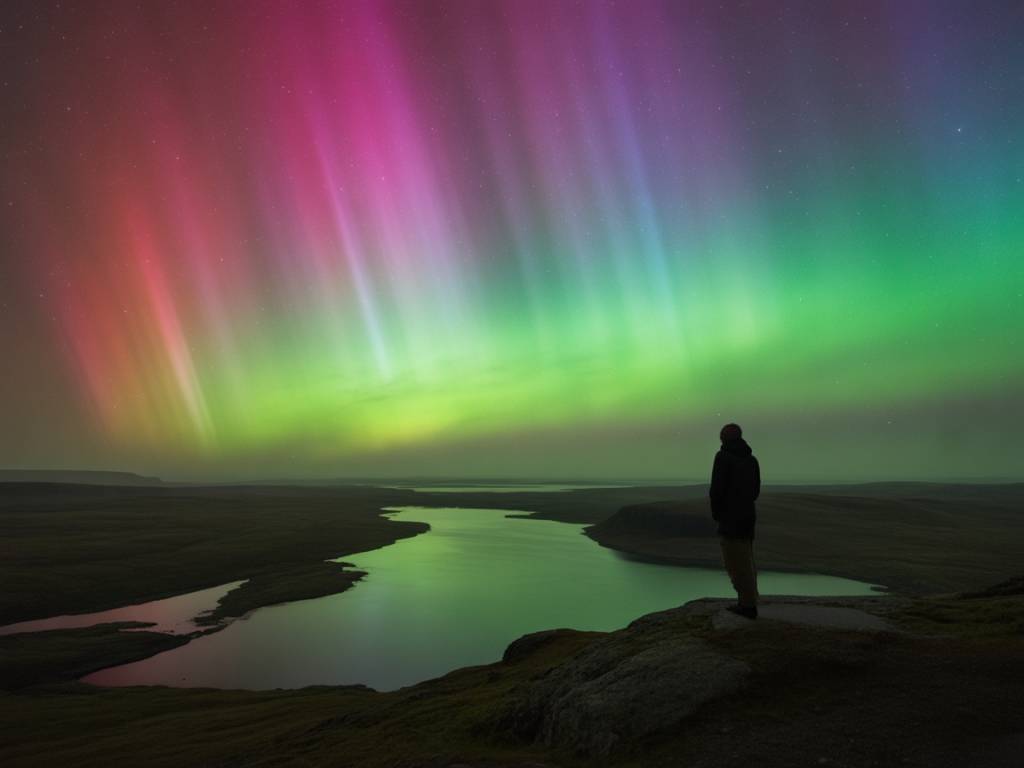
Seeing the aurora from inside a city is a bit like trying to watch a movie while someone shines a flashlight in your face. It’s possible, but you have to be smart about where you stand. The good news: in most towns and cities, you don’t need to drive three hours into the wilderness to get a decent shot at the northern lights. You do, however, need to choose your spot carefully.
In this article, I’ll walk you through a simple, field-tested method to find a solid aurora-watching location in or near your city, with three priorities in mind: minimal light pollution, a clear view of the right part of the sky, and a safe, practical setup you can actually use when it’s -10°C and windy.
Know where to look: direction and height of the aurora
Before you even open a map, you need a basic idea of where in the sky the aurora is likely to appear from your latitude. This protects you from picking a “dark” spot that actually faces the wrong way or has the view blocked.
In the northern hemisphere:
- If you live at high latitude (northern Norway, northern Sweden/Finland, Iceland, northern Canada, Alaska): the aurora can appear almost overhead during moderate activity (KP 3–4) and can spread across the whole sky during strong events (KP 5+). You want as much open sky as possible, 360° if you can.
- If you live at mid-latitude (Scotland, northern Germany, Canada/US border, southern Scandinavia, northern UK): the aurora will usually sit low on the northern horizon during weaker events (KP 4–5) and rise higher only when the Kp index climbs (KP 6+). You mainly need a clean, dark view to the north and northwest.
- If you live further south (northern France, central Europe, US midwest, etc.): aurora is rarer and often sits very low on the northern horizon even during strong storms. You absolutely need an unobstructed northern horizon and minimal city glow in that direction.
Check a compass or a map app before you commit to a spot. I still see people set up facing east because the view is pretty, while all the aurora is quietly dancing behind them to the north.
Step one: read your city’s light pollution map
The fastest way to narrow down possible spots is to look at a light pollution map. You don’t need to become a dark-sky expert; you just want to answer one simple question: “Which direction from the city center gets darker the fastest?”
Use tools like:
- Light pollution maps (e.g. LightPollutionMap.info, DarkSky tools)
- Satellite night-light layers on mapping apps (where available)
When you open the map, look for:
- The brightest core: this is usually your city center – red or white on most maps.
- The gradient of brightness: notice which side of the city shifts fastest from bright to darker colors (yellow → green → blue).
- Pockets of relative darkness: parks, rivers, lakes, industrial zones that shut down at night, and rural fringes.
From there, pick one or two “corridors” where the light pollution fades quickly. For example:
- A river valley heading north, with fewer streets and buildings.
- A belt of fields or wetlands on the edge of the city.
- A coastline, lake shore, or fjord opposite from the city lights.
This doesn’t have to be perfect. Even moving from a bright inner suburb to a darker outer suburb can make the aurora much more visible, especially lower on the horizon.
What makes a good aurora spot inside a city?
From my field notes over the years, here are the core ingredients of a solid city-based aurora location:
- Dark in the right direction: You can’t avoid all lights, but your view toward the north (or overhead at high latitudes) should be as free as possible from direct streetlights, car headlights, and retail signs.
- Open sky: A good spot has low buildings, no big trees blocking the northern horizon, and ideally a slight elevation or open water view so you’re not staring at the back of an apartment block.
- Safe and accessible: A place you can reach quickly at night, park or get off public transport safely, move around without trespassing, and stand still for 1–2 hours without being in anyone’s way.
- Shielded from stray lights: Even if you’re near a road or building, you can often use small hills, embankments, or tree lines to block direct glare while keeping the sky clear.
- Legal to be at after dark: Some parks, school grounds, and private car parks are off-limits at night. You don’t want your aurora session interrupted by a security visit.
If a spot scores well on four out of five of these, it’s probably worth testing during the next clear, active night.
Locations that often work surprisingly well
Every city is different, but certain types of places keep showing up in my notes as “better than they look on paper”. Here are a few to scout in your area.
Waterfronts, riversides and lakeshores
Any stretch of water can help you in two ways: it creates an open horizon and it blocks buildings and traffic between you and the northern sky.
Look for:
- Rivers that flow north–south: Stand on the southern bank and look north across the water, using the river itself as a dark corridor.
- Lakes and ponds on the city edge: Some small lakes in suburbs are dimly lit, with just one or two lamps you can step away from.
- Coastlines pointing away from town: If the main city glow is to your south, find a beach or rocky shoreline with the city behind you and open sky in front.
Field tip: walk the shoreline in daylight first. Note where the brightest lamps are, which sections are accessible in winter, and where you can stand without being drenched by waves or wind-blown spray.
Hilltops, viewpoints and ridgelines
A bit of elevation can lift you above some of the worst glare. However, you need to be picky: many official viewpoints are lit up like stadiums for “safety” or tourism.
The best elevated spots are usually:
- Minor hills and forest tracks with no major monument or restaurant on top.
- Gravel service roads to telecom towers or water reservoirs (only if public access is clearly allowed).
- Low ridges at the urban edge, with fields or forest to the north.
What you’re aiming for is a place where the city glow shines mainly behind you or low on the horizon, but the sky above and to the north is darker. Avoid platforms with decorative floodlights or LED rails – they might look great on Instagram, but they will wipe out your night vision.
Urban parks and green belts
Large city parks are rarely “dark” in an absolute sense, but they can still be much better than surrounding streets if you choose your spot carefully.
Look for:
- The darkest corner of the park, away from main paths and playgrounds.
- Small clearings or sports fields facing north, where you can stand with the lights behind you.
- Raised embankments, sledding hills, or river levees that hide the nearest road or car park lights.
Check local rules: some parks close at dusk, others allow quiet use all night. In winter, parks also tend to be icy and unmaintained, so bring proper footwear and a headlamp you can switch to red mode to preserve your night vision.
Car parks and roadside pullouts (used wisely)
Car parks aren’t romantic, but they are practical. Many of my “emergency” aurora sessions around cities start from a supermarket or sports-center car park on the edge of town.
Good candidates include:
- Car parks overlooking a valley or field to the north.
- Small roadside lay-bys on minor roads, especially those on a slope facing away from the city.
- Industrial-zone car parks that are mostly empty and dimly lit at night (check signs for time limits).
Two key rules here:
- Don’t block access or park in spaces reserved for residents, trucks or emergency vehicles.
- Once parked, move a little away from your car and any bright lamps – even 20–30 meters can make a difference.
From a technical standpoint, a car-based location is valuable because it gives you a warm retreat, extra gear storage, and a quick escape if the weather changes or the aurora fizzles out.
How to check a spot in advance (without wasting a clear night)
Instead of waiting for the “big night” to test everything, do a quick scouting run on any clear evening, even without aurora forecast.
Here’s what to check in 10–15 minutes:
- Light sources: Stand where you would for aurora and slowly turn 360°. Are there any lamps shining directly toward your eyes? If yes, can you move a few meters to block them with a tree, hill, or building corner?
- Sky quality: Look north and overhead. Can you see the main constellations clearly? If you struggle to see more than the brightest stars, you’re probably too close to the glow.
- Obstacles: Any tall trees or buildings right on the northern horizon? Remember that low aurora arcs can sit just 5–10° above the horizon.
- Safety and comfort: Is there a safe place to stand off the road? Is the ground flat and not too muddy or icy? Are you likely to attract unwanted attention?
Make quick notes on your phone: GPS coordinates, parking options, and any “must-avoid” angles or lamps. These notes save a lot of time later when the aurora alert pops up and you have 30 minutes to decide where to go.
Using city lights to your advantage
We usually treat city light as the enemy, but sometimes it can help you.
- Silhouettes and reflections: If you’re photographing, a faint city glow behind a line of trees, a church or a bridge can create nice silhouettes against the aurora. Similarly, reflections on a river or wet pavement can add interest while the sky stays relatively dark.
- Shielding glare: A low building behind you can block the worst of the city glare, acting like a big “light shield” for your eyes while you look above it.
- Orientation cues: A brightly lit tower or landmark to your south can help you quickly check that you are indeed facing north without pulling out a compass every five minutes.
The trick is to keep those lights low in your field of view and behind you if possible, while the part of the sky you care about stays free from direct beams.
Weather, clouds and microclimates inside the city
Even a perfect dark spot is useless under solid cloud. In cities, cloud patterns can shift quickly due to local topography and heat islands. Here’s how to give yourself better odds:
- Use short-range cloud forecasts: Look at high-resolution weather models and satellite loops 2–3 hours before your outing. Focus on low and mid-level cloud cover, not just generic “cloudy/clear” icons.
- Know your local “wind corridors”: In many cities, certain valleys, rivers or coastlines tend to clear first when a wind picks up. If your river valley usually gets less fog or cloud at night, that’s where you head.
- Stay mobile: If you are using a car, plan 2–3 backup spots within a 15–30 minute drive, ideally in slightly different directions (northwest vs northeast) to dodge local cloud banks.
Remember that the aurora can be patchy and brief. Being already positioned in a reasonably dark, clear spot before it intensifies is far more effective than trying to chase it once everyone on social media is posting green skies.
Safety, etiquette and realistic expectations
A few last points that matter just as much as the technical ones.
- Stay visible to traffic: If you’re near roads, use a reflective band or a dim red light to ensure drivers can see you without destroying your night vision.
- Respect residents: Avoid shining bright headlamps into windows, shouting in the middle of housing estates, or blocking private driveways. The fewer complaints locals have, the easier it is for everyone to enjoy future aurora events.
- Be honest with your expectations: In or near a city, you’re rarely going to see the ultra-bright, multicolored, full-sky displays you see from remote Arctic locations. What you’ll often get are faint arcs, subtle pillars and short bursts of brighter movement. These are still special – but they’re not always the postcard version.
- Dress for staying still: City aurora watching usually involves long periods of standing still, not hiking. Prioritize warm boots, extra layers and decent gloves over stylish city clothes.
If you can accept that some nights you’ll only see a faint green band, and a few times a year you’ll get that one explosive show, the whole process becomes much more enjoyable and less stressful.
In the end, the “perfect” city aurora location doesn’t need to be dramatic. A modest riverbank, a quiet hill, or a dim car park on the northern fringe of your town can be enough – as long as it’s dark in the right direction, has open sky, and lets you relax instead of fighting glare and traffic. Spend a little time scouting before the next active night, and your odds of actually enjoying the show – instead of just chasing it – will increase sharply.