


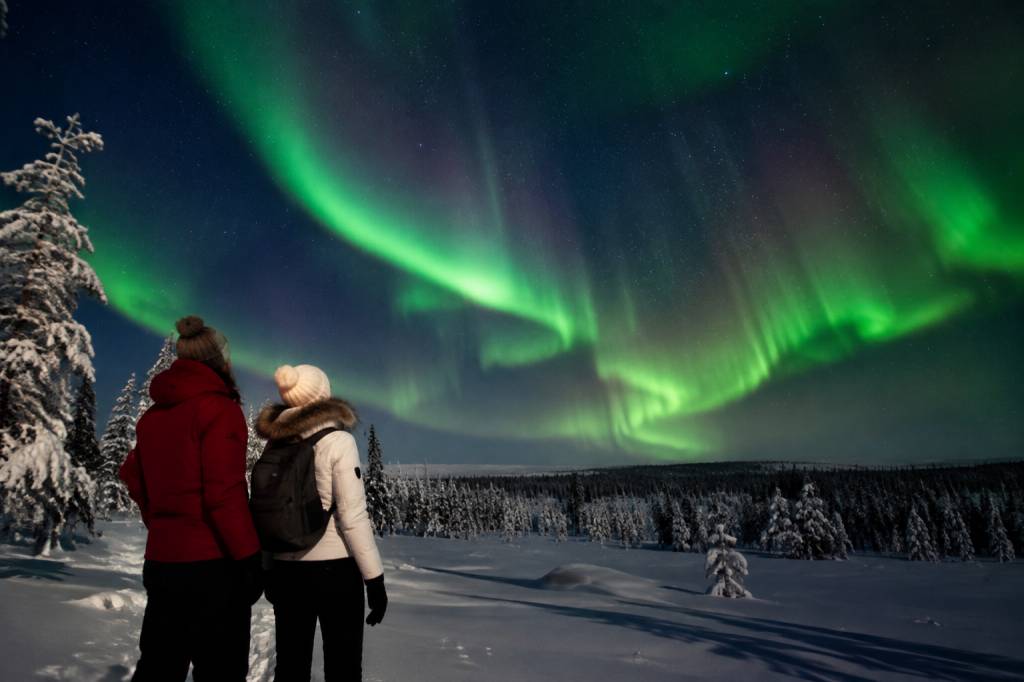
A Lapland aurora tour can mean a short evening drive from a resort, a full night chasing clear skies, or several days based above the Arctic Circle. The best choice depends less on finding a “perfect” forecast than on timing your trip well, staying flexible and knowing what the forecast can—and cannot—tell you.
Lapland stretches across northern Finland, Sweden and Norway, and conditions vary widely between them. A cloudy sky over one town does not mean the whole region is cloudy. Here is when to go, what a tour is really like, and how to give yourself a sensible chance of seeing the northern lights without expecting the sky to follow a timetable.
When is the best time to visit Lapland?
The aurora season generally runs from late August or September to early April, when nights are dark enough for the lights to be visible. The exact dates depend on your location and the amount of darkness. In high summer, northern Lapland has very bright nights and, in some places, the midnight sun; even strong aurora activity cannot be seen against a bright sky.
For many visitors, September to October and February to March are practical choices. Autumn can bring milder temperatures and dark nights, while later winter offers longer evenings and established snow cover. December and January are also popular, especially for travelers combining an aurora hunt with Christmas activities, but expect short daylight hours, cold conditions and busy resort periods.
No month guarantees a sighting. The aurora depends on solar activity, darkness and clear skies lining up at the same time. A bright moon does not prevent the lights from appearing, although it can make faint auroras and stars less striking. If you can choose your dates, plan for at least three nights in the region. That gives you several opportunities to work around cloud and changing conditions.
Choose your base with the weather in mind
Lapland is not one small viewing area. Travel times can be long, and the weather can change between inland and coastal locations. Before booking, check where your accommodation sits, how far it is from open, dark countryside, and what transport is available after sunset.
-
Rovaniemi, Finland: A convenient base with an airport, accommodation and tour operators. It is a good option for a first Arctic trip, but the town’s lights and cloudy skies can affect viewing. Many tours drive away from the central area when conditions allow.
-
Saariselkä and Inari, Finland: These northern bases offer access to dark landscapes and a strong choice of wilderness activities. Distances between villages and services can be significant, so check transport arrangements before relying on a late-night taxi.
-
Abisko and Kiruna, Sweden: Visitors often choose this area for its mountain scenery and access to national park landscapes. Local conditions still matter: a reputation for clear weather is not a forecast, and clouds can settle in at any destination.
-
Tromsø and nearby northern Norway: This is a popular base for aurora trips, with mountain and coastal scenery. Coastal weather can be changeable, so operators may travel inland or to another viewing area when the forecast points to better conditions.
Do not pick a base only because it appears in a famous aurora photo. A practical base has accommodation, reliable transport and more than one place to try when clouds move in. Ask tour providers how far they usually drive, whether that decision is based on live weather information, and what happens if roads become unsafe.
How to read an aurora forecast
Three factors matter most for a viewing attempt: a dark sky, clear or partly clear weather, and aurora activity overhead. You do not need to become a solar physicist. A simple check of local cloud cover and an aurora activity forecast is enough to guide your plans, provided you understand their limits.
-
Cloud cover: This is often the immediate obstacle. A strong aurora above thick cloud is still invisible from the ground. Look at the forecast for the specific place and hours you will be outside, not just a regional daily summary.
-
KP index: This estimates geomagnetic activity on a scale from 0 to 9. Higher readings can suggest that auroras may be visible farther south, but KP is not a local “lights on” switch. A low reading does not rule out a display in northern Lapland, and a high reading does not guarantee clear skies or a visible show.
-
Darkness and light pollution: Move away from streetlights and bright buildings when practical. The darkest part of the night can be useful, but auroras can appear at other times too. There is no single guaranteed viewing hour.
-
Solar wind and short-term updates: These can help explain changes in activity, but forecasts are uncertain. Treat them as clues, not a promise that a display will begin at a particular minute.
A forecast is a planning tool, not a booking confirmation from the sky. Check updates before you leave, then pay attention to conditions on the ground. If a nearby area is clear, a short move may be more useful than waiting under an unbroken cloud layer.
What happens on an aurora tour?
Most evening tours begin with a pickup or a meeting point in town. The guide checks the forecast, chooses a viewing area and drives away from the brightest lights. Some tours stay near a single site; others are mobile and may travel farther in search of clearer skies. A typical outing includes time outdoors, help spotting the aurora and a return to town later in the evening.
Ask what is included before you book. Some tours provide thermal overalls, hot drinks or a small meal; others expect you to arrive fully dressed and bring your own snacks. Check the expected duration, maximum driving time, group size, cancellation policy and whether the operator offers a second attempt if the weather is poor. A “chase” can involve several hours in a vehicle, so it is worth knowing what the experience actually looks like.
Guides can help interpret forecasts and find safe, dark places, but they cannot control the weather or promise a sighting. Be wary of any description that guarantees the aurora. A responsible operator should explain the uncertainty clearly and have a plan for cloud, cold and road conditions.
On a clear night, the first signs may be subtle: a pale band or a faint grey-green patch that looks like a cloud. Give your eyes time to adjust and avoid staring at your phone. A camera may record colour before it is obvious to your eyes, particularly when activity is weak. If the display strengthens, it can ripple, brighten and shift across the sky—but some nights the lights remain quiet.
What to wear and bring
Standing still in Arctic weather feels colder than walking around town. Dress for the time you expect to spend outside, not just the short walk from your hotel to a vehicle. Layers let you adjust if you are moving, waiting or sitting beside a fire.
-
Base layer: Wear wool or synthetic fabric next to the skin. Avoid cotton, which holds moisture and can leave you feeling cold.
-
Insulating layers: Add fleece, wool or another warm layer, then a windproof outer jacket and trousers. A tour may provide extra overalls, but do not assume they replace your own layers.
-
Hands, feet and head: Use warm gloves or mittens, a hat that covers your ears, and insulated boots with room for warm socks. Tight boots can make cold toes worse.
-
Useful extras: Pack hand warmers, a small snack, water, a headlamp with a red-light setting and a power bank kept warm in an inner pocket.
Bring a tripod if you want to photograph the aurora. A phone can capture a bright display in night mode, but hold it steady or use a small tripod and turn off flash. Keep spare batteries warm; cold drains them quickly. Most importantly, take a few minutes to watch without a screen. The memory is better when you are looking at the sky, not only checking whether the camera is focused.
Planning around cloud and changing conditions
Build flexibility into your itinerary. If your only free evening is the night of arrival, a delayed flight or cloud could remove your best opportunity. Staying several nights makes it easier to shift your tour, try a different area or take a break after a late return.
For a practical routine, check the local cloud forecast in the afternoon, confirm the tour’s meeting time and ask whether the operator is adjusting its route. Recheck conditions before departure. If the guide decides to change direction, allow time for the drive and follow instructions at stops. Arctic roads may be icy, visibility can deteriorate, and a photo opportunity is never a reason to leave a safe parking area or walk onto a road.
If you have a rental car, do not assume you should chase the aurora independently. Check winter driving requirements, road conditions and local advice first. Keep fuel, warm clothing, a charged phone and emergency supplies in the car. Avoid stopping on narrow roads, blocking traffic or driving into unfamiliar terrain just to escape a few lights. When conditions are poor, staying with an experienced local driver is often the calmer option.
If the sky stays cloudy
A cloudy forecast does not automatically mean a wasted evening, but it does change your options. Ask your hotel or tour operator whether another area is realistically within reach. A clear patch may be nearby—or the cloud may cover the wider region. Driving farther is not always useful, particularly if the road forecast is poor.
If no safe viewing area is available, use the evening for a warm indoor activity and keep another night open. Some towns offer museums, saunas, restaurants and other winter experiences that do not depend on the sky. You can also step outside briefly if cloud breaks appear, but dress properly and stay near your accommodation unless you have a safe transport plan.
Lower expectations can make the experience better. You might see a bright, moving aurora, a faint glow on the horizon, or nothing at all. Each outcome is possible, even on a trip planned carefully. The northern lights are a natural event, not a scheduled show.
How to choose a tour that suits you
Compare tours by their operating plan, not by dramatic photographs. Useful questions include: Where does the tour normally go? How does the guide decide where to drive? What is the maximum time in the vehicle? Are warm clothes included? Can you reschedule if the forecast is poor? What is the refund policy if the tour is cancelled for safety reasons?
Think about the kind of night you want. A small-group chase may offer more flexibility and time to ask questions, while a larger excursion can be a straightforward introduction. Families should check minimum ages, toilet access and how long children are expected to wait outdoors. Travelers with limited mobility should ask about vehicle access, walking distances and the surface at viewing stops.
When the forecast is uncertain, book an early night in your stay rather than waiting until the last evening. If the first attempt is cloudy, you still have time to try again. That small planning decision can reduce a lot of stress.
Set up a realistic aurora trip
A good Lapland aurora tour combines dark skies, local weather knowledge, safe transport and enough time in the region to adapt. Choose a base that fits your travel plans, stay for several nights if possible, and judge each evening by cloud cover as well as aurora activity. Dress for standing outside, keep your camera simple and follow local guidance on roads and viewing spots.
Then give the sky room to surprise you. Some nights begin with a faint arc and end in a moving display; others deliver stars, silence and a long drive back. Both are part of travelling in the North. The best preparation is not a promise of success, but a flexible plan that lets you make the most of whatever the weather allows.