


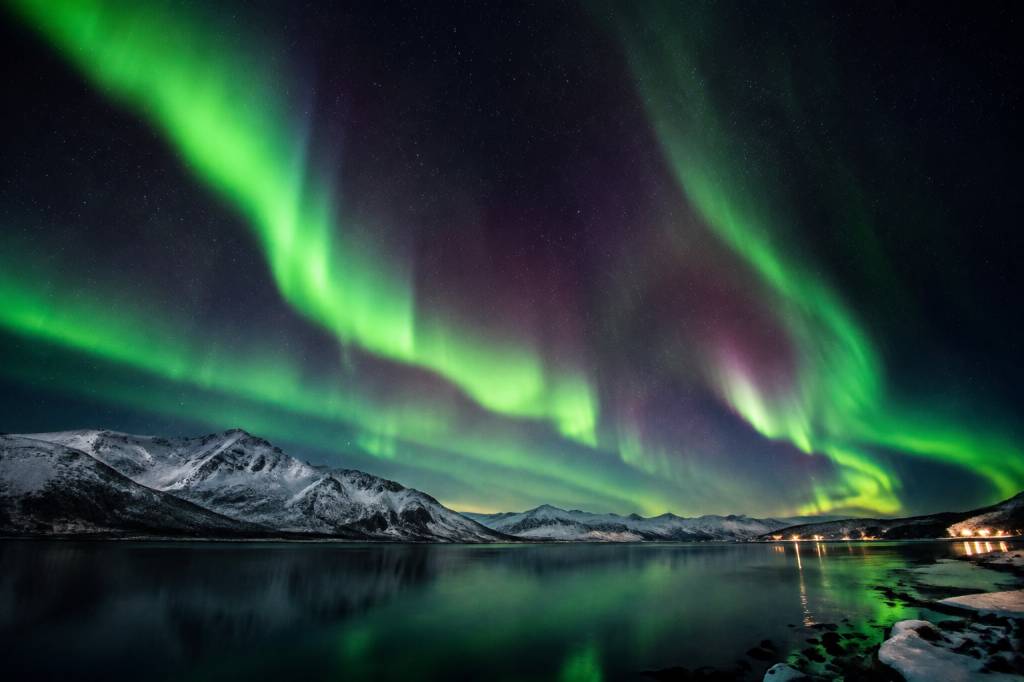
“Northern lights forecast tomorrow” sounds like a simple question. In practice, a useful answer needs three things: aurora activity, clear skies and a dark viewing spot. A strong solar forecast cannot shine through thick cloud, and a clear night under a quiet aurora may offer little more than stars. Check all three before you choose where to go.
I can’t verify tomorrow’s live conditions from here, so this guide does not promise that the aurora will appear in a particular city. Instead, it shows you how to read the latest forecast and turn it into a practical plan. Forecasts change, especially cloud cover, so check again on the day and keep a backup location in mind.
What “tomorrow’s aurora forecast” actually tells you
Aurora forecasts combine several kinds of information. Solar activity indicates whether energy from the Sun may reach Earth. The geomagnetic forecast estimates how strongly Earth’s magnetic field may be disturbed. Local weather tells you whether you can see the sky at all. Your location and the darkness of the night complete the picture.
The most familiar number is the Kp index, which runs from 0 to 9. Higher values generally mean stronger geomagnetic activity and a greater chance of seeing auroras farther from the polar regions. But Kp is not a local visibility score. A Kp value of 5 does not mean “five out of ten chance of seeing the lights,” and it does not account for the clouds above your parking spot.
Think of Kp as a broad signal, not a promise. Near the Arctic Circle, auroras can appear during relatively modest activity. Farther south, stronger activity is often needed, but even a high Kp forecast can disappoint if the sky is overcast or the aurora arrives during daylight.
Where to look tomorrow
Your best destination depends on where the auroral oval is expected to be and, just as importantly, where the sky is clear. For many travellers, northern Norway, Sweden, Finland, Iceland, Greenland, Alaska and northern Canada offer good geographic access to the aurora. These are not guarantees: local weather and seasonal darkness still matter.
If you are already in a northern city, start by checking the cloud forecast around the city and in nearby areas. A short drive may take you out from under a cloud bank, but the clearest patch can also be farther away than expected. Do not set off on a long journey based only on a colourful aurora map.
In northern Norway, towns such as Tromsø can be useful bases because they have transport, accommodation and access to several directions for a weather-dependent outing. In Iceland, Reykjavík offers a range of services, but light pollution and cloud cover can make a darker location outside the city more appealing. In Finnish Lapland, a clear opening near your accommodation may be more practical than driving across the region. The right choice is the one that combines clear skies, safe access and a realistic return plan.
If the forecast shows stronger activity than usual, people at lower latitudes may have a chance to see auroras too. Treat this as a possibility rather than a travel guarantee. Check an aurora oval forecast and local sky conditions, then choose a dark site with an open view to the north where appropriate.
When to go outside
Auroras can occur at any time during darkness, but many observers watch the hours around local midnight. That is a useful starting point, not a strict schedule. Activity may increase earlier or later, and the best interval can be brief. If the sky is clear and the aurora forecast is promising, give yourself more than one short look.
Check the forecast’s time zone. Some aurora and space-weather services display time in UTC, while your weather app uses local time. A forecast labelled “tomorrow” can also refer to a different calendar day if you are travelling across time zones. Confirm the date, the time zone and your local hours of darkness before making plans.
In winter at high latitudes, darkness lasts long enough to give you several opportunities, but cold and fatigue matter. In late spring and summer, parts of the far north have very little darkness, or none at all. Even active auroras are difficult or impossible to see against a bright sky. Check local sunset, twilight and sunrise times; the presence of a dark viewing window is essential.
How to check the forecast without getting lost in graphs
You do not need to interpret every solar data chart. Use a short checklist and compare sources that answer different questions:
-
Check a geomagnetic forecast, such as the NOAA Space Weather Prediction Center’s aurora information, for expected activity and the approximate viewing region.
-
Check a local weather service for cloud cover, precipitation, wind and temperature. For Iceland, use the Icelandic Meteorological Office; in Norway, Sweden or Finland, consult the relevant national weather service.
-
Check the local sunset, twilight and moon phase. A bright Moon does not prevent an aurora, but it can make faint displays and stars less noticeable.
-
Check road conditions and transport schedules before choosing a remote viewing point. Weather and road information can change faster than your travel plan.
Look at cloud cover at the scale of your intended trip, not just the icon for the nearest city. A city forecast may show clouds while a nearby coast or valley has a clear gap, or the reverse. Hourly forecasts and satellite images can help you spot a possible opening, but neither removes uncertainty. Recheck shortly before you leave.
Clouds matter more than a perfect Kp number
For an observer on the ground, cloud cover is often the deciding factor. A moderate aurora under clear skies is visible; a powerful display behind a solid cloud layer is not. If the forecast is cloudy where you are, look for a reachable clearer area before you decide to cancel.
Do not chase a tiny clear patch across an unfamiliar region without checking the route. A cloud gap may close before you arrive. Mountain roads, icy surfaces, strong winds and limited winter daylight can make a “quick detour” a poor trade. If the clearer area is several hours away, consider whether the likely viewing window is long enough to justify the drive.
One practical approach is to choose a primary location and one backup within a manageable distance. Set a time to reassess the weather, rather than refreshing apps every few minutes. That gives you a decision point and helps reduce forecast stress: you are monitoring conditions, not trying to control them.
Find a dark, accessible viewing spot
Once the sky looks promising, move away from bright streetlights where it is safe to do so. You do not need a famous viewpoint or a dramatic mountain backdrop. A clear view of the sky, a stable place to stand and a legal, accessible parking area are more useful than a photogenic location with a difficult approach.
Before leaving, check whether the site is open at night and whether parking is permitted. Avoid stopping on narrow shoulders, blocking gates or walking onto roads to frame a photograph. In snow or ice, use marked paths and carry a light you can switch on when moving around. Keep enough battery and fuel for the return journey, and tell someone where you are going if you are heading to an isolated area.
At the site, give your eyes time to adjust to darkness. Keep phone screens dim and avoid shining a bright flashlight into other people’s faces. The aurora may first look like a pale, grey-green haze to the naked eye; a camera can show more colour than you see directly. Do not mistake every light cloud for an aurora, but do not dismiss a faint display just because it is not glowing like a travel poster.
What to bring for a night outside
Waiting is part of aurora watching. A forecast can point you toward the right place, but it cannot make the night warmer. Dress for standing still in cold conditions, not for a brisk walk from the car.
-
Wear warm layers, including a windproof outer layer, hat, gloves and insulated footwear.
-
Bring a charged phone, an offline map and a power bank kept warm inside a pocket.
-
Carry a headlamp or flashlight, but use a low setting when walking near other observers.
-
Pack water and a warm drink, and bring any medication you may need.
-
If driving, keep winter essentials in the vehicle and follow local advice about tires, road closures and weather warnings.
For photographs, a tripod helps with long exposures. A phone’s night mode can also capture the display, but take a moment to look up rather than watching the entire night through a screen. The memory does not need a perfect exposure.
What if tomorrow’s forecast looks weak?
A low forecast does not always mean “no aurora,” especially at high latitudes. The aurora can appear during quieter conditions, and short-lived changes may not be captured in a forecast issued well in advance. If you are already in the north and the sky is clear, checking outside can be worthwhile.
If activity is low and cloud cover is poor, adjust your expectations rather than making a risky drive. Look for another night in your trip, choose a local dark site if conditions improve, or enjoy the evening without treating the aurora as the only measure of success. Northern destinations offer plenty to do when the sky is cloudy; a good trip should not depend on one uncertain display.
Travellers planning a dedicated aurora trip should, where possible, allow several nights in the region. More nights give you more chances to find a combination of darkness, clear skies and auroral activity. They do not guarantee a sighting, but they are a better strategy than flying in for one night and expecting the forecast to behave on schedule.
A simple plan for tomorrow night
Use this routine on the day you plan to observe:
-
In the afternoon, check the aurora forecast, local cloud cover and hours of darkness.
-
Choose a primary viewing spot and a nearby backup, checking access and road conditions for both.
-
Recheck the weather and space-weather information before departure, paying attention to the forecast times and time zone.
-
Leave enough time to reach the site safely and settle in before the likely viewing window.
-
If clouds move in, reassess once. Make a sensible change of location only if the route and timing justify it.
-
Keep warm, give your eyes time to adjust and watch the sky rather than expecting the lights to appear at an exact minute.
The most reliable answer to “when and where can I see the aurora tomorrow?” is therefore a practical one: go where the sky is darkest and clearest within safe reach, during local darkness, and stay flexible. Check the latest forecast before you leave. Then give the sky time to do its part.