


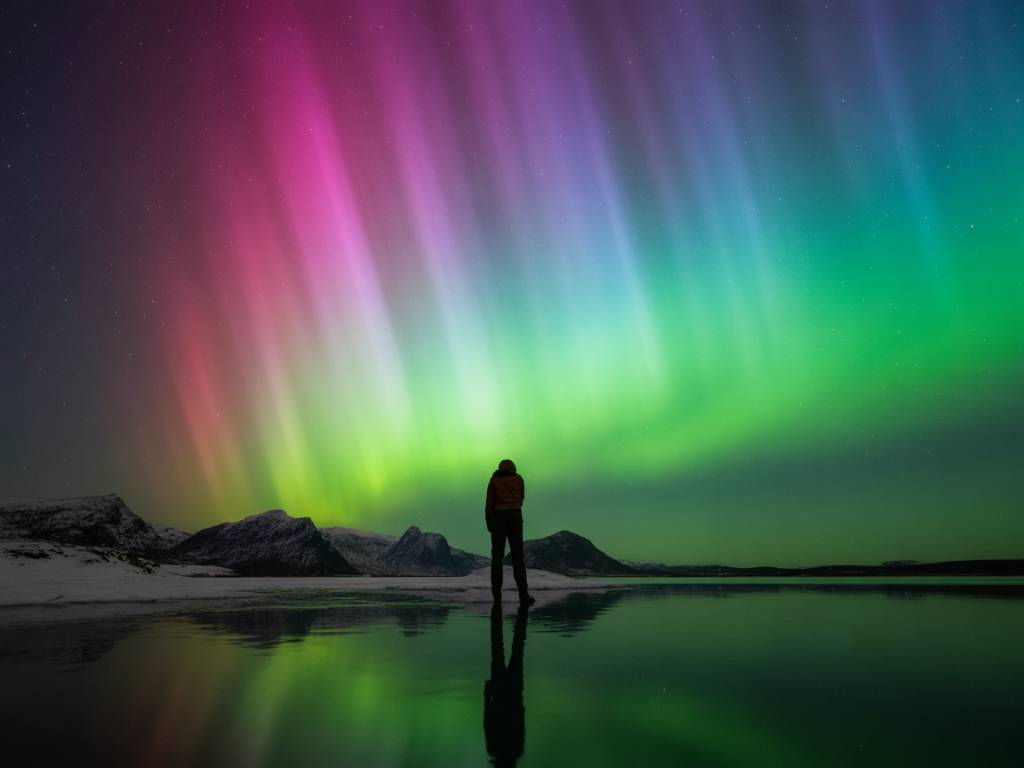
If you’re reading this, chances are you’ve just seen a post about a possible aurora tonight, you’re in or near a city, and you’re wondering: “Is it even worth it to go out?” The answer is: maybe – and you can tilt the odds in your favour with a bit of method and very little time.
In this guide I’ll walk you through a short-notice routine I use on the road and at home. The idea is simple: turn raw KP indexes, cloud maps and vague social media alerts into a concrete plan for tonight from where you actually are.
Reset your expectations (and your stress level)
Before opening any forecast app, it helps to set a realistic frame. Chasing the northern lights from or near a city on short notice is not the same game as booking a week in Tromsø or Iceland in peak season.
On a last-minute city-based chase, your main goals should be:
- Maximise your chances in the 2–6 hours you have available tonight
- Reduce “forecast stress” by using only the data that actually matters for you
- Come back with either aurora photos or at least a clear feeling of “I gave it a proper try”
You’re not trying to “win” against the forecast; you’re trying to make quick, rational decisions with limited time and imperfect data. That’s exactly where a simple routine helps.
The 5‑minute forecast checklist (only what you really need)
On short notice, forget the dozens of parameters. Focus on four: latitude, KP, clouds, and timing.
1. Check your latitude band
Your latitude narrows down the KP you realistically need:
- 60–70°N (Northern Norway, Iceland, northern Finland, parts of Alaska, northern Canada): KP 1–2 can already give visible aurora on a dark night.
- 55–60°N (Oslo, Stockholm, Helsinki outskirts, parts of Scotland, southern Canada): KP 3–4 is typically required; KP 5+ gives good chances even with some light pollution.
- 50–55°N (northern Germany, Denmark, UK midlands, Netherlands, northern US states like Minnesota or North Dakota, southern Canada cities): Look for KP 5+ and preferably 6+ to see distinct structures.
- Below ~50°N (continental Europe, most of the US): You’re in rare-event territory. You need KP 7+ and a very clear northern horizon.
Knowing this keeps you from getting excited about a KP 3 storm in Paris or disappointed by “only KP 2” in Tromsø.
2. Check the KP forecast, but don’t obsess over the number
Use a reliable source (like the NOAA or a trusted aurora app) and look at:
- The next 3–6 hours, not just tonight in general
- Whether the KP is rising, falling, or staying steady
A steady KP 4 for several hours is often better for planning than a brief spike to KP 6 that disappears before you’ve left the city.
3. Cloud cover is usually more important than KP
Even a KP 7 storm does nothing under thick clouds. Open a cloud map (your usual weather app is fine if it shows total cloud cover hour by hour) and zoom in:
- Check coverage between your city and a radius of 50–100 km
- Look for gaps or edges in the cloud field you can drive to
- Note the time window when skies are clearest (e.g. 22:00–01:00)
If clouds are widespread, your best strategy may be: stay flexible, choose the direction where the clearing is expected earliest, and be ready to move again if needed.
4. Timing: when to actually be outside
The northern lights can appear anytime it’s dark, but statistically they’re more active around local magnetic midnight (often between 23:00 and 01:00 local time). On short notice, align three things:
- Darkness (check actual darkness, not just sunset; civil/nautical/astronomical twilight matters at high latitudes)
- Cloud gaps over your area
- Rising or stable KP according to the forecast
When these three overlap, that’s your primary window. Plan your drive or public transport around this block rather than “we’ll just see at some point tonight”.
What you can realistically see from inside a city
City lights don’t make auroras impossible, they just raise the threshold. From inside a medium to large city, you usually need a stronger event (KP 5–7 depending on latitude) to see anything more than a faint wash.
To give yourself a chance without even leaving town:
- Find an open area with a clear view to the north: riversides, harbours, hilltops, parks, or rooftop terraces
- Get away from direct streetlamps and bright billboards; even moving 50–100 m into a darker corner helps your eyes
- Turn off or dim your phone screen while scanning the sky; night vision starts improving within minutes
- Don’t just look up: scan from low over the northern horizon up to the overhead sky
In a city, the aurora might first appear as a greyish arc or a subtle veil. Your eyes may not see strong green at first; a quick 1–2 second photo on your phone (night mode off, ISO high, 1–2 s exposure if possible) can reveal the colour before it becomes obvious visually.
When and how to escape to nearby dark-sky locations
If the KP and clouds suggest a decent chance and you have a car or can share a ride, getting out of town is usually the single biggest improvement you can make on short notice.
How far do you actually need to go?
In many regions, 30–60 minutes of driving is enough to cut light pollution dramatically:
- Leave the main urban cluster in any direction that has clearer cloud cover
- Aim for small villages, lakes, or forest edges rather than totally remote mountains if time is limited
- Use a light-pollution map in advance (or right now) to mark 2–3 dark-ish spots within your radius
What makes a good short-notice dark spot?
On a last-minute chase, prioritise logistics over romantic scenery. Look for:
- Easy access: main or secondary paved roads, no complicated off-road tracks or gates
- Safe parking: an official lay‑by, rest area, boat ramp car park, or a wide farm track entrance where you can pull fully off the road
- Open horizon to the north: fields, lake shores, sea cliffs, frozen lakes, or low hills
- Minimal local lights: no big industrial sites, strong farm floodlights, or busy roads right next to you
If you’re doing this often, it’s worth building your personal map of 5–10 known “escape spots” within a 1‑hour radius of where you live. The time to research those is on cloudy or non-aurora nights, not when the KP jumps to 6 at 21:00.
How to plan quickly using online maps
Here’s a simple routine I use from hotel rooms and rented apartments when a surprise aurora chance appears:
- Open your usual map app and locate your city
- Zoom out until you see a radius roughly representing a 1‑hour drive around you
- Look for blue patches (lakes), coastline, or clear open rural areas with few road intersections
- Drop pins on a few plausible spots: lake parking lots, small marinas, panoramic viewpoints, minor road junctions on ridgelines
- Cross-check those pins with a light pollution map in another tab – aim for at least one or two steps darker than your city centre
If possible, do a quick street view check on your top 1–2 spots:
- Is parking obvious and legal?
- Is the northern horizon relatively free of trees and buildings?
- Are there intrusive local lights?
In 10–15 minutes, you can turn a blank map into a very usable shortlist, even in a country you don’t know well.
Gear checklist for a last-minute outing
You don’t need a full expedition kit for a 2–4 hour chase from the city, but missing two or three basics can ruin the night. Think in three blocks: visibility, warmth, and recording.
Visibility
- Headlamp with red light mode (to preserve night vision)
- Small handheld flashlight for the car and ground around you
- Reflective vest or band if you’ll be near roads or parking lots
Warmth and comfort
- Layered clothing: base layer, mid layer (fleece/wool), windproof and waterproof outer shell
- Hat, gloves (and a thin pair you can use while handling a camera or phone)
- Extra socks; standing still on cold ground eats warmth fast
- Hot drink in a thermos – not mandatory, but a morale booster at 01:00
Recording the moment
- Phone fully charged, with enough storage space for long exposures or video
- If you have one: DSLR or mirrorless camera, tripod, and a wide, fast lens (f/2.8 or better)
- Simple manual settings to remember for cameras: ISO 1600–3200, aperture wide open, 2–10 second exposure depending on aurora brightness
Even for a spontaneous outing, tossing a small “aurora bag” into your car or by the door with these basics will save you from repeating the classic mistakes (no gloves, no headlamp, dead battery).
On-site routine: what to actually do once you’re there
You’ve done the forecast check, chosen a spot, and arrived. Here’s a simple step-by-step to make the most of your time.
1. Settle in and adapt
- Park safely, turn off headlights, and avoid leaving hazard lights on if not needed
- Give your eyes at least 10–15 minutes to adapt to the dark
- Scan the entire sky every few minutes, especially the north and overhead
2. Use your phone as a “detector”
If you suspect something faint but aren’t certain:
- Point your phone north on a tripod or stable surface
- Use a night or long exposure mode if available; otherwise set the longest exposure you can (often 1–4 seconds) and high ISO
- Take a shot and check for green or purple structures your eyes may not yet pick up
This is particularly useful in light-polluted areas or early in the night when your vision is not fully adapted.
3. Don’t panic if it “disappears”
Auroral activity often comes in waves or short “substorms” that last 15–45 minutes. It’s common to see a burst of activity, then 30–60 minutes of quieter sky, then another burst.
If the forecast suggests continued activity and the clouds are cooperating, it’s usually worth staying at least 1–2 hours on site rather than leaving immediately after the first lull.
Safety and practical limits on short-notice chases
It’s easy to get carried away by a red KP bar and forget basic safety. A few reminders that matter more than any aurora:
- Don’t drive exhausted, especially at night on winter roads. If you feel drowsy, your best aurora shot is from your bed tonight.
- Avoid stopping on narrow roads with no shoulder; always look for proper pull‑outs or car parks.
- Watch for wildlife (moose, deer, elk) on rural roads in northern regions. Auroras are not worth a collision.
- In very cold conditions, always keep enough fuel, a charged phone, and basic emergency gear in the car.
It’s perfectly acceptable to set a clear “abort time” before you leave home (for example: “If there’s nothing by 01:30, we head back”) and stick to it. Last-minute aurora hunts should be intense, not reckless.
Example scenarios: turning raw data into a quick plan
To illustrate how all this comes together, here are a couple of simplified scenarios.
Scenario 1: You’re in a mid-sized city at 60°N
- Location: outskirts of Tromsø, Reykjavik, or a similar latitude
- Time: 19:30
- Forecast: KP 3–4 steady from 21:00 to 01:00, patchy clouds with clearer skies inland
Plan:
- 19:45 – Check cloud maps and pick a valley or lake area 30–40 minutes inland in the clearest sector
- 20:00 – Pack minimal gear (layers, headlamp, tripod), set navigation to a known parking spot near open terrain
- 20:30 – Arrive, let your eyes adapt, check northern horizon and overhead
- 21:00–00:00 – Stay put, adjusting compositions as needed; clouds may move but KP is steady so patience is rewarded
In this case, escaping the city glow is almost guaranteed to pay off because at that latitude KP 3–4 is often enough.
Scenario 2: You’re at 52°N in a big city
- Location: Berlin, Amsterdam region, Calgary outskirts
- Time: 20:00
- Forecast: KP peaking at 6 from 22:00–23:00 then dropping to 4; clouds mostly clear to the north
Plan:
- 20:05 – Open a light pollution map and locate rural areas 45–60 minutes directly north with clear skies
- 20:15 – Choose a lake or field with road-side parking and a good northern view; share location with someone for safety
- 21:00 – Arrive on-site, set up before peak time, test your camera/phone settings
- 22:00–23:30 – Focus on the northern half of the sky; expect the main structure to sit low or mid-sky, not directly overhead
- 23:30–00:00 – If activity clearly fades with KP dropping, pack up and head back
Here, the difference between staying in the city and driving an hour north can be the difference between “a faint glow above the skyline” and “full arcs and pillars reflected in a lake”.
Keeping it enjoyable, even when it doesn’t work out
Even with perfect planning, some nights will be misses: clouds win, the KP forecast overestimates, or the timing simply doesn’t line up with the few hours you had. That doesn’t mean the outing was wasted.
If you’re starting from your city or a nearby dark spot, each attempt should also be treated as a recon mission:
- You test a new location and decide if it’s worth returning to
- You refine driving times, parking options, and sight lines
- You iron out gear issues (tripod stability, battery life, clothing layers) for the next event
The more you do this, the less “short notice” it feels. On the third or fourth try, you’re no longer improvising; you’re simply executing a plan you’ve already tested in daylight or under clouds.
And when the next alert pops up on your phone at 19:00 saying “strong geomagnetic storm expected tonight”, instead of panicking over KP charts, you’ll know exactly what to do: two or three forecasts to check, one or two escape routes to pick from, a bag ready by the door – and a much calmer drive into the dark.