


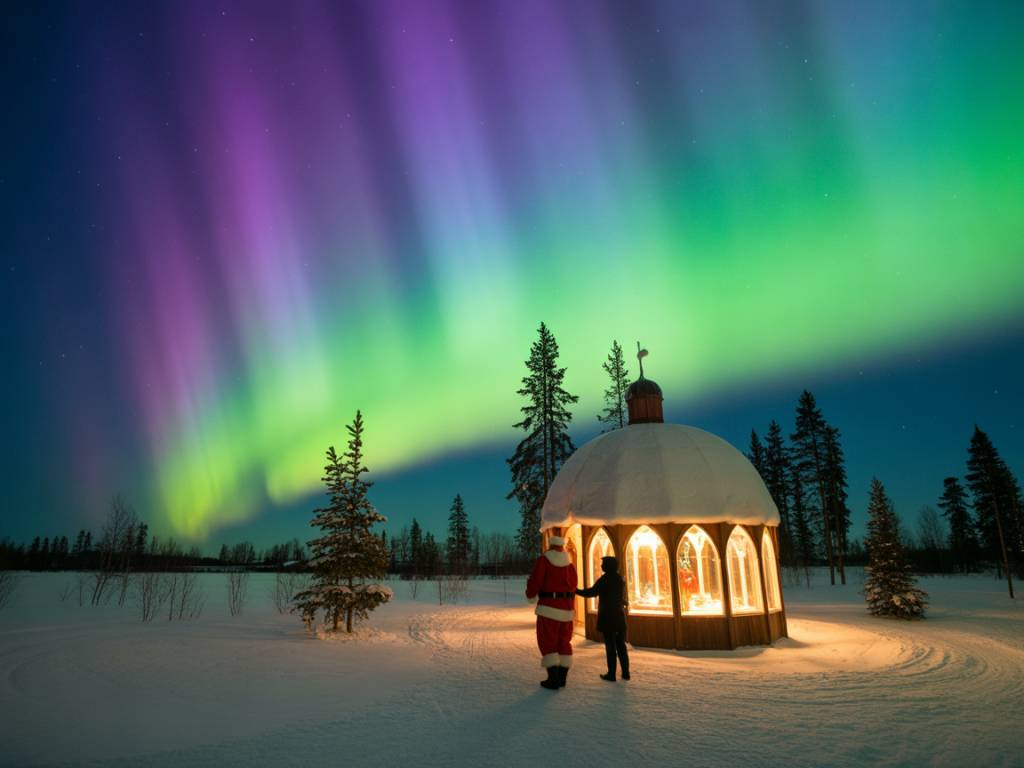
Rovaniemi sells two dreams at once: shaking hands with Santa Claus in his official village, and watching green curtains of light ripple across a Finnish Lapland sky. One of those dreams is essentially guaranteed the moment you book your ticket. The other requires a bit of strategy. This guide breaks down exactly what to expect, when to go, and how to stack the odds in your favour — whether you’re travelling with kids chasing elves or with a partner chasing auroras.
Why Rovaniemi, Finland is a good place to see Santa Claus and Northern Lights
Rovaniemi sits right on the Arctic Circle at approximately 66.5°N — a latitude that puts it on the southern edge of the auroral oval, the ring-shaped zone where geomagnetic activity produces visible northern lights most frequently. It is also the official home of Santa Claus Village, a year-round theme park built around Father Christmas himself.
That combination is rare. Most destinations with strong aurora credentials — Tromsø, Abisko, Inari — don’t offer a ready-made family activity programme during the day. Rovaniemi does. Here’s what the auroral position means in practice:
- Quiet nights (KP 1–2): A faint arc may appear low in the northern sky, often greenish but subtle.
- Moderate nights (KP 3–4): Clearly visible aurora, sometimes directly overhead, with movement and structure.
- Active nights (KP 5+): Full-sky displays, multiple colours, and fast-moving curtains even from within the city area.
You don’t need a major geomagnetic storm to see something memorable. But you do need three things to align: darkness, clear skies, and enough solar activity to light up the oval. The first is entirely predictable. The second is Lapland’s biggest wildcard. The third can be tracked 1–3 days in advance with reliable aurora forecast tools.
Best time of year to visit for both Santa and auroras
The aurora season in Rovaniemi runs from late August to early April — any time the nights are dark enough. For travellers who want the full Lapland experience, the realistic planning window narrows to a few key periods:
- September – October: Mild temperatures (0 to +5°C), early autumn colours, darker evenings, and very good aurora potential. Santa Village is open but far less crowded. Great for adults and light-packing families.
- November: Snow begins to settle, days shorten dramatically, and the Christmas atmosphere starts building. A solid balance of darkness, snow, and manageable crowds.
- December: Peak Santa season. Nights are long and dark, temperatures often drop to −10°C or below, and the village is in full festive mode. Aurora chances are real, but accommodation is expensive and cloud cover can be persistent.
- January – February: Deep winter. Long nights, excellent aurora windows, and bone-chilling cold (−20°C is not unusual). Prices dip slightly after the New Year rush, making it a smart pick for aurora-focused travellers.
- March: Longer days return, but nights are still dark enough and skies statistically tend to be clearer than in midwinter. Snow is usually still thick. Often the best month if auroras are your main reason for coming.
If you want both Santa and a genuine shot at northern lights — especially with children — two windows stand out:
- Last week of November: Snow on the ground, Christmas magic in full swing, reasonable availability, and long dark nights.
- First half of March: Bright days for outdoor play, clear nights for aurora hunting, and a less frantic atmosphere than December.
How realistic is it to see the northern lights in Rovaniemi?
Local guides often say « every second clear night » in winter produces some aurora activity in the Rovaniemi region. That’s an approximation, but it aligns with long-term observations during an active solar cycle. The real limiting factor is almost never solar activity — it’s cloud cover.
Finnish Lapland in winter can be stubbornly overcast. A typical 3-night stay in December might look like this:
- One night fully clouded over — no chance regardless of solar conditions.
- One night with broken cloud — short windows possible, some patience required.
- One night with reasonably clear skies — a proper aurora hunt is on the table.
This is why the single most practical piece of advice for aurora seekers is: book at least 3 to 4 nights. Three nights gives you a fighting chance. Four nights gives you flexibility. Keep at least one evening completely free of fixed plans so you can react quickly when the forecast turns green.
Santa Claus Village and aurora watching: managing expectations
Let’s be honest about something many travel blogs skip over: from the courtyard of Santa Claus Village itself, your chances of a dramatic aurora display are low. The village generates significant light pollution, the surrounding landscape is flat, and the aurora horizon is narrow. This doesn’t mean it never happens — on a strong KP 5+ night, you might catch flickers above the rooftops — but it shouldn’t be your primary viewing strategy.
The smart approach is to use Santa Village as your daytime base and plan your aurora viewing away from it. Two trip templates that work well:
- Family trip (4 nights): Dedicate one full day to Santa Village and Santa Park activities. Book one evening guided aurora tour with transport and a warm shelter included. Keep one evening flexible for self-guided spotting if the forecast looks good. The fourth night is your buffer.
- Couple or solo trip (3–5 nights): Visit Santa during the day, then focus evenings on aurora hunting by rental car or small-group tours. Build in the flexibility to drive toward clearer skies if cloud cover is uneven across the region.
Where to watch the northern lights in and around Rovaniemi
Light pollution in the city centre is strong enough to wash out faint displays. On a very active night you may spot a glow from anywhere, but for a proper experience you need darker surroundings. Here are the most practical options, organised by access type.
Spots accessible without a car
- Arktikum riverbank: Walk 10–15 minutes from the city centre toward the Arktikum museum and the Ounasjoki river. Move beyond the main streetlights and find a darker stretch of riverside path. You’ll still see some city glow, but auroral arcs and beams are clearly visible on active nights.
- Koivusaari Nature Trail: A small island just downstream from the centre, offering slightly darker surroundings and a more open sky. Bring a proper headlamp, warm waterproof boots for icy paths, and an offline map — it’s not signposted for night visits. Suitable only in stable conditions and for walkers confident on snowy trails in the dark.
Spots that require a rental car or tour
- Ounasvaara Hill: A few kilometres from the centre, this local ski hill has small parking areas and forest roads that offer noticeably darker skies. Avoid blocking access routes, and be aware that snowploughs and emergency vehicles use the same roads.
- Minor roads toward Vikajärvi or Sinettä: Driving 15–30 minutes out of Rovaniemi on smaller roads opens up a world of roadside lay-bys with very dark skies and open northern horizons. This is the most popular self-drive strategy among experienced aurora chasers in Finnish Lapland. Always assume icy roads in winter — drive slowly, keep wide braking distances, and warm up regularly in the car.
- Guided tours with transport: Most operators based in Rovaniemi drive guests 20–40 minutes out of the city, often to a fixed wilderness camp with a fire shelter, warm drinks, and a guide who monitors the forecast in real time. This is the most beginner-friendly option and removes the stress of navigating icy roads in the dark.
Quick aurora checklist for your Rovaniemi trip
- Check a reliable aurora forecast daily — apps like Space Weather Live or My Aurora Forecast give 1–3 day outlooks.
- Watch the cloud forecast as carefully as the KP index — on cloudy nights, no aurora is visible regardless of solar activity.
- Dress for −15°C minimum in midwinter, even if the forecast says −5°C. Standing still in the dark drops your body temperature fast.
- Plan to be outside between 10 pm and 2 am — peak aurora hours in Finnish Lapland.
- Give your eyes at least 15 minutes to adjust to the dark before deciding « there’s nothing to see ».
- Use manual camera settings if you want photos: ISO 800–3200, aperture f/2.8 or wider, shutter speed 5–15 seconds depending on aurora movement.
Rovaniemi won’t guarantee you a sky full of northern lights — no destination in the world can. But it gives you a compelling reason to be in Finnish Lapland during the aurora season, a solid geographic position on the auroral oval, and enough infrastructure to hunt the lights intelligently while also giving children — and the child in every adult — the magic of meeting Santa Claus in his Arctic home.