When the aurora forecast turns orange or red, I know exactly what happens next in my inbox: “Why was the sky so green last night?”, “What are the purple edges?”, “Is a red aurora stronger than a green one?”
On paper, auroras are just charged particles meeting gases in the upper atmosphere. In the field, standing on a frozen road shoulder in Tromsø at 1 a.m., what matters is: what do these colors mean for you, tonight, in this specific sky?
In this article, I’ll keep the science simple and link every color to what you’re likely to see on a real aurora chase: where to look, when to expect certain hues, and what the colors say about the strength of the storm.
The basic recipe: particles, gases and altitude
Every aurora color comes from the same basic mechanism:
- Charged particles (électrons, protons) arrive from the solar wind.
- They are guided by Earth’s magnetic field into an oval around the poles.
- They collide with atoms and molecules in the upper atmosphere.
- Those atoms and molecules absorb energy, then release it as light.
Two parameters decide the color:
- Which gas is hit (oxygen vs nitrogen).
- At what altitude it happens (about 80–300 km above your head).
Think of the atmosphere as a layered neon sign. Different layers and gases light up with different colors when they’re “switched on” by incoming particles.
Why the aurora is usually green
If you’ve seen one single aurora photo online, you’ve seen green. That’s not an Instagram filter, it’s physics doing its most common trick.
Green auroras mainly come from oxygen atoms around 100–150 km altitude. When energetic electrons hit these oxygen atoms, they emit light at a very precise wavelength: about 557.7 nanometers. Our eyes perceive this as a vivid green.
Why is this color so dominant?
- Oxygen is everywhere in these mid-altitudes of the auroral zone.
- Particle energies in typical storms are perfect to excite this green emission band.
- Our eyes are very sensitive to green, especially in low light, so we notice it first.
On a standard KP 2–4 night around Tromsø, Abisko or Rovaniemi, most of the aurora you see overhead will be this green band. It often appears as:
- A calm arc stretching from east to west.
- Rippled curtains with well-defined edges.
- Fast-moving “drapes” when the storm briefly intensifies.
If you go out on a forecast that looks “average” and the sky is clear, bet on green as your baseline color. Everything else is a bonus.
Where the deep red glow comes from
Every time I post a picture of a pure red auroral arc, someone asks if it’s a sunset effect. It’s not. This red isn’t from the Sun, it’s from oxygen high above 200 km.
At those altitudes, the air is extremely thin. When particles hit oxygen atoms up there, they can trigger another emission line at 630.0 nanometers, which we see as red.
This red behaves differently from green:
- It’s fainter to the naked eye. Long exposures exaggerate it.
- It tends to form a soft, broad glow above or around the main green structures.
- It can appear as an entirely red arc during strong geomagnetic storms, often at lower latitudes (e.g. Scotland, northern Germany, northern US states).
On the ground, under a strong display, you might notice:
- Green curtains with a red “hood” on top, especially when the aurora is near the zenith.
- A faint red dome to the north when the auroral oval is sitting just above your horizon.
One practical tip: if you’re standing outside and you think you’re just seeing city glow, step away from direct city lights and look straight up. If the red is higher and slowly shifting shape, it’s not light pollution, it’s the high-altitude aurora layer doing its job.
What creates the purple and pink edges
Purple and pink are the colors that make people gasp on the spot. They appear in some of the most dynamic parts of the aurora, when the show goes from “nice” to “unforgettable.”
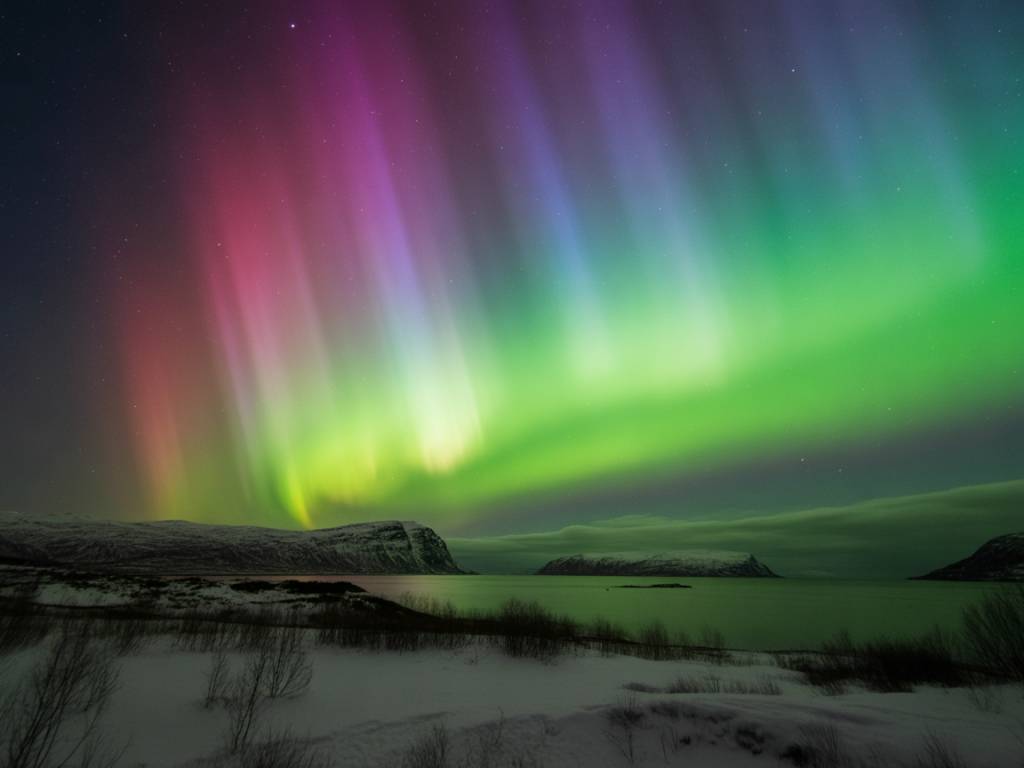
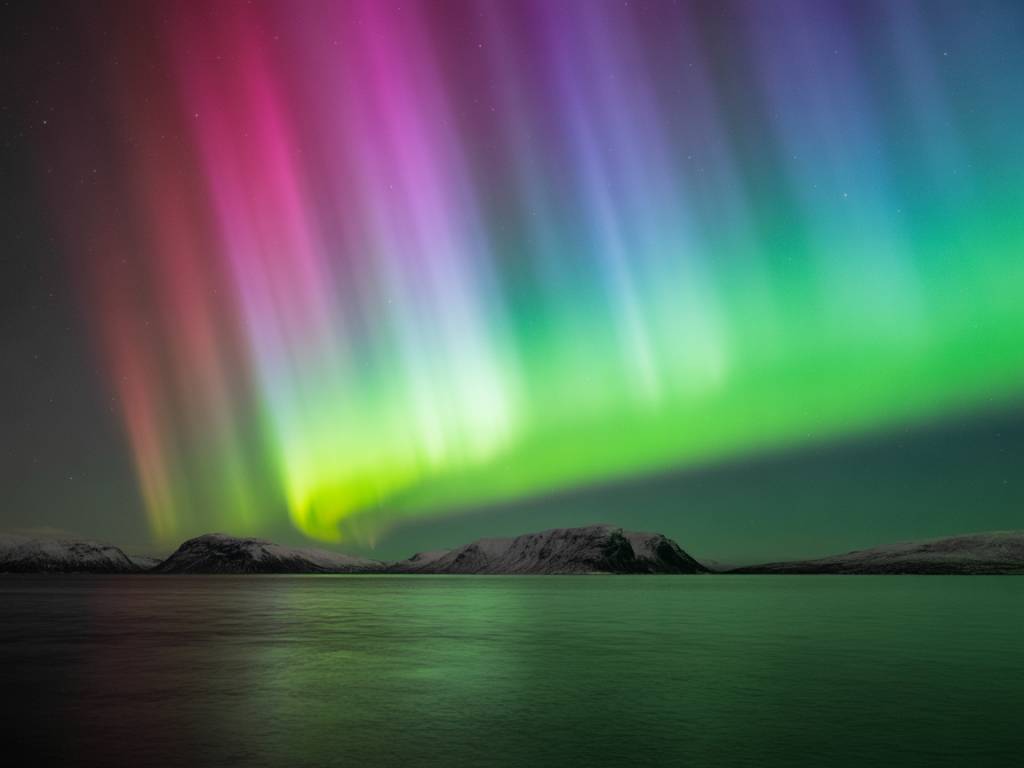
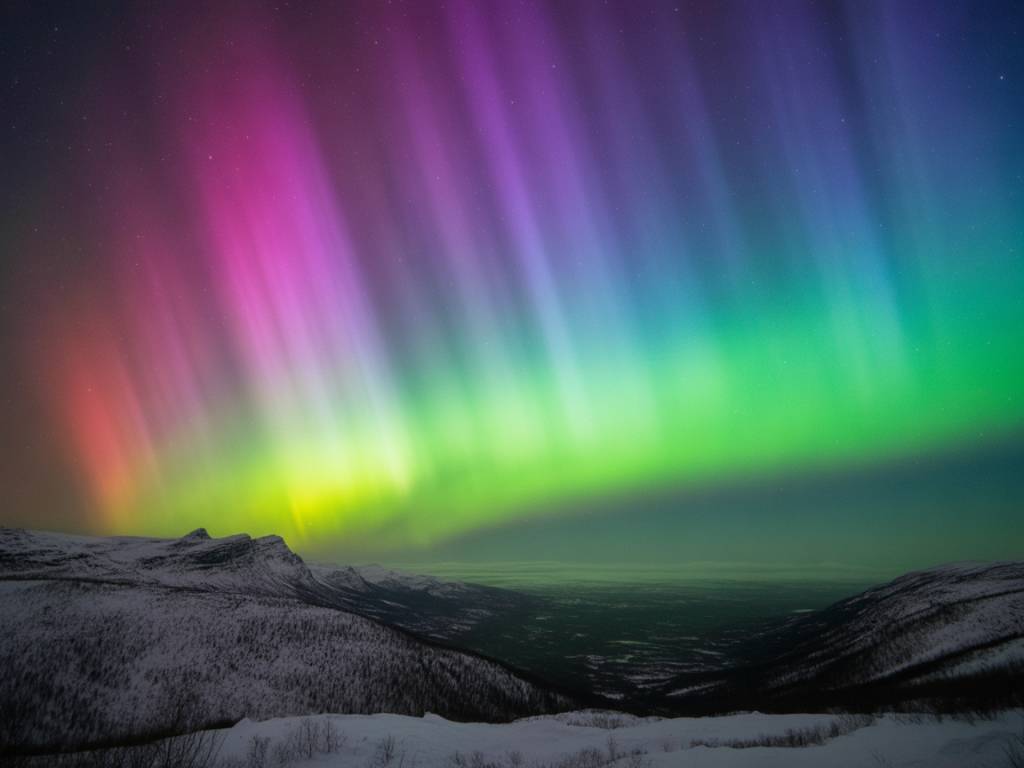
These hues are mostly due to nitrogen molecules, especially at lower altitudes (around 80–100 km). When excited, nitrogen can emit in the blue and violet part of the spectrum. Combine that with green from oxygen and you get purple and pink transitions.
In field conditions you usually see them as:
- Bright purple edges on fast-moving rays.
- Pinkish bottoms of curtains when the aurora dips lower in the sky.
- Short bursts of violet “pillars” during strong substorms.
The key point: these colors almost always signal more energetic activity. When the oval is really fired up:
- Particles penetrate deeper into the atmosphere.
- They reach nitrogen-rich layers.
- The mix of emissions changes quickly with height.
So if you suddenly start seeing purple edges and pink highlights at the base of green curtains, that’s a good sign the storm is intensifying. Cancel the idea of going to bed “in five minutes” and stay out a bit longer.
Rare colors: blue, yellow and “white” auroras
You may occasionally hear about blue, yellow or white auroras. They exist, but they’re less common or often misunderstood.
Blue auroras
Pure blue comes mainly from ionized nitrogen at lower altitudes. It’s usually faint and most visible:
- On photos with longer exposure times.
- On the lower edge of very intense auroral curtains.
- During big geomagnetic storms when the oval pushes far south.
Yellow auroras
Yellow is typically not a separate emission. It’s a visual mix of green and red, often when:
- The red oxygen glow overlaps brighter green structures.
- Cameras with certain white balance settings blend the two.
To your eyes, this often looks like green with a warmer tint rather than a “pure” yellow.
White auroras
This is probably the most common confusion. Many first-timers in Finland or Iceland report a “white cloud” in the sky, which then turns out to be aurora on camera.
There are two possibilities:
- Very faint aurora where your color perception is limited, so it appears greyish or white. Your night vision is more sensitive to brightness than color.
- Very bright, structured aurora with mixed emissions. To the naked eye, all those colors can blend into something that looks almost white, especially along the brightest filaments.
As a rule of thumb: if a “white cloud” is clearly moving, pulsing, or forming vertical structures against an otherwise stable sky, assume aurora and check with a short phone exposure.
How storm strength changes the color palette
KP index, solar wind speed, Bz… it’s easy to drown in numbers. Let’s translate this into something more visual: how stronger geomagnetic activity changes the colors you see.
On a typical trip in the auroral oval (northern Norway, Swedish Lapland, Iceland), here is the pattern I see again and again:
- Low activity (KP 1–2) Mostly green, quite faint, often just a static arc in the north. Red is barely visible, purple extremely rare.
- Moderate activity (KP 3–4) Green brightens, arcs start to dance, occasional red tops when overhead. Brief purple hints on fast rays.
- Strong activity (KP 5+) Structures fill much of the sky. Strong red caps, well-defined purple and pink edges, sometimes blue at the very bottom of the brightest curtains. At mid-latitudes, you may see a red arc to the north without much green.
What actually changes physically?
- The particle flux increases (more particles per second).
- The particle energy increases (they hit harder).
- Particles penetrate deeper into the atmosphere, reaching nitrogen layers.
So more power from the Sun doesn’t just make the aurora brighter; it activates more layers and gases, which broadens your color palette.
Why cameras see more color than your eyes
This is the part that frustrates many travelers: “It looked grey to me but green and purple on the photos.” That’s not your eyes failing; it’s how vision works in low light.
Your retina uses two main systems:
- Rods – very sensitive to low light, but almost color-blind.
- Cones – detect color well, but need more light to be activated.
Under a faint aurora, your rods dominate. You see shapes and motion, but not much color. The camera, on the other hand, can keep its shutter open for several seconds, “collecting” light and color that your eyes can’t integrate over time.
Practically, this means:
- Faint auroras may look greyish or pale green to you, but appear rich green or even purple on a 5–10 second exposure.
- Bright, fast auroras will show strong color to the naked eye, and even more saturation on photos.
Field tip I use with groups: if you’re not sure it’s aurora, take a 3–5s photo at ISO 3200 with any modern phone or camera pointed at that “cloud.” If it’s aurora, you’ll instantly see green or purple on your screen.
Reading the sky: what colors tell you in practice
Understanding the science is nice, but when you’re out in -15°C with batteries dropping fast, you want quick decisions. Here’s how I personally “read” auroral colors in the field.
- Green only, quite faint Activity is present but moderate. I stay near the car or cabin, keep an eye on the real-time data (especially the auroral oval maps and ground magnetometers), and wait for possible intensifications.
- Green with a stable red band above Energy is higher, oval is overhead or slightly south. I look for darker locations and wide horizons because the show might expand rapidly.
- Fast-moving green with purple/pink at the edges We’re in a substorm. Time to stop driving and choose a fixed viewing spot. The most dynamic phase usually lasts 15–45 minutes; don’t waste it relocating unless clouds are closing in.
- Deep red glow low in the north at mid-latitudes You’re likely seeing the top part of the oval from afar. It’s worth staying out and adjusting your expectations: the aurora may never climb overhead but can still be spectacular on photos.
In other words, think of aurora colors as the sky’s own “activity indicators,” more intuitive than KP values once you learn to decode them.
Colors and photography: keeping it realistic
Modern sensors are very sensitive, which is great, but it also means it’s easy to produce unreal aurora colors with a few wrong settings.
To keep your aurora colors close to what the physics actually produce (and what I see on forecasting tools), I recommend:
- White balance: start around 3500–4000 K. Warmer values (5000–6000 K) will push greens towards yellow and reds towards orange.
- Exposure: 3–8 seconds for bright auroras, 8–15 seconds for faint ones. Very long exposures (20–30 seconds) will over-saturate colors and blur structures.
- ISO: 1600–3200 is often enough with modern cameras. Going much higher can add noise and strange tints.
When you review your images, ask yourself:
- Did the aurora really look that neon and saturated to the eye?
- Do the foreground colors (snow, buildings) look natural or radioactive?
If everything looks like a video game, dial back the saturation and contrast. You’ll still keep the greens, reds and purples, but they’ll be closer to what someone next to you would have seen.
Field notes: how color changes over a typical night
To end with something concrete, here’s a pattern I’ve seen on dozens of nights in northern Norway and Swedish Lapland. Times are approximate and based on local time in winter.
- 18:00–20:00 If there’s activity early, it’s usually low and green, a faint arc in the north. Good time to test cameras, scout foregrounds, and let your eyes adapt.
- 20:00–22:00 The arc often brightens and starts to move. You might see stronger green with occasional red tops. On some nights this is the main show; on others it’s just a warm-up.
- 22:00–01:00 This is when many substorms peak. Curtains expand, fill more of the sky, and you get those fast greens with clear purple and pink edges. If the solar wind stays favorable, multiple waves can occur.
- 01:00–03:00 Activity often becomes more intermittent. You may still catch slow, high red glows and softer green arcs, especially if the KP remains elevated and you’re patient.
Of course, real nights don’t follow a strict timetable, but this cycle — from faint green, to dynamic multi-colored structures, to softer red/green mixes — is extremely common during active periods.
Next time you’re under clear polar skies and see the first green arc appear, try to “read” it. Ask yourself: which gas is glowing, at what altitude, and what does this color tell me about what might happen in the next hour? Once you connect the physics to your own field observations, the aurora stops being just beautiful; it becomes readable — like a living, moving forecast above your head.