


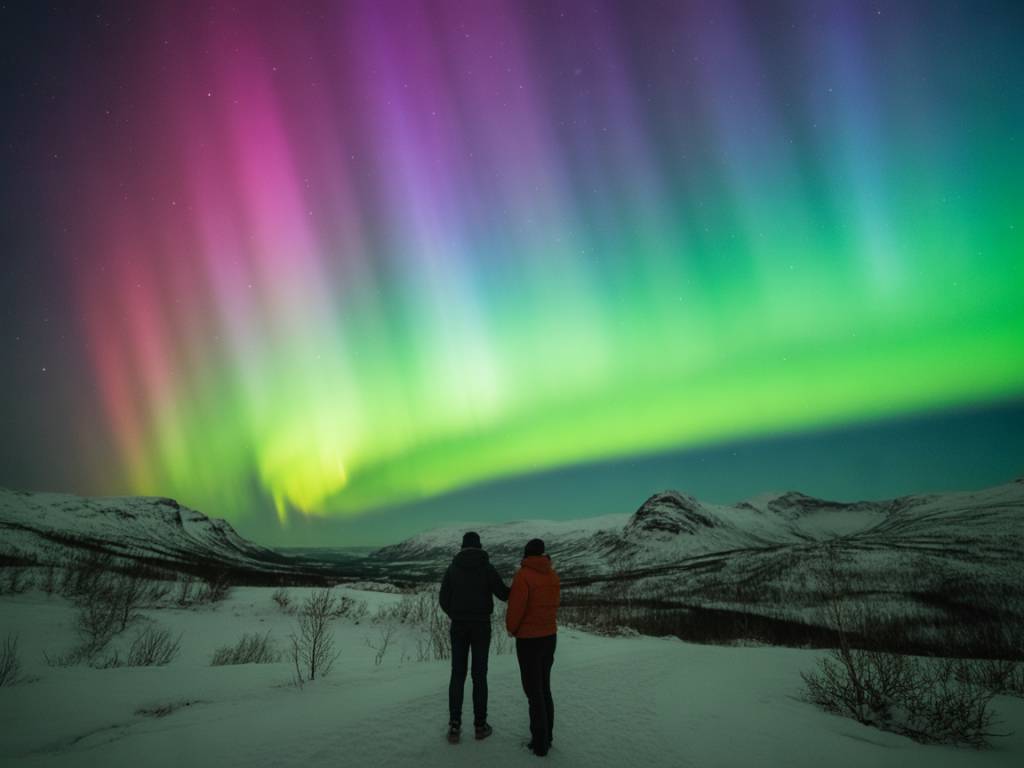
Why northern lights forecasts feel so confusing
If you’ve ever stared at a northern lights forecast and thought, “KP 5, Bz -3, cloud cover 80%… so do I go out or not?”, you’re not alone.
Most beginners make the same forecasting mistakes: they overtrust a single index, misread the maps, or give up too early when the numbers don’t look perfect. The result: missed displays on good nights, ou wasted energy waiting outside on bad ones.
In this article, we’ll go through the most common errors I see from first-time aurora chasers and how to read the data the way an on-the-ground observer does. Think less “space weather geek” and more “practical field guide”: what the numbers actually mean for your evening plan.
Mistake 1: Treating the KP index as a yes/no button
The KP index is usually the first thing people check. It runs from 0 (very quiet) to 9 (extreme geomagnetic storm). The big misunderstanding: KP is not a binary “will I see the aurora / will I not” answer.
Two classic beginner errors:
In reality, KP tells you how far south the auroral oval is expected to extend. At high latitudes (Tromsø, Abisko, Finnish Lapland), you can absolutely see northern lights with KP 1–2, if the sky is dark and clear.
On the other hand, you can have KP 5 over Reykjavik and still see nothing because of full cloud cover or bright moonlight.
How to use KP correctly:
- KP 1–2: Northern Norway, Northern Finland, Northern Sweden, northern Iceland
- KP 3–4: Reykjavik area, southern Lapland, Fairbanks
- KP 5+: Scotland, Baltics, southern Canada, northern US border
Field example: In Tromsø, I’ve had nights with KP 1 where we had stable green arcs for hours, while a separate KP 5 night gave us only faint activity through cloud gaps. Location and clouds beat KP every time.
Mistake 2: Ignoring the clouds because “the KP is high”
This is the most expensive mistake in terms of lost evenings. Someone sees KP 6, gets excited, but doesn’t look at the cloud forecast. They drive to a famous viewpoint… and spend the night under a solid overcast, while 50 km away, the sky is clear and glowing.
High KP cannot punch through thick clouds. Ever.
How to read cloud forecasts for aurora chasing:
- High thin clouds (cirrus): often manageable, aurora can still be visible through them
- Low broken clouds: sometimes workable if you move around and use gaps
- Thick, layered overcast: usually a write-off for that area
Practical routine I use on the road:
This order reduces “weather frustration” a lot. If you’re in Reykjavik and the entire southwest coast is forecasted at 100% clouds, it doesn’t matter if KP is 7 — you either drive north or you stay in and enjoy a hot chocolate.
Mistake 3: Trusting long-range aurora forecasts like they’re precise
Everyone loves planning trips months ahead. So when they see “aurora activity forecast” for next week with specific KP values, they treat it like a weather forecast for Sunday’s picnic.
Problem: beyond 2–3 days, aurora forecasts get very uncertain. Solar wind conditions can change, CMEs (coronal mass ejections) can miss Earth, and high-speed streams can arrive earlier or later than predicted.
How to think about time scales:
For your trip planning, think in terms of nights available, not “the one magical night”. The more dark, flexible nights you have in an auroral zone, the less you depend on long-range guesses.
Mistake 4: Ignoring Bz, Bt and solar wind speed
When people start reading more “advanced” data, they bump into strange letters: Bz, Bt, v (solar wind speed), density. Many ignore them, assuming they’re for physicists only. That’s a missed opportunity: Bz and speed often tell you more about the next hour than KP.
Quick translation into practical terms:
- < 350 km/s: usually low activity, weak displays
- 400–600 km/s: decent potential, common on active nights
- > 600 km/s: often associated with stronger storms and dynamic auroras
- Negative Bz (southward): good, helps connect solar wind with Earth’s field
- Positive Bz (northward): bad for aurora, tends to shut things down
- Stable Bz between -5 and -10 nT for an hour or more is very promising
How to use this in practice on a trip:
- Speed > 450 km/s
- Bz consistently negative
- Some activity in the KP/auroral oval forecast
Then: go out if your sky is clear or partly clear, even if the official KP forecast looks “average”.
On many of my best nights in Finnish Lapland, the KP forecasts were sitting around 2–3, but Bz was locked at -8 to -10 with decent wind speed. On the ground, that translated into explosive substorms every 30–60 minutes.
Mistake 5: Misreading auroral oval maps
Auroral oval maps can be very useful, but they’re easy to overinterpret. One common beginner error is to assume that if your town lies “under the green oval” on a map, you will definitely see aurora overhead.
In reality, these maps are simplified projections. They show a probability distribution, not a sharp edge.
Things to keep in mind when using oval maps:
Practical use:
- Inside the bright core of the oval → good odds, even at low KP
- Near the southern edge → you’ll benefit a lot from higher KP or strong Bz
- Well south of the oval → you need storm-level conditions (KP 6+)
Mistake 6: Focusing only on midnight and missing the best window
It’s true that around local magnetic midnight (often close to 23:00–01:00 local time, depending on longitude) you have good odds. But activity can spike much earlier or later, especially when a CME hits.
Two typical timing mistakes:
In reality, substorms tend to come in waves. You can have 40 minutes of calm, 15 minutes of explosion, another quiet break, then another burst.
How to time your outing realistically:
- 1–2 hours after solar wind conditions suddenly improve
- After faster wind or a CME arrives (you’ll see KP jump, Bz move, speed increase)
On several nights near Abisko, we had the strongest displays between 19:30 and 21:00. Many tour buses arrived later and missed the peak.
Mistake 7: Overlooking the impact of the Moon and light pollution
Forecast sites often focus on space weather, but on the ground, brightness matters. A beginner might see a promising KP value, go out under a nearly full Moon or in the middle of a bright town, and come back saying “there was nothing”. In reality, the aurora was there, just washed out.
Two things to always check alongside your aurora data:
- Full Moon: fine for strong auroras, but weak arcs become hard to see
- Half Moon: manageable; can even light up the landscape nicely for photography
- New Moon: best for faint structures and pillars
- City centres: strong gradient in the sky, aurora must be very intense to stand out
- Suburbs: slightly better, but still not ideal
- Dark sites 10–30 minutes outside town: huge improvement in visibility
Practical tip: use your forecast to pick both time and direction. For example, if you’re in Tromsø with a bright Moon in the south, go to a spot with a clear view to the north and northwest, and try to shield yourself from city lights (small harbour, dark parking area, lakeshore).
Mistake 8: Not planning “escape routes” from bad weather
Many beginners stay fixed in one town and depend entirely on that local forecast. If it’s cloudy above the hotel, the night is declared “lost”. In aurora regions, this is rarely necessary.
Because of coastal mountains, fjords and continental influences, clear patches can be just 30–60 minutes away.
How to integrate forecasts into real route planning:
- 1–2 coastal locations (milder, more variable weather)
- 1–2 inland or higher-altitude areas (often clearer, colder skies)
- Check cloud cover along a corridor, not just over your hotel
- Pick a primary and a backup destination based on the lowest expected cloud cover
In northern Norway, for example, I often start the evening with three simple rules: “If the coast is blocked, go inland; if inland is foggy, go a bit higher; if both are bad, stay flexible and watch the radar for gaps.” The aurora forecast only matters once I know I can probably find stars somewhere.
Mistake 9: Chasing perfection instead of probability
The last mistake is more psychological: people want the numbers to tell them “Tonight is The Night”. They wait for KP 6, Bz -10, clear skies, no Moon, perfect snow, no wind… and they end up missing good displays because they’re always waiting for better conditions.
Aurora chasing is a game of probabilities and persistence, not perfection.
How to think like a field observer:
- Skies are at least partly clear
- Solar wind conditions are “reasonable” (speed not too low, Bz occasionally negative)
- “Low KP tonight, but I’m at 69°N and it’s clear → I aim for subtle arcs and maybe a small burst”
- “Strong CME incoming, good Bz, wide oval → I prepare for long sessions, multiple spots, lots of movement in the sky”
This mindset removes a lot of stress. Your goal is not to match a forecast perfectly, but to give yourself enough chances under the sky for the statistics to work in your favour.
Putting it all together on a real aurora night
Let’s assemble this into a simple field checklist you can use on your next northern trip.
On any given afternoon:
- Open a cloud cover map for your region (next 6–12 hours)
- Identify the zone with the best chance of clear or broken skies
- Pick a main target area and at least one alternative
- Check the KP forecast for a general idea
- Look at real-time solar wind speed, Bz and Bt
- Note any CME or high-speed stream arrivals expected that night
- Check Moon phase and rise/set times
- Choose a dark spot with a good northern horizon (parking area, lakeshore, hill)
- Plan driving times so you arrive before the most promising window
- Adapt based on real clouds vs forecast (sometimes you just need to move 10–20 km)
- Watch the northern horizon carefully; early activity often starts low and faint
- Stay at least 2–3 hours if conditions are decent; be patient between bursts
Do this over several nights, and you’ll quickly see why many experienced chasers stop obsessing over a single KP number. The real power of a northern lights forecast is in how you translate the data into practical decisions: where you stand, when you go out, and how long you stay.