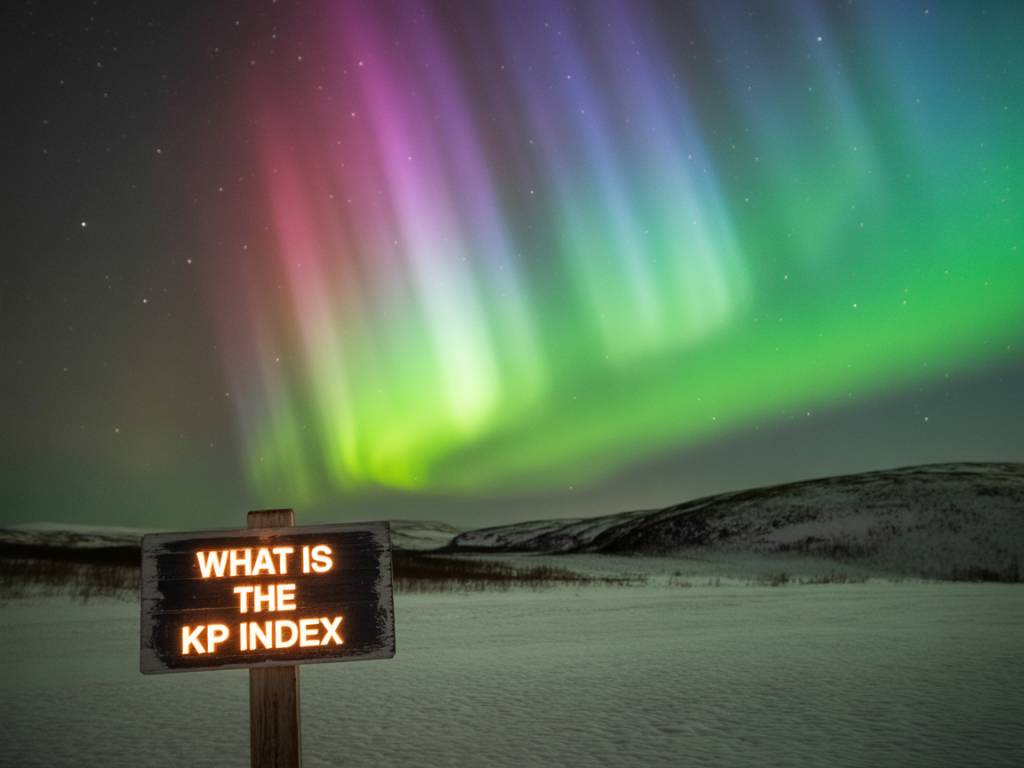


Why these “weird space numbers” matter for your night out
If you’ve already checked a northern lights forecast, you’ve seen a wall of terms: Bz, solar wind speed, density, Kp, Bt, AE index… It looks like a space physics exam. In practice, you don’t need a PhD to use these numbers. You just need to know which ones really change your decisions on the ground: do I drive out tonight, how far, and for how long?
In this article I’ll break down the key parameters I use in the field when I decide to leave a warm cabin at 22:30 or stay by the fireplace. I’ll also show you where they can fool you, and how to combine them with real-world constraints: clouds, moonlight, and roads.
Bz: the “gate” that decides if solar wind can light up your sky
If you only remember one parameter from this article, make it Bz.
Bz is a component of the interplanetary magnetic field (IMF) carried by the solar wind. You’ll usually see it in nanoteslas (nT), with a + or – sign.
What matters for aurora watching is simple:
- Bz south (negative, e.g. -3 to -20 nT): the “gate” is open. Energy from the solar wind can couple with Earth’s magnetic field and power strong auroras.
- Bz north (positive, e.g. +2 to +20 nT): the “gate” is mostly closed. Even with good solar wind speed, your sky can stay quiet.
Think of it like this: solar wind brings the fuel, Bz south turns on the pump.
How to use Bz in your decisions
- Bz hovering around 0 to -2 nT: I stay flexible. Short drives are ok, but I don’t commit to a 3-hour trip unless other indicators are very good.
- Bz stable at -3 to -7 nT for at least 30–60 minutes: I get serious. This is enough to support nice displays if other factors (speed, density) are decent and the sky is clear.
- Bz deeply south, below -10 nT, especially with high speed: this is “drop what you’re doing and go” territory if you are within or near the auroral oval.
A quick field example
I once sat outside Tromsø with a tour group under perfectly clear skies and Kp forecast at 4. For an hour: nothing. Why? Real-time Bz was strongly north at +10 nT. The fuel was there, the gate was locked. When Bz finally flipped south to -6 nT, the aurora ramped up in about 20–30 minutes and we had a full arc overhead.
Moral: if you’re checking one live data graph before deciding to stay out another hour in the cold, check Bz.
Solar wind speed: how fast the “fuel” arrives
Solar wind speed tells you how fast the charged particles are streaming from the Sun towards Earth, usually in km/s. Higher speed delivers more energy to Earth’s magnetic field.
Typical ranges
- < 350 km/s: slow. Aurora is often weak or confined to high latitudes, unless Bz is very strongly south.
- 350–500 km/s: normal background. Good auroras are possible with moderate southward Bz.
- 500–700 km/s: fast. This range is common after coronal holes and CMEs (solar storms) and supports strong activity.
- > 700 km/s: very fast. Can mean stormy conditions if other parameters line up.
How speed changes your plan
- Low speed, good Bz: I still go out, but I expect slower development. I allow more time outside and don’t panic if nothing happens in the first 30 minutes.
- High speed, Bz a bit south: I am more optimistic. Even modest negative Bz can produce active auroras at high latitudes.
- High speed, Bz strongly south: if you’re at mid-latitudes (e.g. Scotland, northern Germany, US-Canada border), this is when you consider a late-night drive to a dark spot.
Solar wind density: how thick the stream is
Density (usually in particles/cm³) tells you how many particles are in the flow. On its own, density doesn’t guarantee auroras, but it can support stronger activity when combined with good Bz and speed.
Simple reading guide
- 1–5 p/cm³: quite low. Not ideal but can still work with fast speed and strong Bz south.
- 5–20 p/cm³: typical, workable range.
- > 20 p/cm³: a dense stream. Watch for sudden jumps; they can trigger brief but intense responses in the magnetosphere.
How density affects your night
Imagine two nights:
- Night A: speed 450 km/s, Bz -4, density 3 p/cm³
- Night B: speed 450 km/s, Bz -4, density 20 p/cm³
On Night B, the same Bz and speed will generally produce more active and brighter auroras, all else equal. In practice, I watch density for sudden spikes. If I see a density jump and Bz is already south, I expect a ramp-up in 10–30 minutes and I make sure I’m not stuck in a supermarket car park with street lamps.
Kp: useful for the big picture, less useful minute-to-minute
Kp is a planetary index (0 to 9) that describes geomagnetic disturbance. Many apps turn Kp into a “chance” line on a colored map, which looks very reassuring. But there are some traps.
What Kp is good for
- Trip planning days in advance: if you see forecasts of Kp 5–6 with a coronal mass ejection (CME) expected, that’s a good sign to keep your plans flexible.
- Estimating how far south the auroral oval might extend: Kp 2–3: typical northern Norway/Finland/Sweden show. Kp 6–7+: possible from Scotland, northern Germany, northern US states.
What Kp is bad at
- Short-term decisions: Kp is often a 3-hour or averaged measure. It reacts after the fact, not before. The aurora can be exploding while Kp still looks modest.
- Local conditions: Kp doesn’t know about your clouds, mountains, light pollution or the exact shape of the auroral oval over your head.
How I use Kp in practice
- Before a trip: if the coming days show Kp 1–2 and no incoming CMEs, I adjust expectations for guests. We might still see beautiful arcs at high latitudes, but I warn them not to expect a sky-filling storm.
- During a night: I barely look at real-time Kp. I watch Bz, speed, density, and the sky itself. Kp is background noise compared to those.
Bt and IMF: how “loaded” the magnetic field is
Two more terms you’ll often see are Bt (total magnetic field strength) and IMF (interplanetary magnetic field). Bz is one component of this field; Bt is the overall strength in nT.
Why Bt matters
Higher Bt means a stronger magnetic field in the solar wind. Combined with southward Bz, it can significantly increase the energy transfer into Earth’s magnetosphere.
In practice:
- Bt < 5 nT: weak. Even with Bz south, effects can be modest.
- Bt 5–10 nT: normal to good.
- Bt > 10 nT: strong. If Bz is also south, this is often when big shows begin.
Decision shortcut
If I see Bz south, speed > 450 km/s, Bt > 10 nT, I take the forecast very seriously. I’m willing to drive further from town and stay out longer, as long as clouds cooperate.
Substorms, AE index and “why did the sky explode suddenly?”
Even on a “moderate” night, you’ll often experience quiet periods followed by sudden bright outbursts, where the aurora races across the sky in a few minutes. These are associated with substorms.
A related parameter is the AE index, which measures auroral electrojet activity (currents in the auroral zone). Higher AE usually indicates more active and dynamic auroras.
What this means for you
- A “boring” stable arc at 21:30 can suddenly erupt into a full-sky display at 22:10 without any obvious change in Kp.
- Patience pays. If the basic conditions (Bz, speed) are good, I often tell people to wait through the quiet phases rather than giving up at the first lull.
Field guideline
If I’ve already driven out to a dark location and see:
- Bz roughly south, not strongly positive
- Speed in a decent range (> 380–400 km/s)
- Sky mainly clear
…then I usually advise waiting at least 60–90 minutes before packing up, because substorms can and do appear after a long “nothing is happening” period.
Watching the shock fronts: sudden changes to respect
One of the most useful “signals” on the data charts is not an absolute number, but a sudden change: a sharp jump in density, speed, temperature or Bt. This often indicates the arrival of a solar wind structure like a CME shock front.
What you might see in the data
- Density jumps from 5 to 25 p/cm³
- Speed increases by 80–100 km/s in a short time
- Bz flips from north to south and stays there
How I react
- If I’m at home and see a shock arriving with Bz still unknown: I get ready. Batteries charged, car tank checked, warm layers laid out.
- If I’m already outside and see a shock with Bz going south: I tell everyone to stay put and keep watching. The best part of the night may be starting.
Combining space weather with clouds and geography
Space weather parameters are only half the story. On the ground, there are three more big players:
- Cloud cover
- Local light pollution
- Your latitude and geography
Clouds vs. perfect data
A classic situation: solar wind speed 600 km/s, Bz -12 nT, density 20 p/cm³. On paper, it’s a dream. But if your sky is 100% overcast the whole night, you’ll see nothing.
In that case, I use the strong space weather situation as justification to drive further than usual to chase clearer skies. If the data were marginal, I might not burn extra fuel. With excellent data, I do.
Light pollution and how low activity changes your plan
- Mild activity, Bz just slightly south: from a city, you may see nothing. From a dark site 20–30 minutes outside town, you could catch a nice arc.
- Strong activity, Bz deeply south: even from a small town you may see pillars and bright structures. Still, a short drive into darkness improves the experience massively.
Latitude threshold thinking
Where you are on Earth sets your “threshold” for needing strong space weather:
- High latitude (e.g. Tromsø, Abisko, Ivalo): you can see auroras with very modest conditions (Kp 1–2, Bz only gently south). Live data is still useful, but the bar is low.
- Mid-latitude (e.g. Scotland, Denmark, northern US states): you need Bz clearly south and usually higher speed or a CME. Here, checking Bz and speed is crucial before deciding to drive out at 01:00.
- Lower mid-latitude (e.g. France, central Germany): you reserve your serious efforts for big events: strong storms, Kp 6–8, Bz deeply south, fast CMEs. The everyday background aurora won’t reach you often.
Building a simple decision routine for your nights
You don’t need to refresh 10 tabs every five minutes. Here’s a compact routine you can adapt to your location.
3–6 hours before your planned outing
- Check general forecasts (CME arrival, expected Kp, cloud forecasts).
- Decide your “level of commitment” for the night (short drive vs. long chase).
1–2 hours before
- Look at live Bz, speed, density, Bt.
- If Bz is north and has been positive for hours, downgrade expectations unless a big change is expected.
- If Bz is south, speed > 400–450 km/s and clouds are manageable, prepare to leave.
On site
- Keep an eye on Bz trend and any incoming shocks.
- If Bz suddenly turns strongly south or density spikes, be patient and keep watching the sky even if nothing has started yet.
- If clouds close in but data is excellent, consider a short relocation rather than going home immediately, if roads and safety allow.
Setting realistic expectations without killing the magic
Understanding Bz, solar wind speed, and the other key parameters doesn’t remove the unpredictable part of aurora hunting, but it makes your choices less random and your stress level much lower.
Some nights you’ll have perfect numbers and still only see moderate auroras. Other nights, a small coronal hole stream and slightly negative Bz will give you a quiet, beautiful arc that makes the whole trip worthwhile.
If you use these parameters as tools, not promises, you can:
- Avoid pointless all-nighters on dead-calm nights with Bz locked north and thick clouds.
- Recognize the genuine “this might be special” setups and make the extra effort when it really counts.
- Spend more time enjoying the sky, and less time guessing what those mysterious graphs actually mean for your spot on the map.
In the end, the best forecast is always a mix of space weather, local weather, and your own tolerance for cold toes at 02:00. The data helps you pick your battles; the sky does the rest.