


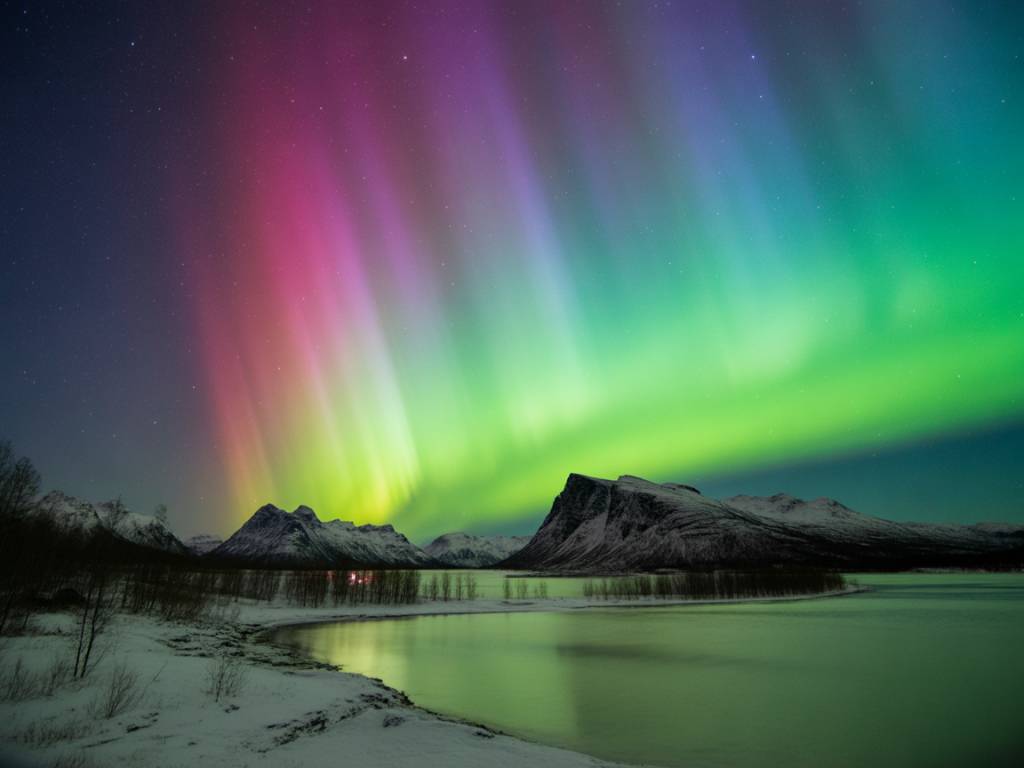
If you only have a weekend to chase northern lights, the biggest question is simple: when do you actually stay up late, and when is it smarter to sleep, recharge and wait for better conditions?
In this article I’ll walk you through a practical way to read a weekend aurora outlook and turn it into a simple plan: which night to prioritize, which hours to aim for, when to get out of the city, and when not to bother. No advanced space-weather degree needed.
The three things that decide your weekend
Every weekend aurora plan boils down to three factors:
- Aurora strength: usually shown as the KP index or similar scale
- Cloud cover: low, mid and high clouds over your exact area
- Darkness: time of astronomical twilight and moonlight
If just one of these three is wrong, your chances drop fast. If all three line up, you stay out late. If two out of three look bad, you sleep.
How to read KP forecasts without panicking
The KP index runs from 0 to 9 and measures geomagnetic activity. In simple terms: the higher it is, the farther south the aurora oval expands.
What it means for your weekend depends on where you are.
- Inside the auroral zone (Tromsø, Abisko, Fairbanks, Iceland, northern Lapland): you do not need huge KP. Even KP 1–2 can be enough if the sky is dark and clear. For a weekend:
- KP 1–2: Stay flexible, but don’t ruin your sleep for the whole night. Best window: around local midnight, a couple of checks outside.
- KP 3–4: This is your “normal good” weekend. Plan one serious late-night outing, and keep a backup night.
- KP 5+: Strong storm potential. This is when I tell people: nap in the afternoon, stock up on snacks, and plan to be out from 22:00–02:00 at least.
- South of the auroral zone (Scotland, northern Germany, southern Canada, northern US states): you need more activity to see anything.
- KP 4–5: Maybe a faint glow low on the northern horizon, if skies are clear and you have a dark site.
- KP 6–7+: Time to seriously consider staying up late and driving away from city lights.
For a weekend plan, ignore tiny hour-by-hour wiggles. Focus on the nightly trend:
- Is KP expected to be mostly below 2 all weekend? Then only chase if you are in the core auroral zone and skies are crystal clear.
- Is there a clear bump (for example KP 4–5) showing for a specific window, like Saturday 21:00–03:00? That’s your prime night, mark it in your schedule.
- Is the forecast very uncertain (wide range, like KP 2–6)? Plan a flexible approach: short checks every 30–60 minutes rather than one long frozen wait.
Cloud cover: the real weekend deal-breaker
Most failed aurora weekends are not because of bad space weather. They fail because of clouds.
When I prepare a Friday-to-Sunday outlook, I always open cloud maps before I even look at KP. I check:
- Low clouds (stratus, fog, coastal clouds)
- Mid-level clouds (typical weather fronts and overcast decks)
- High clouds (thin cirrus that can blur or dim auroras)
For deciding whether to stay up late or sleep, use this simple rule:
- More than 70–80% solid low/mid cloud cover over your area for the whole night? You probably won’t see much. Sleep, or move if possible.
- Patchy cloud cover (40–60%) with movement on the map? Worth it. The aurora often appears through gaps. In that case, pick a place where the wind is pushing clouds away from you rather than towards you.
- High, thin clouds only? Still go. They may soften the show, but you can usually see the main structures.
On many weekends, the best strategy is to match the cleanest sky with the highest KP window rather than only chasing the strongest KP. A slightly lower KP under clear skies beats a high KP hidden behind solid overcast.
Darkness and moonlight: not every night is equal
Even with good KP and clear skies, you need real darkness.
There are three things to check in your weekend outlook:
- End of evening twilight: when the sky becomes fully dark
- Start of morning twilight: when the sky starts to brighten again
- Moon phase and rise/set times
For a typical autumn or winter weekend in the North, you often have 10–16 hours of darkness. The practical aurora window usually sits between 21:00 and 02:00, with a peak probability around local midnight.
Moonlight doesn’t kill the aurora, but it changes your decisions:
- New moon or thin crescent: stay up on the night with the highest KP and best clouds. The sky will be dark enough to see even weak auroras.
- Half moon: still good. The moon will wash out the faintest structures, but you can get great landscape shots with snow and mountains visible.
- Full moon: prioritize stronger KP windows (3+ in the auroral zone, 5+ further south). Short, sharp shows are still possible, but don’t expect subtle arcs or faint pillars.
If the moon is very bright, I often recommend shorter, targeted outings around the strongest KP periods instead of waiting outside for hours.
Turning a raw forecast into a weekend plan
Let’s imagine a typical Friday–Sunday in Tromsø, Abisko or similar latitude. You check a trustworthy forecast site on Thursday evening and see this:
- Friday night: KP 2–3, mostly clear until 01:00, then clouds moving in
- Saturday night: KP 4–5 possible between 22:00 and 02:00, but 80–90% cloud cover over your city
- Sunday night: KP 1–2, crystal clear, good darkness, light moon
Here is how I’d translate this into “stay up vs sleep” decisions.
Friday:
- Don’t burn all your energy, but don’t ignore the evening either.
- Have an early dinner, then drive 20–40 minutes away from city lights.
- Stay out from ~21:30 to midnight, watching the north and northwest horizons.
- When clouds start to thicken after midnight, head back and sleep. No need for an all-nighter with KP 2–3.
Saturday:
- This is the classic “stress night”: high KP potential, but heavy clouds.
- First, look at cloud movement and think “Can I drive out of this?” If a 1–2 hour drive takes you to clearer skies, it might be worth a focused chase during the strongest KP window.
- If the cloud deck covers the whole region, I usually tell people to protect their sleep. Have a normal evening, maybe set an alarm for a quick sky check around midnight, but don’t wait outside for hours if satellite and radar are clearly bad.
- If you’re based in a city, use this cloudy night to rest, organize gear, and enjoy indoor activities. Save your energy for the clearer night.
Sunday:
- Yes, KP looks weaker, but the sky is clear. This is still a valid aurora night in the auroral zone.
- Plan a calm, focused outing: maybe 22:00–01:00, with a flexible drive to a dark viewpoint.
- Even if the aurora is faint, you’ll appreciate the stars, the Milky Way and the general Arctic night atmosphere.
With this approach, you only “push” yourself hard on a night that has at least two of the three key factors in your favour. You reduce disappointment and avoid going home exhausted and frustrated.
When to leave the city – and when to stay put
A common weekend mistake is to drive long distances every single night “just in case”. That’s expensive and tiring. Instead, match your driving effort to the outlook.
Stay closer to the city when:
- KP is low (0–2) and not expected to rise
- The cloud forecast is uncertain, with fast-changing showers
- You’ve already had one good night and mostly want a quick check for a bonus show
In those cases, I look for:
- A nearby hill or coastal area with a clear northern horizon
- A dark parking lot 15–30 minutes from town
- Accessible spots with no risk of getting stuck in snow or ice
Commit to a longer drive when:
- There is a clear cloud gap or drier area within 1–2 hours’ drive
- KP is forecast to be 3+ for several hours
- You have one “main night” left in your weekend and want to maximize it
Under those conditions, it’s worth driving to known dark-sky valleys, mountain passes or inland plateaus where you have a wide view of the north and fewer artificial lights.
Always keep a backup city plan: a road with a good view to the north just outside town, a bridge, or a harbour promenade where you can at least watch the sky if the longer drive doesn’t make sense at the last minute.
How to schedule your sleep around the weekend peak
Sleep planning sounds unromantic, but it often decides whether you are outside when the short bursts happen.
With a typical Friday–Sunday trip, here is a low-stress pattern I often recommend:
- Friday: Don’t stay up all night unless the forecast screams “major storm”. Aim for bed by 01:00–02:00. This keeps some energy for Saturday.
- Saturday: Check the daytime updates. If the evening and night still look promising, nap from late afternoon to early evening (for example 17:00–19:00). Then stay outside between 22:00 and 02:00, with short warm-up breaks in the car or a cabin.
- Sunday: Use this as your “soft landing” night: a shorter outing, then bed at a reasonable hour to be fit for travel the next day.
Notice the pattern: you only sacrifice a full night’s sleep once, when KP, clouds and darkness really align. The rest of the time, you rely on shorter checks or earlier nights.
Recognizing “go now” moments vs “wait and see” hours
Even during a single night, aurora activity often comes in waves. It’s useful to learn the signs that tell you to get your jacket on now instead of checking your phone again.
“Go now” signals:
- Rapid rise in local magnetic activity graphs (for example, strong swings on local magnetometer plots)
- A clear increase in KP or ground-based indices in the last 30–60 minutes
- Other chasers or webcams in nearby areas reporting bright arcs or pillars
- Thin northern cloud edges starting to glow faintly green to the naked eye
In those cases, even if it’s a bit earlier than your planned time, I usually tell people: step outside and watch the sky for at least 15–30 minutes. Many of the strongest bursts barely last that long.
“Wait and see” conditions:
- Flat KP around 1–2 with no sign of rising in the next hours
- Solid featureless overcast with no clear movement
- No reports from webcams or nearby observers despite good darkness
Under those conditions, it’s better to check once an hour for five minutes than stand outside hoping for a miracle.
Gear and safety for late weekend outings
There is no need to overpack, but a few items make a big difference when you’re deciding whether to stay out one more hour or go home.
- Clothing: base layer, insulating mid-layer, windproof outer shell, warm hat, gloves you can operate a camera with, and proper winter boots.
- Light and power: headlamp with red mode, spare batteries or power bank for your phone and camera.
- Car basics: full tank (or good battery level), ice scraper, brush, small shovel if you’re in snow country, blanket, thermos with hot drink.
- Navigation: offline maps downloaded, because mobile coverage can be weak in good dark-sky locations.
When you read a forecast that suggests staying up late, always mentally add 1–2 extra hours for unexpected delays: icy roads, minor wrong turns, or simply being too mesmerized by the sky to leave on time.
Managing expectations so the weekend still feels like a success
Even with perfect planning, nature does what it wants. The goal of a weekend outlook is not to guarantee a show; it’s to give you the best odds while protecting your energy and mood.
Here is how I frame it for my own trips:
- If I get one strong display during the whole weekend, the mission is a success.
- If I only get faint arcs and a few subtle pulses, the mission is still a success if I had clear skies, stars and interesting winter landscapes.
- If clouds win every night, I want to go home thinking, “I made smart calls with the information I had,” not “I stood in a parking lot all night because of a random KP number.”
Use the outlook to choose your battles: identify your one main night, protect your sleep on the weaker ones, and remember that the trip is also about being in the North: the cold air, the snow under the headlights, the quiet roads, the feeling of watching the sky with a plan rather than pure stress.
If you treat the forecast as a tool to decide when to be outside and when to relax, your odds of catching the northern lights improve—and your weekend feels far less like a gamble.