


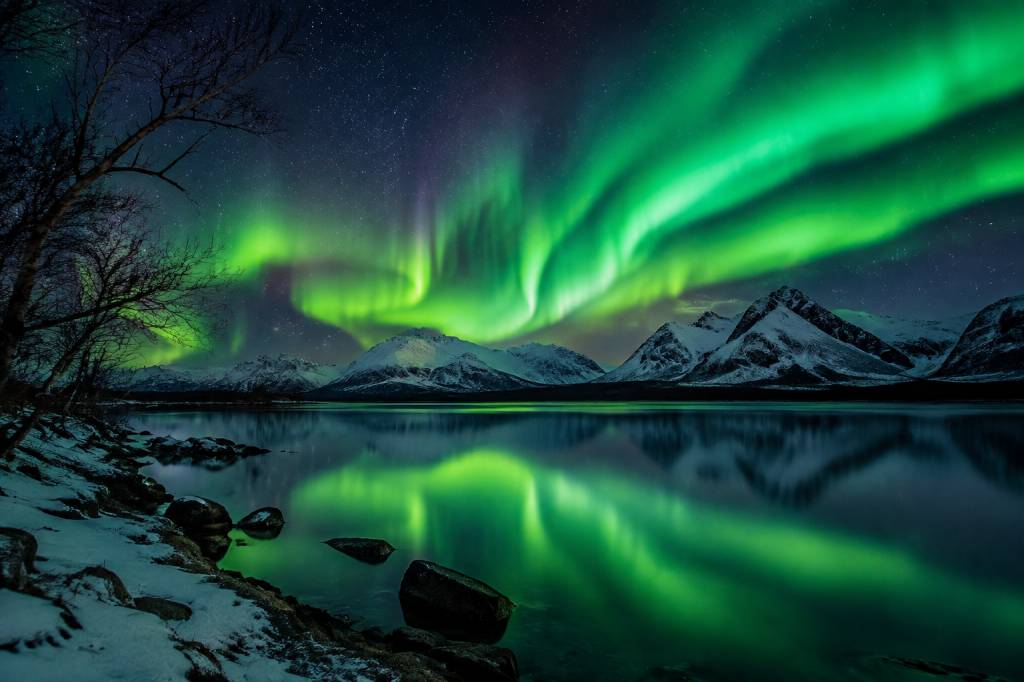
If you are asking, “What time are the northern lights tonight?”, the honest answer is: it depends on darkness, cloud cover, and how far south the aurora is reaching. There is no fixed showtime. In many northern locations, your best plan is to be outside between about 10 p.m. and 2 a.m. local time, while staying flexible enough to go out earlier or later if the forecast changes.
That window is a starting point, not a guarantee. A bright display can begin before midnight, while a quieter aurora may be easiest to spot in the small hours. The practical goal is to combine the night’s darkness with clear skies and a suitable viewing spot—not to stare at one forecast number and wait for a precise minute.
Best hours to look for the northern lights tonight
For many destinations in the auroral zone, the most useful first check is the period from 10 p.m. to 2 a.m. local time. This is often when the sky is fully dark and auroral activity is easier to see. In winter, however, darkness lasts much longer than that. If the sky is clear and the aurora is active, an evening check at 8 or 9 p.m. can be worthwhile, and a late display may continue after 2 a.m.
Think of the time window as a way to organize your night, rather than a schedule the aurora has promised to follow:
-
Early evening: Check the cloud forecast and get to your viewing location before the roads and parking areas become busy.
-
Late evening to around midnight: Make this your main viewing period if it is dark and the sky is clear.
-
After midnight: Stay longer if activity is increasing and you are warm, rested, and somewhere safe.
Local time matters. A forecast showing 11 p.m. in Tromsø means 11 p.m. in Tromsø, not necessarily the time on your phone back home. Confirm that the forecast, your location, and your travel plans use the same time zone.
Why there is no exact aurora start time
The northern lights are produced when charged particles from the Sun interact with gases in Earth’s upper atmosphere. Solar activity can influence how likely a display is, but the aurora does not follow a dependable nightly timetable. It may build gradually, flare up for a short period, fade, and return later.
This is why a forecast should be read as a guide to conditions, not as a ticket for a specific show. Even a strong activity forecast cannot make clouds disappear, and a quiet-looking forecast does not always rule out a visible display. The sky you can actually see is the final check.
On a field night, I use a simple routine: check cloud cover first, check aurora activity second, and then choose a dark, accessible location. A clear patch of sky with moderate activity is usually a better plan than a highly promising activity forecast beneath a solid cloud deck.
How to read tonight’s aurora forecast
Most forecast pages combine several kinds of information. You do not need to decode every chart. Focus on three factors: darkness, cloud cover, and auroral activity.
-
Darkness: The sky must be dark enough for the aurora to stand out. In summer, high-latitude destinations can have too much daylight or twilight for ordinary aurora viewing. Check local sunset, twilight, and sunrise times.
-
Cloud cover: Clouds can block the display even when auroral activity is strong. Look at the forecast for the exact area you plan to visit, and check whether cloud cover is expected to break or shift during the night.
-
Auroral activity: The KP index is a broad measure of geomagnetic activity. Higher values can indicate that aurora may be visible farther from the polar regions, but KP is not a visibility guarantee and does not tell you whether your local sky is clear.
For a more useful view of the night, check forecasts at more than one time. A cloud map can change quickly, and a forecast for a whole city may hide a clear patch just outside it. If your first choice is cloudy, compare nearby areas that you can reach safely. Do not drive a long distance based on a vague possibility of clearer skies; verify road conditions, travel time, and the return journey first.
What the KP index can—and cannot—tell you
The KP index is often treated as an aurora score, but it is better understood as one piece of the picture. A higher KP value can mean that auroral activity is stronger or that the auroral oval may expand farther from the poles. That can improve the odds in locations farther south than the main aurora zone.
For travelers already in northern Norway, Iceland, Finnish Lapland, Swedish Lapland, Alaska, or northern Canada, local cloud cover and darkness can matter more than chasing a higher KP number. At high latitudes, the aurora may be visible at relatively modest activity levels when conditions are right. Conversely, a high KP forecast is of little help if you cannot see through the clouds.
Also check what time the KP forecast covers. Some charts show values averaged over a period rather than a precise moment. Use them to judge the general trend, then make your decision with local sky conditions and a live look outside.
Where to go if the sky is cloudy
If the forecast is cloudy over town, look for a nearby area with a clearer forecast—but keep the plan realistic. Coastal weather, mountain terrain, and local wind can produce sharp differences over short distances. A cloud map may show a promising gap, but the road to it could be icy, closed, or exposed to poor visibility.
Before leaving, check official road and weather information for your destination. Choose a place with a safe pullout or public parking, not a narrow shoulder or an unlit road where stopping could put you or other drivers at risk. Let someone know where you are going, keep your phone charged, and avoid walking onto unfamiliar ice or snow-covered ground in the dark.
If the clear patch is too far away or the roads are unsafe, stay near your accommodation and try again later. In many northern towns, even a short walk away from bright streetlights can improve the view. A quiet waterfront, open field, or designated viewpoint may be enough—provided access is permitted and conditions are safe.
Practical viewing plans in northern destinations
Tromsø: Start by checking cloud cover over the city and the surrounding region. Bright streetlights reduce contrast, so a darker viewpoint outside the center can help when roads and conditions allow. Do not assume that driving inland is automatically better; coastal and inland weather can differ, and winter roads require time and attention.
Reykjavík: City lights make a dark location outside the center useful, but cloud cover is still the key decision. Check conditions for the destination you intend to reach, not only for Reykjavík itself. Leave enough time for the return drive and confirm road conditions before setting out.
Fairbanks: The long winter nights provide a generous viewing window, but cold temperatures make preparation essential. Check the local cloud forecast, dress in layers, and plan where you will wait. A warm vehicle nearby can be valuable, but park only where it is safe and allowed.
Lapland towns: Many viewing areas are outside town centers, where the sky may be darker. Confirm that a viewpoint or parking area is open and accessible, and remember that snow, ice, and limited daylight can make a familiar-looking route harder to navigate at night.
How long should you stay outside?
Give your eyes time to adjust to the dark. When you first step away from bright lights, the sky may seem empty. Wait for a few minutes, avoid looking at your phone screen at full brightness, and scan a wide area rather than staring at one point. A faint aurora can look gray or pale to the naked eye, while a camera may record stronger color.
Plan a first check of 30 to 60 minutes, then reassess. If the sky is clear and the forecast suggests activity may continue, stay longer if you are comfortable. If clouds have closed in, the roads are deteriorating, or you are getting too cold, call it for the night. Waiting another hour is not worth compromising your safety.
Take a warm layer you can add while standing still, insulated footwear, gloves, and a hat. Bring a charged phone and a small flashlight, preferably with a red-light setting to preserve night vision. If you are taking photos, a tripod helps with long exposures; it is useful equipment, but not a requirement for seeing the aurora.
What if the forecast looks quiet?
A quiet forecast is a reason to manage expectations, not necessarily to cancel every plan. If you are already in a dark, clear location, take a look outside. Aurora displays can vary, and forecasts cannot promise exactly what any one traveler will see. If the sky is cloudy or the season is too bright, however, waiting outdoors for hours is unlikely to solve the problem.
Set a practical limit before you go. For example, decide to check the sky for an hour, then return to town if conditions do not improve. If you have several nights at your destination, use them: one cloudy evening does not determine the whole trip. Check the forecast again the next afternoon, when you can adjust your route and clothing without making a rushed decision at midnight.
A simple checklist for tonight
-
Confirm darkness and local sunset or twilight times.
-
Check cloud cover for your exact viewing area, not just the nearest city.
-
Use KP and other activity forecasts as guidance, not as a guarantee.
-
Choose a dark, legal, accessible spot with safe parking.
-
Check road conditions and allow time to return.
-
Dress for standing still in cold weather and keep your phone charged.
-
Start with the 10 p.m. to 2 a.m. window, but remain flexible if conditions are good earlier or later.
So, what time are the northern lights tonight? Begin by planning for late evening, then let darkness, cloud cover, and local activity decide whether to stay, move, or head back. The most useful forecast is the one that helps you make a safe, realistic plan—not one that promises a show at a precise hour.